© 2009-2014, Kevan Hashemi
The Vanadium Mines
HSW Notes
HSW Home
Map of Satian Sea
Mittelmarch and Environs
Northern Dukedoms of Weiland
Contents
Cast of Characters
Galoopius's Proposal
Research
On Horseback
The Red Dragon Inn
Onkian Goldman
Charlotte Nigglebottom
From Wicklow's Notebook
From Martha's Notebook
The Archbishop
The Lord Chancellor
A Dozen Questions
Ordwell Kelmiran
The Smoking Room
Divine Maneuvers
The Library
The Missing Brother
Legal Questions
Niel Blessed
Setting the Trap
Springing the Trap
Helping Hands
Private Letters
Justice of the Peace
Divine Initial
Traveling Separately
The Pressing
Saving David
Show-Down at the Sphinx
More About Candor
Battle Upon the Dias
The Duchess is Dead
Erasmus Abelbody
Candor Bowles
Battle for the Garden
The New Duke
Cast of Characters
| Name | Occupation | Age |
|---|
| Galoopius Maximus | Businessman and Collector, Native of Belgorash | M 66 |
| Miseralis Maximus | Wife of Galoopius, Native of Gowachin | M 46 |
| Stockandsteel | Master of the Kobold Village, Exiled from Kratanak | M 186 |
| Dreadmanifold | Earl of Swamp Bottom, Exiled from Kratanak | M 195 |
| Richard Manchester | Duke of Plantinack | M 47 |
| Lucinda Bowles | Duchess of Mittelmarch | F 53 |
| Candor Bowles | Lucinda's Younger Brother | M 41 |
| Viscount Larkin | Cousin of Miseralis, former owner of vanadium mine | M 32 |
| Onkian Goldman | Lawyer in Clapton, Mittelmarch | M 62 |
| Francis Masterman | Lord Chancellor of Mittelmarch | M 57 |
| Clair Martin | Owner of Red Dragon Inn, Clapton, Mittelmarch | F 27 |
| Ian Martin | Owner of Sphinx Inn, Mittelmarch, Mittelmarch | M 56 |
| Matilda Edwards | Director of the Miner's Relief Charity | F 43 |
| Charlotte Nigglebottom | Foreman of the Larkin Mine | F 62 |
| David Bradford | Archbishop of the Church of Amaethon | M 72 |
| Ordwell Kelmiran | Patronite Merchant of Cilmahog | M 110 |
| Niel Blessed | Wizard to the Court of Lucinda Bowles | M 27 |
| Erasmus Abelbody | Captain of the Royal Guard | M 37 |
| Apitan Bellringer | Captain of the National Guard | M 43 |
| Eldaran Malworth | Lieutenant of the National Guard | M 32 |
| Embargio Cohen | President of Aggregate Trading | M 58 |
Table: Cast of Characters. Ages given on 1st August 2478.
Galoopius's Proposal
13th July 2478
"I own a Vanadium mine," Galoopius says. He smiles and raises a glass of ice water to his lips.
"Congratulations," Wicklow says.
They sit in the living room of Galoopius's mansion in Dakka, but Galoopius is not master of the mansion today. He has leased his property and its servants to Global Mediation Incorporated from 9th June to 1st September. So he finds himself a guest in his own house. He has come from the mountains of Gowachin to make a business proposal. Sitting upon the couches in the living room are Hocus, Wicklow, Jack, and Heraklese. Martha, Jessica, and Stanley have gone with Bonita to a party at her parents' house. Sallina and Garibaldi have hitched a ride on a journeyman sailing ship to Godiva, to visit their children. Galoopius himself looks well. He appears younger than when they saw him last, in November of the previous year. He has lost more weight too. He is still rotund, but not obese.
Galoopius sets his glass down upon a lacquered side table. "Ten years ago, when times were good, this mine I own produced a profit of ten thousand guineas a year. My wife's cousin on her father's side owned it. Now it's almost worthless. The mine is still there, in reasonable condition, from what I gather, and there are a dozen staff, I think, and a foreman, a woman actually, who remain loyal to it, but there is no mining."
"Why did you buy it?" Hocus says.
Galoopius laughs. "Because I had it for a good price. My wife's cousin is Viscount Larkin of Mittelmarch, one of the nations in the Dukedoms of Weiland. It is in the foothills of the Kratanak mountains. There are five vanadium mines in this little nation, and none of them are being worked. Lord Larkin fled the nation and came to stay with my wife. It was he who sold me the mine. I paid him ten thousand guineas for it. And that's why I'm here: I propose that you arrange to fix whatever troubles Mittelmarch is facing and get the mine working again. After that, we'll split the profits for ten years."
Wicklow nods. "Interesting."
"Okay," Heraklese says. "Tell us the full story."
Galoopius stares at his hands for a moment before he begins. "Let me start with the Duchess Lucinda Bowles. She has been on the seat of power, if you can call it that, for fifteen years. During that time, she appears to have so mismanaged her accounts that the is in debt to her neighbors."
"Her neighbors?" Heraklese says. "Do you mean, Sally the Washerwoman down the street, and His Lordship the Rich?"
The language they are speaking is Latin, which is indeed the language of Belgorash. But Heraklese's Latin has a strong Accent, and Galoopius has to consider before he understands it. "No, I mean the neighboring nations, and some banks as well, actually, if you want to know, or so the Viscount tells me."
"Go on," Jack says."To meet her obligations, she raised taxes. She taxed the rich and the poor. Everyone in the nation was upset about it. And she taxed the vanadium mines. As I said, there are five of them. And vanadium is rare, I hear. There are no other vanadium mines on the west side of the Kratanak Mountains, and the dwarf city east of Mittelmarch buys all that the mines can produce."
Hocus nods. "How big is Mittelmarch."
Galoopius frowns. "I don't know. I'll have to find out. I have been in communication with a friend of Viscount Larkin in Mittelmarch city, asking him about the deeds of the mine, the history of profits, the health of the staff, and the state of the nation's accounts, but I have not thought to ask how big the country is."
"Do you know the population?"
"No. More than ten thousand, but not a million. That would be my guess."
"Go on," Jack says.
"Duchess Lucinda raised the taxes on the poor, but in court, the juries refused to convict their peers of tax evasion, so the tax could not be levied. She came to rely upon the tax on the vanadium mines, which were owned by the aristocracy, who were unwilling to defy her. Her tax was ten percent when she inherited the seat from her father. Two years ago she raised it to eighty percent. Viscount Larkin's income was greatly reduced, but he kept spending as he always had. He has no head for money. This spring he gave his entire estate to the Duchess in payment of back taxes and left the country. He took with him the deeds to his mine. He left behind him a staff that continues to maintain the mine without pay. I don't know how they are surviving. Maybe they are sneaking the stuff out."
"Why don't they mine it?" Jack says.
"Ah, well, that's the interesting bit. Whenever any of the mines try to produce vanadium, criminals come and vandalize the mine. Some miners have been killed. It seems that the people are so dissatisfied with their duchess that they want to starve her out by stopping the mines from producing. Viscount Larkin said the vandals were just criminals, but according to my agent in Mittelmarch, the criminals have the people on their side."
"So what is the Duchess doing about it?" Wicklow says.
"She sends her soldiers to guard the mines, but the people, or the criminals still get in. They appear to be clever. The dwarves in the mountains to the east became so displeased by the lack of vanadium that they sent their own troops to protect the mines. At this point, the people and the Duchess found common cause, and drove the dwarves out, with considerable cost in life, from what I hear, although I don't know the details."
"Dwarves were killed?" Wicklow says.
"I think so," Galoopius says.
Heraklese says, "Why did the Duchess fight the dwarves if they were protecting her source of revenue?"
"I don't know," Galoopius says, "That's a good question. Out of patriotism, perhaps. I don't know. So, after that, the mines operated for a while, but then the criminals stopped them. That's about the time that Viscount Larkin sold his estate and left. Six months later, he sold the mine to me, but only after I spent two months finding an agent in Mittelmarch and checking that his story and his ownership and his right to sell the mine to me were genuine. Of that I am now satisfied. I am indeed the owner, and all it takes is for the political problems of Mittelmarch to resolve themselves, and I will make a good profit."
Wicklow nods. "And that's where we come in."
"Yes. My wife is not so pleased with my purchase. I spent ten thousand guineas on it, and our expenses are substantial. For domestic peace, I want this mine to show a profit as soon as possible. That's why I thought of you."
Our heroes ask more questions, and Galoopius does his best to answer them. They agree to meet with him again in a few days, after they have tried to confirm his story for themselves. They talk also of his antiquities, in hushed voices, and of Stockandsteel, who is living up in the kobold village.
"I made an effort to befriend him," Galoopius says, "He's polite, but he's shown no interest in keeping company with me. It's a pity. I miss talking to Dreadmanifold. He was always interesting, if terrifying."
"Stockandsteel is cranky," Jack says.
On his way out of the house, Galoopius takes time to enter the small room to the side of the entrance hall, where an image of Polyamen, Goddess of Belgorash, sits in an alcove with a prayer mat in front of it. He lights an incense stick and kneels for a full five minutes. Our heroes wait for him outside.
"Thank you," Galoopius says, when he emerges, rubbing his knees. "I have missed her, as she is here."
"You're welcome," Jack says.
The two sons of the butler stand beside the doorway. Galoopius ruffles their hair and gives them each a silver piece as he leaves.
Research
One of the first things our heroes do is go to the Belgorash Library and look for books about the Dukedoms of Weiland. Wicklow reads the following in one of them.
Five ranks of peer exist in the Dukedoms of Weiland, in descending order, these are: duke, earl, viscount, and baron. The title "Lord" is used most often by barons who are rarely addressed with any other. The style of this address is "Lord X", for example, Alfred Tennyson, 1st Baron Tennyson, is commonly known as "Lord Tennyson". The ranks of earl and viscount commonly use Lord as well, with viscounts using the same style as used for baron. However, earls have a slightly different form of address where they can be called either the "Earl of X" or "Lord X". Dukes also use the style, "Duke of X", but it is not acceptable to refer to them as "Lord X". Dukes are formally addressed as "Your Grace", rather than "My Lord".
Heraklese finds an old book about Mittelmarch. It mentions two vanadium mines, and provides a map of the country. Heraklese makes a sketch of the map.
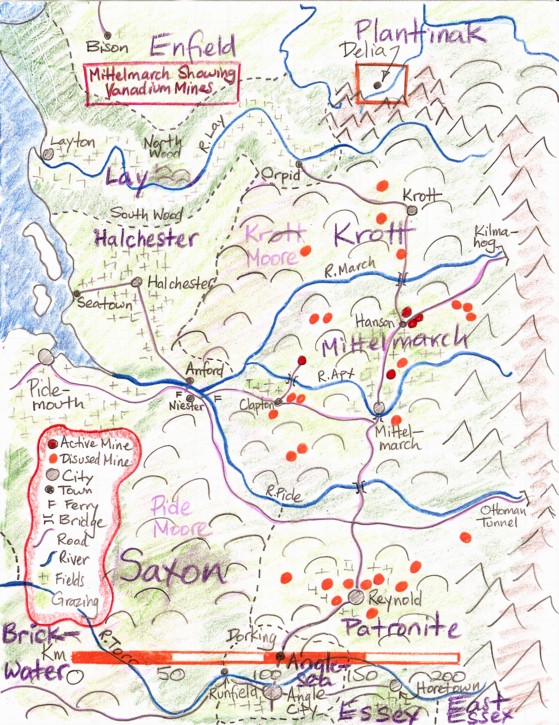
Figure: Mittelmarch and Environs, Northern Dukedoms of Weiland. Note the location of the Ottoman Tunnel, which runs thirty kilometers beneath the mountains and the Kratanak Outlands to Weiland. For a larger-area map with populations of some countries marked, as drawn by Heraklese, see Northern Dukedoms of Weiland.
The nation to the south of Mittelmarch is named after the vanadium ore that occurs in the sedimentary rock of the foothills: Patronite. There was a time when Patronite had a dozen working vanadium mines, but today they are all exhausted. The only remaining mines that produce more than a few tonnes of patronite per year are the five mines in Mittelmarch.
Our heroes agree to go to Mittelmarch as Galoopius's agents and investigate the state of the Larkin Mine. This mine is north of Clapton. In Clapton, they will find a lawyer called Onkian Goldman, who has been acting as Galoopius's lawyer.
At the end of August, Global Mediation Incorporated pays 2664 guineas for new suits of armor for Jack, Wicklow, Martha, and Heraklese. They equip themselves with luminous stones that fit onto their helmets. They have a small pick-axe, two jeweler's loupe's, and the space bridge thruster mechanism. They decide to leave the bench and ropes behind, to save weight. Hocus learns to make the ropes and a bench with a spell.
On the 7th September, Loose Lips arrives in Godiva on the coast of the Dukedom of Brickwater. Here they are reunited with Sallina and Garibaldi and stay as their guests in Tonbridge Manor a few kilometers to the north of the city. This large house is home to several other families of sailors, all former colleagues of Sallina and Garibaldi. Also living there are Sallina and Garibaldi's son and daughter, who are the superintendents of the establishment.
Tonbridge Manor belongs Horatio Tawnish, whom everyone there refers to only as The Captain. Heraklese and Bonita met in Mizzen Island at the Mayor's Party. He was captain of the Reliant, the first ship that Sallina and Garibaldi sailed with, twenty-five years ago. The legendary assassin Dan Milatos was surgeon on this ship, and Margaret MacLoghanlogh the dwarf locksmith was and remains Dan's wife. It was Margaret who made the lock for Dreadmanifold's cave. Dan and Margaret were at the Mayor's party. Dan is now over eighty years old. He is training Scythe and Cleopatra Amashintra (alias Grellian Ptumash). Horatio and his wife, a native of Chiin, spend half the year in Mizzen and half the year in Tonbridge Manor.
Sallina takes our heroes to the library to see what they can find about Mittelmarch and vanadium mining.
Patronite, the ore, is vanadium sulfide, with chemical formula VS4. It is a dark brownish-black fine-grained rock with metallic luster and hardness 2. You can scratch it with your fingernail. Its density is 2.8 g/cm3. Historically, patronite sells at the mine for $100/kg. Vanadium itself is a soft, ductile, silvery-gray metal that resists corrosion. It is used in corrosion-resistant steel alloys. It melts at around 1900°C, compared to iron at around 1500°C. Historically, vanadium ingots sell at the foundry for $1000/kg.
There is no mention of a vanadium foundry in Mittelmarch. All the ore makes its way to the dwarf city of Kilmahog under the mountains to the north-east.
In recent newspapers, there are brief, second-hand accounts of an invasion of Mittelmarch by the dwarves of Kilmahog, and their repulsion with loss of life. The dire state of the Dukedom of Mittelmarch's finances is mentioned in other articles, along with speculation that Duchess Lucinda Bowels, who came to power fifteen years ago, has accumulated debts amounting to a hundred million dollars. Here creditors are the dukes of Halchester and Patronite, as well as several banks in various nations. The loans were issued on the strength of Mittelmarch's vanadium ore deposits, and Lucinda's ability to tax their revenue. For the past two years, the mines have been shut down by a series of murders among the miners, and what appears to be a popular movement against the Duchess. The dwarves of Kilmahog are now paying $500/kg for patronite and selling vanadium for $2000/kg. The only other source of vanadium ore is in Telaran in Ursia, on the other side of the continent.
On the 10th September, Loose Lips sails for Pidemouth. Here, Hocus, Wicklow, Jack, and Martha disembark. The ship sets off for Cloghlogan, where Sallina will sell their rough diamonds. On board are Jessica, Stanley, Heraklese, Bonita, Sallina, Garibaldi, and Stephanix the Demon.
Hocus, Wicklow, Jack, and Martha buy maps enough for everyone, oilskins and hats. Hocus carries with him the walkie-talkie box that contains all the bridges between GMI members. He will tune these once a month to keep the bridges working. On 13th September, they buy horses and set off on the East Road towards Niester.
On Horseback
13th September 2478
The sun is setting at the end of a warm, late-summer day on the road to Niester. Hocus rides behind Martha on a fine, brown gelding. Behind them walks another horse without a rider, and on either side are Wicklow and Jack on their own horses.
"I thought you were an expert at buying horses," Hocus says.
Jack grunts. "I never said I was an expert."
A rider gallops up the gravel road behind them. He passes with a pounding of hooves. He has mail bags on his saddle. The sides of his horse are shiny with sweat.
"That looks like a good horse," Hocus says, "I want one like that. A fast one."
"He will be changing his horse every twenty klicks," Jack says.
Martha pats the neck of her gelding. "I'm very happy with this one. He's worth twice what you paid for him."
They walk on in silence.
Martha cries out. "Get that thing off me!"
Ratty the rat has crawled out of Hocus's pocket and into Martha's lap. Hocus reaches out and grabs the little brown animal and stuffs him into the left pocket of his oilskins. This left pocket has a soft lining sewn by Jessica for ratty's benefit.
"Honestly," Martha says, "Crawling around in my lap."
"He's my familiar," Hocus says, "He likes you. Think of him as an extension of me."
"That's exactly what I'm thinking. Now keep it in your pocket."
They arrive in Niester at dusk and spend the night in the Duke's Arms. The next morning, they buy a new horse for Hocus. Jack takes his time looking through those that are available. They trade in his old one.
They ride to the River Pide and cross by rope-drawn ferry. On the other side, they walk their horses off the ferry into Mittelmarch. Two signs with the Duchess's seal upon them quote two laws of the land.
Mittelmarch Code 2476 Chapter 3 Section 6 Page 4. No person shall go about armed in the dukedom, a knife longer than twenty centimeters being considered a weapon, and truncheons being excepted.
Mittelmarch Code 2472 Chapter 2 Section 21 page 1. The transport of any quantity of patronite without permit shall be punishable by not less than one year in prison.
Our heroes sit on their horses and contemplate the laws. Their swords are on their belts. Ratty the rat is on Hocus's shoulder. Martha looks at him and smiles. "Not mentioned is the law prohibiting the bearing of possessed rodents."
Hocus strokes Ratty's nose. The rat grabs at his finger with its little paws.
Jack leans forward to watch Hocus. "You should keep Ratty in your pocket. It's obvious that he's no ordinary rat. Nothing says sorcerer like an animal familiar."
Hocus puts Ratty in his pocket. They dismount and store their swords and Hocus's dagger as best they can, wrapped in their cloaks.
Martha holds up her bow, which is unstrung, but within easy reach at the back of her saddle. She looks at Wicklow. "You're sure bows are okay?"
"It doesn't say bows, so I'm keeping mine out. Unstrung, though, so not so threatening."
Martha nods and straps her bow in place next to her quiver of twenty arrows, each with an adamantine tip.
They mount their horses and proceed west along the road. Martha steers around a pot-hole so large that it occupies half the width of the road. The road itself is more mud than gravel.
"Well," Jack says, "We now know that the Duchess does not award a high priority to the repair of her nations roads."
"So what does she spend her money on?" Wicklow says.
Before them is a large public house with a sign saying The Roaring Lion. "Let's stop here for lunch," Jack says.
After lunch, they take to the muddy, cratered road and head east. It's late afternoon when Hocus's horse begins to limp.
"What are you doing to those horses?" Jack says.
Hocus dismounts and leads the poor beast the last few kilometers to Clapton.
The Red Dragon Inn
Late Afternoon, 14th September 2478
According to the owner and manager, Claire Martin, the Red Dragon Inn of Clapton, Mittelmarch, was once a favorite stopping-place for wealthy merchants and famous adventurers on their way to and from the Ottoman Tunnel. So great was its reputation for good food and warm camaraderie that travelers were wiling to add a day to their journey to Pidemouth in order to ride into Mittelmarch and make their way to Clapton.
She shows them the mantle over the common room fireplace. "Look, see here?" She points at the side-end of the great oak slab. They look. There is a name carved in the wood, and a date. The name is Torque Edwards and the date is 2408.
"Is it genuine?" Hocus says.
"Yes!" Claire says. "But that's not all. There are a bunch of other famous names here." She moves along the length of the three-meter mantle. "I'll let you find them for yourselves. But I want to show you this one in particular." She points to another carving opposite the first.
Martha, Wicklow, and Jack stand and look around the common room. Hocus peers at the carving. "That can't be genuine also, surely?"
"What is it?" Martha says.
Claire answers. "It's Torque Edwards again, but this time in 2370, forty-two years before he was borne. And below it is his father's name, Garath Edwards, on the same day. They were here together in 2370. You can read about it in the third volume of his autobiography."
Hocus nods. "That's pretty special."
"I'll show you to your rooms," Claire says. And she does.
Claire's brother Joseph and sister Jessy work with her at the Inn. Also working there are two carpenters, Chris and Julian. "They are out-of-work miners from the Larkin mine. I hired them as a favor to the forman, Charlotte Nigglebottom."
That evening, our heroes dine in a private room. Claire sits with them for several periods of ten or fifteen minutes, and during these intervals they learn a good deal about recent goings-on in Mittelmarch. Claire won't insult the Duchess, nor will she discuss her own response to the new tax laws, but she does say that these laws are poorly enforced.
"My biggest complaint, as an inn owner, is the quality of the roads. We used to have fine roads. Now they are a disgrace. The Duchess says she spends lots of money on them, and maybe she does, but the roads are still bad."
In the Mittelmarch Courier of the 13th September, Wicklow reads that Matilda Edwards of the Miner's Relief Fund has been arrested on a charge of Undermining the Authority of the State, and is being held pending trial.
15th September 2478
In the morning, go with Jeff, the groom from the Red Dragon Inn, and buy another horse for Hocus. At 7 Beech Street, Clapton, they meet Mrs. Goldman and make an appointment for the next day with Mr. Onkian Goldman.
In yesterday's Mittelmarch Courier, a single broad-sheet newspaper, there is an editorial by Archbishop David Bradford of the Church of Amaethon. He argues that the people and the Duchess should cooperate to pay the Church Tithe of fifty million dollars a year or else their failure to pay will show a lack of respect and gratitude to God. That is the purpose of the tithe, to show recognition for the kindness of God, even though his favors would be valued at ten times the tithe were they for sale.
Wicklow lowers the paper in the common room, where he is sitting opposite Jack in a leather arm-chair. "Population fifty thousand, tithe fifty million. That's a thousand dollars per person per year. Not much. They should pay it." He looks down at the paper. "Says here that old people are not getting longevity drugs and young people are not getting treatments that can be delayed. Lord Amaethon wants his money."
Onkian Goldman
16th September 2478
Meet with Onkian Goldman in his office, which is on the ground floor of his house. He is a gentleman of sixty-two years. His wife serves tea and pastries while Onkian examines their papers with through his gold-rimmed spectacles.
He looks up. "Well, gentlemen, I am convinced that you are the people I have been expecting. So, what can I do for you?"
"We have questions," Wicklow says.
"Ask them. But keep in mind that I answer as a lawyer, not as a man with opinions."
"Understood," Wicklow says. "How much money did the Larkin mine make when it was running well?"
"I have the records here," Onkian says, and taps a ledger on his desk. "Until two years ago, the mine production was a steady twenty tons a year. Revenue was consistently twenty thousand guineas a year. Ten thousand guineas paid the ten miners, the carpenter, and the foreman. The remaining ten thousand was profit."
"What do the miners spend their time doing?" Martha says.
Onkian stares at her for a while. "Ah, you do not know what a miner does in a mine. He breaks rock and carries it out. It is hard work." He looks down at the ledger. "The ten miners carry out twenty tons of rock per day. The rock is suitable for making houses, and they sell it for one guinea a ton, but they sell only a small part of it."
"How much money do the other mines make?"
Onkian leans back in his chair. His lips move for a few seconds. "All told, the mines used to produce roughly a million guineas of taxable income a year. The four other mines are much larger than the Larkin mine."
"And who owns these other mines?"
"They are all owned by Earls of Mittelmarch." He takes a fresh piece of paper and writes upon it. They wait. He reads from the sheet of paper when he is finished. "Earl Elizabeth and Earl Jackson own the first Hanson mine. Earl Mark Delaroy owns the second. Earl Samuel Akton owns the third. Earl Henry Windsor owns the mine just north of Mittelmarch. The fifth is owned by your employer, Galoopius Maximus."
"Why did the mines stop producing vanadium ore?" Jack says.
Onkian smiles. "That's a complicated question. I'll give you some facts and let you draw your own conclusions. Two years ago, in August of seventy-six I believe, a miner in Hanson was murdered on his way home from the pub. According to the Lord Chancellor, the Duchess received a letter from an organization called the People's Front of Mittelmarch in which the organization claimed responsibility for the murder."
"And this murder caused all the miners to quit work?" Jack says.
"There had been threats and various rebellious demonstrations before the murder, in which gangs of protesters demanded that the miners stop work so as to deprive the Duchess of her eighty-percent share in the profits. These protesters claimed that the Duchess should improve the roads and pay the tithe to the church before she receives more money."
"That sounds self-defeating," Hocus says.
"And well it may be. I did say that the matter was complex. There have been another eight murders since then, however, all of miners who have been working the mines. The most recent was only two months ago, when the Duchess persuaded the miners at one of the Hanson mines to start work again."
"Did the People's Front claim responsibility?" Martha says.
"No. They did not. Nobody knows who is killing the miners. It's not gangs of thugs. The miners are found dead in the morning, after moving around at night, or even just taking out their trash."
"And it's true that the dwarves of Kilmahog invaded Hanson?" Martha says.
"Yes, last September. They started the mines again, with their own miners, and paid the Duchess her eighty percent tax. Our Lord Chancellor announced that the dwarves were offering to assume the nation's debts and manage the country. But nobody liked that idea, other than the dwarves. The Duchess mustered her army and a militia and drove the dwarves out. A hundred of our people died, and a dozen or so dwarves. The mines operated for a month or two, but three more murders put a stop to it again."
Wicklow writes in his notebook.
Martha wipes puts down a pastry and wipes her mouth. "If the Duchess were to be deposed, who would take her place?"
"Do you mean who is the next in line for the seat?" Onkian says. "There are two possible replacements. One is her younger brother Candor Bowles. He left the country fifteen years ago when his sister came to power. Nobody knows where he is."
"Nobody?" Jack says.
Onkian smiles. "Somebody knows where he is, I'm sure. His closest friends, perhaps. But I don't think the Duchess knows where he is."
"And the second?"
"Estelle Masterman is the Duchess's cousin. She is married to the Lord Chancellor, Francis Masterman."
"That's interesting," Martha says. "What's this Lord Chancellor like?"
Onkian shakes his head. "I'm not expressing my opinion."
Later, in the common room of the Red Dragon, our heroes look over their notes and tries to make sense of the state of the mines.
"From what Onkian tells us," Hocus says, "The mines should be making a hundred million dollars profit a year. Even at ten percent tax, that's ten million a year. If the Duchess's debt is a hundred million, she could pay the interest with that tax. The tax on the rest of the population is supposed to be ten percent of income."
Jack raises a finger. "But Onkian and Claire says nobody can understand the definition of income in the tax laws."
"That may be," Hocus says, "But average income is around twenty thousand dollars a year. So fifty thousand people is around a billion dollars a year. Ten percent of that would be a hundred million. Compare that to her debt of a hundred million and the tithe of fifty million. Her income should be sufficient."
"But the people are not paying the taxes and the mines are shut down," Jack says, "And maybe she owes a lot more than a hundred million."
"Who gains from the stopping of the mines?" Wicklow says. "Not the Duchess, who needs the tax revenue. Not Amaethon, who wants his tithe. Not the dwarves of Kilmahog, who want the ore."
"Claire's theory," Martha says, "Is that Halchester or Patronite is trying to force the Duchess to default on their loans, thus giving them a pretext for invading the country and seizing the mines."
"That does not make sense either," Hocus says, "The profit is only a hundred million dollars a year. A soldier in the field costs a hundred thousand a year. If they invade with five thousand troops, they'll be spending five hundred million dollars a year on the invasion force alone."
"It could be that Halchester and Patronite have not performed that calculation," Martha says, "Or they performed the calculation and came up with another answer. When you talked to Heraklese, did you run the numbers by him? He's our accountant, isn't he?"
"I can multiply numbers as well," Hocus says. His nose twitches.
"What about the people?" Jack says. "They don't like the Duchess. They don't like taxes."
"Maybe," Wicklow says, "But what about the health care from the church? That's being cut."
Jack shakes his head. "If they don't like her, they'll put up with that for a while."
"I don't think the people are murdering miners," Martha says.
Our heroes ponder in silence.
"We're missing something," Wicklow says.
Jessy Martin brings them a plate of cheese and fresh bread. She puts it on the low table between them. "Anything else I can get you. Ah!" She cries out and points at Hocus's lap. "A rat!"
Charlotte Nigglebottom
17th September 2478
It is twenty-five kilometers from Clapton to the Larkin Mine, riding northeast along the Barnstable Road. Hocus, Wicklow, Jack, and Martha set out in the morning. The road is four meters wide. Its edges are overgrown. A single pair of wheel tracks, twenty centimeters deep in places, and spaced two meters apart, drifts from one side of the road to the other, avoiding the frequent pot-holes.
The horses pick their own way between the cart tracks and the pot-holes, while the riders admire the countryside. On their left, the land is cleared for crops. They see ripe corn, maize, wheat, and several low-lying green plants whose identity they cannot agree upon. On their right are more fields and some woods, and a few kilometers back, grassy hills. Two carts pass, going the other way, each laden with heavy sacks. The cart drivers exchange hearty good-mornings to the adventurers.
"I like this country," Jack says. "It's good to see the land all around you, instead of being hemmed in by trees. It's like the country I come from."
"Except for the weird low-lying green crops," Martha says.
"I'm telling you, those are beets."
"Alfalfa," Martha says.
"Hah!" Jack says.
A horseman overtakes them from behind and canters past without a word of greeting. The road descends slowly into a valley where a wide and vigorous river flows out of the east. This is the River Apt. Here the road crosses the river with a wooden bridge twenty meters long and three meters wide. Its central span is ten meters between supports sunk into the river bottom. Jack halts his horse upon the bridge and looks down into the water.
"Trout!" he says, pointing. "Look at that one. He's a monster."
The river flows between banks of slate and sand. Wicklow dismounts and kneels to examine the bridge. He leans over the edge and watches the water sliding past. There are new poles set in the supports. Upon the bridge surface there are many new planks. The rail along either side is freshly-made with rope and varnish.
"The bridge is in perfect repair." He says. "There's no metal used in the construction. It's all wood joints and rope ties." He jumps up and down upon the planking. "Solid."
Jack mounts his horse. "I think we should do some fishing while we're staying in this country. I think I'll buy a fishing rod."
"I'm not much of a fisherman," Wicklow says.
They ride up the other side of the valley. The pot-holes in the road are filled with gravel, and the entire surface is covered with the same, dark gravel in low-lying places. Wicklow inspects the gravel and deems it to be made of pulverized slate.
They ascend the Barnstable Road with the hills rising on either side. A stream tumbles noisily through the trees nearby. The chirping calls of insects rise from the undergrowth all around them. Butterflies flash their bright wings in the grass by the side of the road. The grassy slopes of the hills are broken by slate cliffs. In places, orange sand slides out from between the layers of slate, and where the sand gathers in a drift, red-barked pine trees take root and tower up into the sunlight.
A flock of twenty sheep grazes upon a slope one thousand meters away. Through his binoculars, Jack sees a shepherd lying in the sun, his eyes shut. A cart descends the road, driven by a woman. A man sits beside her on the bench.
"Is this the way to the Larkin Mine?" Jack says.
"Yes," the driver says, "Follow the road to Barnstable. You can't miss it."
As the cart passes, Wicklow sees that it is laden with slabs of cut slate. Wicklow considers asking the cart-driver where they obtained the slate and whether they work at the mine, but decides against it. He and his colleagues have been debating about secrecy, as they have done many times before. This morning they debated whether or not to wear armor and carry weapons. Armor along marks them as soldiers or adventurers, and weapons are against the law.
Today they are wearing armor and carrying their bows on their saddles. Their swords are locked up in the safe at the Red Dragon Inn. But Hocus has his adamantine dagger. "The blade is only twenty centimeters long," he said, "And the length of the handle is of no importance to The Law."
After two hours ride from the bridge, they hear a regular sound over the babble of the stream. The sound comes every minute or so and grows louder as they advance up the road. They round a corner and see before them a hamlet of twenty houses at the base of two valleys. One valley slopes up in front of them to the north. The other rises out of view to their right. The stream they have been listening to is visible now upon their left. Farther up, in the middle of the hamlet, the stream is constrained by a weir. The water slides over the weir and roars over a bed of sand and slate. Above the weir is a wide and peaceful pond. The twenty houses are gathered around the pond at a distance of a hundred meters or so. The space around the pond is filled with a lawn and several broad and ancient trees.
The road branches at here, below the weir. To the right and east, it proceeds up one of the valleys. A lichen-covered stone marker says, "Larkin Manor". A splendid pot-hole fills the road another fifty meters father on. To the left, the road crosses the stream with a freshly-made wooden causeway and proceeds past the hamlet, across fields sown with crops and vegetables, to the base of the north valley, directly in front of the adventurers. The road ends at a gate in a wall.
This wall is not quite two meters high, and made of gray slate. It runs up from the valley to the summit of a hill on the west side of the valley and descends again to meet itself and enclose the entire eastern face of the hill. The circuit of the wall is three or four hundred meters across. The summit of the hill is over a hundred meters above the gate. Large wood doors cover cave entrances half-way up the slopes. Several large sheds with sloping roofs sit upon shelves cut into the hill-side.
Jack raises his binoculars to his eyes. "Looks like a mining compound to me."
Within the compound are towers and trellises of wood scaffolding that rise tens of meters into the air. The towers and trellis are adorned with wheels, pipes, walkways, and ladders. Several tremendous piles of slate rubble lie inside the lower portions of the wall. Higher up are smaller piles of gravel, and a few stacked piles of square-cut stone. Beyond the scaffoldings are neat, conical mounds of sand. Throughout the compound, well-worn tracks mark the passage of men, wheelbarrows, and carts.
A single water-wheel turns high up within one of the towers. Water pours onto the wheel from a wooden aqueduct. This aqueduct runs to the north, away from Jack, supported by its a trellis until it comes to ground just within the slate wall on the far side of the compound. The aqueduct passes through the wall and makes its way up the valley.
"They are using water from the north stream," Jack says.
Without warning, a pillar drops beneath the water wheel and a cloud of dust explodes below. Jack lowers his binoculars. The dust rises and drifts across the valley. Several seconds later, a boom reaches their ears.
"What was that?" Martha says.
Hocus clears his throat. "My guess is they are crushing rock to make gravel."
The Larkin Mine first opened eighty-three years ago, with horizontal shafts dug into the hillside. Eleven years ago, the horizontal shafts were exhausted. But there was hope that substantial deposits of patronite existed at greater depth, below the water table. Mining below the water table requires pumps. The design and maintenance of pumps requires a master-miner. The late Viscount Larkin, father of the current Viscount, employed master-miner Charlotte Nigglebottom to sink the shafts, pump them out, and manage the subsequent mining operations, should she find the hoped-for ore. This is the story the adventurers hear from Charlotte herself, sitting in her foreman's seat after she serves them a lunch of fried sausages, this morning's bread, and fresh plums.
"I did find ore," Charlotte says, packing tobacco into her pipe. "Enough to please his lordship. But the old fellow died soon after. That was nine years ago."
Charlotte is a lean, gray-haired woman, sixty-two years old. Her thick, denim overalls are dusty but in perfect repair. Her teeth are yellow from her pipe, and slightly crooked on one side to accommodate its mouthpiece. She opens the metal door upon her brick-and-mortar stove and inserts a taper.
"He was a good man, the old viscount," she says. "He and I, we had an understanding." She lights her pipe with the taper and puffs on it. "We still have an understanding. His son, on the other hand, was not the kind of man I would choose to work for. A nice enough fellow in person, and his heart's in the right place, but irresponsible. I have very little patience for irresponsible men." She smiles. "My first husband was irresponsible. Got himself killed in a cave-in thirty years ago, the silly bugger."
"I'm sorry to hear that," Martha says.
"Now this new viscount, he had no head for money. He would have dug the mine out in a year if he could have, and given up ten years of ore to do it."
"How would he give up ten years of ore?" Wicklow says.
"If you don't dig it out right, you undermine the foundation of the hill and compromise the bedrock. After that, mining gets harder. It can get so much harder that the value of the ore you pull out can't cover the wages of the men doing the digging. So the ore is lost."
"But if the price of patronite went up," Wicklow says, "That ore might be viable."
"You're right. And the price is high now. All the mines are shut down, or almost shut down."
Wicklow looks up from his notebook. "Why do you say almost?"
"Some of the Hanson miners are smuggling ore out of the mines, we're pretty sure of that, but it's hard to stop. This mine is the only one I'm certain has produced no patronite at all for two years."
"Who do you think is responsible for the murder of miners?"
"I'm guessing its Patronite, the nation, not the ore. Their mines are not viable at a thousand guineas a ton. Some are viable at three thousand, and most at five thousand, which is where the price is now. If they can keep the price up, they will start their mines again. Until then, they are a country named after an ore they can no longer produce at a profit."
"That's embarrassing," Martha says.
Charlotte smiles. "I've always thought so."
"May we see the mine accounts?" Hocus says.
Charlotte shows them her ledger, which gives an account of every ton of ore recovered from the mine, and every ton or half-ton sold, and at what price. Recently, it gives the price of every ton of gravel, slate, and sand manufactured, separated, and sold by the mine. "This is my book, you understand. I copy the essentials out for the viscount and sign off on them once a year, in triplicate, and give a copy to the viscount. But I don't do the taxes myself. The mine owner does that. So Mr. Maximus will have to do it next year, or Mr. Goldman more likely."
"How easy would it be for the viscount to halve the quantity of patronite in the records," Wicklow says, "So as to halve his taxes?"
Charlotte puffs on her pipe and exhales a cloud of blue smoke. "The tax is on the profit, not the tonnage. He could fiddle the books any way he liked, but he'd not get away with it for more than a year or two."
"Why's that?"
"The tax men come by every few years to look at my records. I'll not lie for the viscount. I'm a master-miner of the guild. I'd lose my license."
"There is a miner's guild in Mittelmarch?" Wicklow says.
"Of course there is. We meet once a month in Hanson. I go to every meeting. Leave my son Emmett in charge of the mine and take a few days off."
"Oh, Emmett is your son. I thought you looked alike," Martha says. "What about the carpenter we met with him outside?"
"Calvin? He's my cousin once removed on my father's side."
From outside the shed comes the sound of several dogs barking, and a man's voice. Hocus turns the pages of the ledger and adds up the quantities for the year 2476. In that year, the mine produced twenty tons of patronite, which it sold at the mine gate for a thousand guineas a ton. The mine's expenses, which included timber, rope, iron tools, and the wages of its carpenter, lead miner, eight general workmen, and Charlotte herself, amounted to ten thousand guineas. Hocus flicks through the earlier years. The ledger begins in March 2467. Starting in 2469, production is close to twenty tons per year, every year.
"Remarkable how consistent production has been," Hocus says.
"I do my job well," Charlotte says.
Hocus nods. "And then production stops two years ago."
"When the first miner was killed for going back to work, I saw the writing on the shed wall. I flooded the mine." She taps the spent tobacco out of her pipe into an iron bucket. "I told his young lordship we had a problem with the pumps. I diverted the aqueduct into the mine and we had it filled in ten days. If I had left it to nature, the mines would have taken months to flood." She leans back in her chair. "After that, I refused to pump the water out, saying our people would be at risk. He knew I was right. He's a decent fellow underneath. He didn't want anyone getting hurt."
They discuss the mine for another half-hour. At their request, Charlotte takes them for a tour of the compound. They see the water at the bottom of the main shaft. Above ground, Calvin and Emmett are at work smashing slate into gravel with a ten-meter oak pillar. This pillar is bound with steel straps and capped with four-millimeter steel plate. The water-wheel raises the pillar up inside a scaffold and a lever releases the pillar to fall down upon the gravel. The noise of the impact is deafening, but none of the miners seem to notice the noise as they describe the functioning of the aqueduct, the pumps, the wheels, and the elevators.
The pumps are made of wood pipes bound with vanadium steel straps. The pump mechanisms themselves are made entirely of steel, but these are stored in the caves, safe behind locked doors. The pipes must be kept wet, or they will spring leaks. Every day, Calvin and Emmett run water from the aqueduct through each of the pipes.
"In the past ten years," Charlotte says, "We excavated twenty thousand cubic meters of rock. The first shaft goes down five meters to the first mine level. Another shaft goes down five meters to the second level, and a third shaft descends five meters to the third level. We have pumps pulling water up each shaft, all worked by ropes and belts from the water wheels. You can't suck water up more than ten meters under the best of circumstances. Five meters is easy. We can pump ten liters of water a second when the north stream is flowing well. We could pump out the entire mine in fifty days."
The remaining eight employees of the mine are working off-site. Two renovating the Red Dragon. All their families receive food from the Miner's Relief Fund. The mine itself has been making a small profit selling gravel and cut stone, as well as sand. When they are not busy with paid work, the miners maintain and repair the road from the River Apt.
"We built the wall as well," Charlotte says, "It won't stop someone getting in who wants to, but it has legal value. There are signs posted saying no trespassing. And it keeps the dogs in. We let them loose at night." She smiles. "Any assassin marching in here will have our dogs to deal with."
"That's good," Jack says.
"Now all four of you is wearing armor," Charlotte says, "That makes you soldiers. You don't have your swords. That's respectful of the law. I'm glad of both. Because if you're poking around here, and going about the country asking questions, you'll be stirring up interest in our little mine. And if that's going to happen, my crew will need protection."
Jack bows at the waist. "Madame. We are Global Mediation Incorporated. It is our business to mediate for our employer and protect his allies. We have many means of persuasion at our disposal. I assure you that anyone going after our side, and you are on our side, will meet with stiff resistance and unrelenting pursuit."
Charlotte chews on her pipe and smiles. "Well, I like you sir. I'll not deny it." She turns to Hocus. "And you're a strange bird, aren't you? You don't have the hands of a working man or a soldier. Your nails are too clean. But you know engineering all the same. I couldn't peg you at first, but I think in the end I have you figured."
"You do?" Hocus says.
"There's a man at court, working for the duchess. Made her a multicolored robe of some strange magical material. She wears it all the time, from what my second cousin tells me. His name's Niel Blessed. About your age, maybe older. Bad skin like an adolescent's, and shy like one too."
"Doesn't sound like Hocus," Martha says.
"No, but I'm not finished. He has a cat that crawls all over him and follows him everywhere. His familiar it is."
"Oh," Hocus says. "He's the court wizard. Very interesting."
"Yes. I thought you'd be interested in the cat. On account of that rat you keep in your pocket."
"Oh," Hocus says. "You mean Ratty the Rat."
They stand in silence. The gravel-smasher drops. Martha squints at the deafening crash. A cloud of dust drifts overhead. Charlotte laughs. "Well, and there's the fact that Mr. Maximus wrote to me and told me you were a wizard. Would never have figured it out on my own. It's as well he warned me, or I might have brained that rat with a wrench before I knew what I was about." She slaps Hocus on the arm. "You don't look like that spotty little kid at all. Quite handsome, in fact."
"He's my man, you know," Martha says.
"I figured that all on my own," Charlotte says. "Now, you'd better go down and stay in the Miner's Arms tonight. It's two hours till sundown and a long ride back to Clapton."
"Sounds like a good idea," Jack says. "Can I buy a fishing pole in town?"
"You can buy a fishing pole from anyone you meet. That's all the men around here thing about: fish and sheep."
"Not women?" Martha says.
"Hard to believe isn't it," Charlotte says, and spits a yellow lump on the packed sand at her feet.
From Wicklow's Notebook
The following is from the page in Wicklow's notebook that is marked, "Miner's Arms, Barnstable, 17th September 2478." Wicklow uses the short-hand notation for writing thousands and millions that he learned from Heraklese. He uses Olympian Dollars for money. At that time, one full-weight pure guinea on Clarus was worth a hundred Olympian dollars, although the same guinea, if passed through to Olympia, would be worth around seventy-five dollars. Almost all countries on Clarus use gold and silver as a basis for currency. Ursia is an exception, with the Ursian Dollar, which has no basis in anything other than the Ursian Government.
Francis Masterman, Lord Chancellor. Chief administrator under Duchess Lucinda Bowles. Estelle Masterman, his wife, is Lucinda's aunt's daughter, Lucinda's cousin. Population of Mittelmarch 50k × $20k/yr income = $1B/yr national income. In past, income tax of 10% for Duchess, revenue $100M. Tithe for church is $1k/yr × 50k = $50M should be paid by Duchess, leaves her with $50M for roads, personal income, government, soldiers. Not police of individual villages and towns, these paid for by taxes raised by local Earl or the town itself.
5 patronite mines produce 1000 tons/yr. Price use to be $100/kg so revenue was $100M per year, of which $50M profit for mine owners. Tax on this used to be $5M. Duchess raised tax to 80%, hoping to obtain $40M. Murders began. Mining stopped. People won't pay 80%. Juries won't convict citizens for tax evasion. Tax revenue may now be lower than before. Lucinda's collectors seizing assets from wealthy citizens. Delays and corruption in the courts.
500 miners in all, would need 500 soldiers for protection against murder × $100k/yr cost of soldier = $50M to protect mines, which exceeds tax from mines when patronite sells for $100/kg. Now selling at $500/kg, so 1000 tons is $500M/yr. If mines can get going, cost of production $50M plus soldiers $50M leaves $400M profit divided into $80M for mine owners and $320M for Duchess. But price would drop if production rose again to 1000 tons/yr. Nation of Patronite is opening some of its old mines. Current production unknown. Only other source of patronite is in Ghermez Mountains in Ursia. If Lucinda owes $100M, interest is $10M/yr, small compared to 10% income of $100M, even after paying tithe to church.
Larkin mine produces 20 tons per year. Suspect mine could produce more, but Charlotte limited production. 20 tons × 1000 kg/ton × $100/kg = $2M/yr. Cost of production is $1M for salaries of miners and for materials and tools. Profit was $1M. Make $1M/yr for owners after 80% tax when patronite sells for $300/kg.
Our heroes travel from Barnstable to Clapton on the 18th and from Clapton to Mittelmarch on 19th. They leave their swords behind in the Red Dragon Inn but wear their armor and bring their bows. They stay in the Sphinx Inn, owned by Ian Martin, Claire's father. They find a city a thousand meters across, surrounded by a five-meter high slate. The main streets are in good repair. The next morning, they depart for Hanson, the site of three of the largest patronite mines, producing a total of 900 tons/yr. In Hanson, they check into a hotel, but they hold their discussions in the common room of the Chimera Pub, which is the favorite watering hole of rebels and discontents. They find a town in depression, with people sitting on the streets and in bars. In the town center, the Miner's Relief Fund is running a soup kitchen, and is handing out food. Here is the page in Wicklow's notebook marked, "Chimera Pub, Hanson, 21st September".
Met with the Hanson chief of police, Inspector Erasmus Porkchop [sic] at 3 pm. Eight miners murdered in two years. 7 in Hanson, 1 at mine to south. 2 women no families, 6 men of which four had families. 1 was a foreman and master miner. Three rebels claimed they committed one of the early murders, but their confessions did not agree, and turned out to be lies. Two men: Henry Bloomer, Patrick Gulche. One woman: Gertrude Downs. All in the Hanson jail serving one year for perjury, will be released in three months. Murders at night, in gardens, in streets, always when victim was alone. Foreman was being guarded by three men he paid for himself, but was killed while walking from outhouse to back porch at night, with guards at front and back gates, and another inside house. Guards heard no sound. Found him when he had been dead for a few minutes. This foreman, name Lincoln Kilnmaster, was known for loyalty to Duchess, and was running his mine.
Two priests also murdered in past year. Both had been preaching that miners go back to work and people support Duchess. This was in Mittelmarch and a village to the south. Erasmus does not recall their names. But deaths similar to those of miners: knife in back, garrote around neck.
In Chimera: customers open about their disliking of Duchess. Hate her taxes, call them "robbery". Hate her rules. "Treats us like children." Furious about lack of medical care. "Robbing us and letting our children die." Furious at imprisonment of Matilda Edwards, director of the Miner's Relief Fund. Determined to tough out the bad times. Believe the Duchess cannot survive without her taxes much longer. "She'll break before we do."
News from Loose Lips. Sallina sold diamonds as a lot to dwarf friend of hers for 3840 guineas cash. Money is in strong box on the boat. Crew has delivered 20 kobolds to Plantinak, returned to coast of Belgoria, just picked up 20 more and are on their way east. Motion sickness hooch worked well on previous outward journey, had fair weather. But kobolds terrified of water. All had a miserable time. Sallina can speak to them, took care of them. Arrived safely. New bunch just as scared. Have a total of 200 to transport, which is ten trips, weather is going to get worse. Sallina thinking of asking Richard Manchester recommend a single, reliable, big ship to finish the job in one trip. GMI being paid $1M to transport all 200. Dreadmanifold and Stardiamond flew low past the boat this morning.
From Martha's Notebook
22nd September, 2478, Hanson
This place is getting us down. The people don't smile much. In the pubs, they drink until they can't buy any more beer. We're staying at the Hanson Arms. It rained all day yesterday and the roof leaked, so that the maid put a bucket on the floor of our room. The owner says there's no money for repairs. Half his rooms are empty and he can hardly pay wages. It's the same story at the other three hotels: eighty rooms between them, only half of them occupied. In the good times, travelers were sharing rooms. The only business they still do here is taking food for the five thousand dwarves that live in Kilmahog City. That's the same city that invaded Hanson a year ago. There are a few dwarves here, but they keep to themselves. I saw one man spit on the street in front of two dwarves yesterday.
We wrote letter to five Earls of Mittelmarch today: the ones that own shares of the mines. We want to talk to them about how we might get the mines started again. I think it's futile to ask them a question like that, but Wicklow wants to be thorough. Hocus is the only one of us who is in a good mood today. He has discovered that he can understand human speech when listening through the ears of his beloved Ratty the Rat. The more time he spends in the mind of the animal, the more adept he becomes at its use, but the more its twitching mannerisms affect his behavior the rest of the time. This morning he covered his head with a sheet and didn't want to come out because it was too bright in the room. At lunch, he was nibbling at his bread. He crinkles his nose when he sniffs his food. He even smells like a rat, because he keeps the creature in his pocket the whole time. I suppose I'll have to put up with it.
The Archbishop
2 pm, 24th September, 2478, Mittelmarch City
Archbishop David Bradford receives Hocus, Martha, Jack, and Wicklow in his home beside Mittelmarch Cathedral. His white hair is cut short, and shaved in a circle at the top. His beard is trimmed and neat.
Wicklow opens his notebook. "Candor Bowles is the younger brother of the Duchess Lucinda, is that correct?"
The archbishop smiles. "Yes."
"Do you think he might be behind the assassination of miners, in some kind of effort to upset the rule of his sister and replace her as duke?"
The archbishop shakes his head. "No. Candor was a good man. He would have made a fine duke, but he never wished to be duke. He wanted to live as an ordinary man." He sighs. "It was a waste. He had a fine and discerning mind."
"Do you know where we might find him?" Wicklow says.
"I don't, and I won't lead you on to people who might know. You are not the first to try to find him." He holds up his hand. "And don't ask me who else has been trying to find him. It's my turn to ask some questions. To start with, I have learned a little about you. You were involved with the downfall of the King of Diamantis a year ago, were you not?"
"We were," Wicklow says.
"Tell me about it."
"We were hired to protect the rightful heir to the throne," Hocus says. "We took part in the rebellion against King Ortophus, fighting on the side of the young prince Dushkin and the current regent Toylandic Miastadon. Our side won. We were instrumental in the victory, perhaps even essential."
"And what are you doing here in Mittelmarch?"
"We are doing exactly what we say we are doing," Martha says. "We are here as representatives of a friend of ours who owns the Larkin Mine. We want to get the mine working again. It now appears that we figure out what is going wrong in this country and fix it."
"That is ambitious."
"If we can see no way to do it," Wicklow says, "We'll go home and tell him he's wasted his money."
"So we'd like to know," Hocus says, "Who you think is responsible for the murder of the miners."
"I don't know for sure. For some reason, my Lord Amaethon chooses not tell me. God acts in strange ways, but he has a reason I am sure. But for myself I believe it is the People's Front of Mittelmarch. They are desperate people, committed to ending the rule of our duchess. They mean to starve her by shutting down the mines and depriving her of taxes. They terrorize juries so that they will not convict tax evaders. They murder miners who work the mines. All they achieve is poverty."
"We understand that the crown is not paying tithe to the church, and the church is refusing medical care to the people as a result."
"The tithe is not being paid in full, only in part. Medical care is being given to children, and essential care to others, but luxuries like longevity drugs and cures for the sicknesses of old age are being withheld. If the nation cannot respect their God enough to pay the little he asks for prolonging and improving their lives, it does the people no good to receive their many blessings for free." He drums his fingers on his desk. "It is unpleasant, but that is what we have come to."
"But how can these rebels get away with such murders and never a one of them be caught?" Martha says.
The archbishop shrugs. "I don't know. The police may be intimidated by them. Or perhaps they have hired a professional assassin. Such was the suggestion of the Lord Chancellor in a recent speech to the city."
"And how would you prefer the crisis to end?" Jack says.
"With the people being cared for and once again embracing the Word of God."
"For which the tithe would have to be paid," Jack says.
"Indeed."
"For which the mines would have to be working."
The archbishop places his hands together. "Quite so, which means that you and I are working towards the same end, which makes me glad. I hope you will feel free to come to me whenever you want to talk. If I have something that might help our cause, I will write to you. Where are you staying?"
"At the Sphinx."
"A fine establishment. I might come there and dine with you."
The four visitors rise from their chairs. "Thank you archbishop," Wicklow says. "It has been a pleasure."
The Lord Chancellor
10 am, 25th September, 2478
Undersecretary Dana Bearden looks up from the papers upon her desk and peers at her visitors over her glasses. "Ah. You again. I said I would write to you if I could find you and appointment with the Lord Chancellor."
Martha, Jack, Wicklow, and Hocus stand in her office. Hocus has his hand in his pocket, stroking Ratty the Rat. None of them are wearing armor or carrying any weapons.
"We understand," Jack says, "And we thought we might impress upon you just how grateful we would be if you were to convey the urgency of our request to the Lord Chancellor, busy though he is."
Jack bends and appears to pick something up from the carpeted floor. "What's this?" He places a gold piece on the undersecretaries desk. "Is that yours?"
She raises her eyebrows and looks at the coin. Jack bends again and puts two more gold pieces on the desk. "There are two more I found."
The undersecretary covers the gold pieces with her hand and slides them under her papers. She opens a large appointment book. "Well, let me see. He is so very busy." She takes a deep breath and sighs. "Oh, well now that is good fortune for you. He has a cancellation at three hours after noon today." She looks up and smiles. "What are your names again? I shall need them spelled out in full."
3 pm, 25th September, 2478
"That is slanderous talk, nothing more," The Lord Chancellor says. "Duke Hector left the nation in a deplorable state. The coffers were empty and we were in debt to our neighbors. I have been chancellor for the past five years, and in that time the Duchess has done everything in her power to pay off the debts accumulated by her father, but with the people refusing to pay their taxes, and the mines shut down, what can she achieve?"
He is a tall, slender man with a neat, black goatee. His close-fitting velvet shirt and trousers are embroidered with gold thread. His hair is combed back from his receding hairline. No gray hairs are visible. His hair is black. But his face appears to be that of a man nearing sixty years, although in vigorous good health. He smiles.
"We understand that the Duchess has built for herself a magnificent palace at great expense," Wicklow says.
The Lord Chancellor laughs. "Great expense? Magnificent? Hardly. The place was falling apart. She felt that our creditors would begin to plot against us if their representatives came to a throne hall with a hole in the roof. So she re-built much of it and improved the gardens. The work provided jobs for unemployed miners and other would-be wastrels."
Our heroes look at one another. They are standing in front of the Lord Chancellor's desk. He has been standing also, leaning upon the window sill with the afternoon sun behind him. But now he leaves the window and sits in the padded chair behind his desk. "Of course, I know how badly the entire affair looks. We have done our best to put on a good show. This is a difficult time for our nation." He frowns. "But we will get through it."
"Is there no way the Duchess's soldiers can protect the miners?" Jack says.
The Lord Chancellor holds his arms wide. "What soldiers? The Duchess's guard is reduced to fifty men! How can we keep five hundred miners safe with fifty men, while there are thousands of rebels out there plotting murder?" He smiles. "We cannot win this war with force. We must win by endurance."
"I see," Hocus says, "So what are you planning to do to get the mines working again?"
The chancellor's smile remains fixed upon his face. "As I said: we will wait. With each passing month, the people grow more tired of the struggle. The duchess tires also, but her resolve and stamina in the care of her nation and her people is great. She will endure and the rebellion will end."
"So you're going to do nothing," Hocus says.
The chancellor laughs. "You make it sound so unmanly, sir. Yes, we will do nothing. Statesmanship cannot always be daring and dangerous." He smiles at Hocus and blinks slowly. "Sometimes it requires patience."
Our heroes exchange a few whispers. The chancellor watches them, his smile unchanging.
"Perhaps we can help you," Wicklow says. "We are accomplished at resolving such disagreements."
The chancellor holds his finger-tips together. "Is that so? And how do you achieve such resolutions?"
"Let's just say that we have a variety of abilities between us," Wicklow says.
"If you need help," Hocus says, "We will think of a way."
"Fascinating. A variety of abilities. That is indeed inspiring." He stands up. "Well, it has been a pleasure. I am out of time for today, but please, if you have anything you wish to share with me, come and see me again. And be assured that if there is any way I can think of that will make use of your..." he pauses, "various abilities, I will send word to you. Where are you staying?"
"At the Sphinx."
"Oh yes? My wife's favorite restaurant. We may see one another there."
Hocus leans close to Martha. "Maybe I should leave Ratty on the floor to spy on him."
She shakes her head. "Absolutely not." She turns to the chancellor. "Good day, Lord Chancellor. Thank you for your time."
A Dozen Questions
26th September, 2478
The representatives of Global Mediation Incorporated sit in the Green Suite at the Sphinx Inn, this being the room Jack and Wicklow have rented as their base of operations in Mittelmarch City.
"We need to know who benefits from stopping the mines," Wicklow says.
His comrades nod in agreement. Hocus holds up his fingers and counts them down one by one as he talks. "It's not the Duchess. She is losing most of her revenue. It's not the miners. They are losing their income. It's not the Earls: they are losing their income also, and they have little to gain from upsetting the entire nation and bankrupting the Duchess. It's not the people, because they are not going to improve their predicament by impoverishing the country."
"I don't see why that's true," Jack says. "People can drop their tools and go on strike to obtain better wages."
"But no such demands are being made," Hocus says. "The people seem to want better roads."
"We need a better list of their demands," Wicklow says.
"Fine. But so far, we haven't heard anything to speak of. So its not the people. Then there's the owners of the patronite mines in Ursia. What about them? The price of patronite has risen five-fold. They must be benefiting."
"It could be them," Wicklow says, "If patronite is getting through from Ursia to Kilmahog, they will be benefitting."
"Okay," Hocus says. "Maybe the Ursian mines are behind the assassinations." He closes his hand and raises one finger. "These are the guys who might be behind it. But I don't see how they are going to send an assassin all the way across the world and direct him in how and when to kill miners. I don't see how it's practical."
"It could be miners of Patronite the nation driving up the price of ore," Jack says, "to make their old mines profitable."
"I don't think so," Hocus says, "because Patronite trades with Mittelmarch and has lent the Duchess money, so they will once again lose more than they gain by stopping the mines."
"I still think we should look into the mines in Patronite," Wicklow says.
"And how can we assume that the people involved are doing their calculations properly," Martha says, "They could be stupid and greedy."
"Fine." Hocus looks at his hand. "It's not David Bradford's god, because his god is not being paid his tithe. He's losing money. We figure that it can't be Halchester and Patronite getting together to bankrupt the Duchess and invade the country, because the invasion and occupation would cost more money than they could possibly hope to steal or extort from the conquered nation."
"Who else is there?" Martha says.
Hocus shrugs. "The boogie monster."
"Right," Martha says, "I suggest we draw up a list of related questions and look for answers to those. Perhaps, in looking for answers to these questions, we will stumble upon the answer to the larger question."
To this proposal the investigators agree. Here are the questions they write down. They resolve to spend the next few weeks looking for answers.
- What debt was left by the previous duke fifteen years ago?
- Who owns the Mittelmarch temple plot?
- What is the history of that owner's plots?
- Who owns patronite mines that reopened in Patronite the nation?
- What tax does Patronite the nation charge upon the sale of patronite ore?
- Where is Candor Bowles?
- Is patronite or vanadium arriving in Kilmahog from overseas?
- What, if any, is the declared manifesto of the People's Front of Mittelmarch (PFM)?
- Is Matilda Edwards a member of the PFM?
- Were the murdered miners well-liked by their colleagues, or despised?
- Are the Earls who own mines donating to the miner's relief fund?
- How much patronite is left in the mines of Mittelmarch?
"That should do," Martha says. "Let's get to work."
29th September, 2478
From a researcher at Three Aces Summoning Agency, they learn that the god who owns the Mittelmarch temple plot is Amaethon. He suffers from senility, so that he is dormant for ten years and active for ten years. Two years ago he emerged from dormancy and is once again pursuing his anthropological efforts in his various temple plots. His speciality is sparse, self-sufficient, agricultural communities. These communities defend themselves with a militia and guerilla tactics. They govern themselves by elected councils or tribal chiefs. He prides himself upon the profit he can obtain from a harmonious, healthy, stable, and self-sufficient population. At the same time, however, he encourages dynamism in art, philosophy, and law, so that it is not clear what side he takes in the matter of Cultural Dynamism. The researcher provides Hocus with a list of Amaethon's temple plots on Clarus. None of them stand out as relevant to the Mittelmarch Affair.
1st October, 2478
"They were all well-liked," Inspector Erasmus Porkchop says of the miners who were murdered.
2nd October, 2478
The reverend David Bradford frowns for a moment before he answers their question about Candor Bowles.
"He is Duchess Lucinda's younger brother. He married a miner's daughter, against the wishes of his father. He disappeared a year after Duke Hector died. That was fourteen years ago. So he would be middle-aged by now."
Wicklow smiles. "You say he is Lucinda's younger brother. So you know he is still alive?"
The archbishop stares at his desk. "I don't want to be drawn into saying too much about Candor. I have no reason to believe he is dead. When he disappeared, it was not because he had been murdered. He left of his own free will, with his wife, to escape the intrigue of the court and live in peace in some other land." He smiles. "His wife was pregnant."
"Do you think he could be behind all this trouble in the nation?"
"You knew him well, it seems," Hocus says.
"I married him to his wife, despite the Duke's disapproval. Yes, I knew him well. I was his tutor in Latin, philosophy, and statecraft. I assure you he is not the type of man to back any rebellion or assassination."
4th October, 2478
Katherine Ootik is a regular in the bar at the Sphinx Inn. She is almost seventy and rotund, but her skin is still fair. She she wears a fine wig and bright clothes that expose a scandalous amount of cleavage. Wicklow chats with her in the bar. At first, he wonders if all that cleavage is some kind of rubber costume. Katherine leans farther forward and pushes her shoulders together when she sees Wicklow staring down her dress. Over their second drink, she reveals that she was once employed as the secretary to the previous Chancellor.
"Not Lord Chancellor," she says. "Pah! Lord Chancellor. That Francis puts on airs. The previous chancellor was a fine, honest fellow, bless him." She makes a circle upon her forehead with her index finger and dots it in the middle. Wicklow has seen this gesture many times in Mittelmarch. "May he rest in peace."
"He died?"
"Yes."
Wicklow frowns. "Murdered?"
"Oh, you are a one." She prods his arm. "No, not murdered. He was an old man. Died of old age."
Wicklow nods. "I hear that Duke Hector left a mountain of debt for the Duchess to deal with."
Katherine shrieks. "What? Nonsense." Her breath is sweet with the smell of wine. "Duke Hector was as parsim... parsimonious an old bird as you could hope to find." She hiccups. "The coffers were well-filled when he died. The country was in fine shape. Where did you hear such rubbish?"
5th October, 2478
Earl Henry Windsor, owner of the patronite mine just north of Mittelmarch, arrives in the city and stays at the Sphinx. He calls upon our heroes and talks to them in the lounge of the hotel. He is about fifty years old with a ruddy face and a big, groomed moustache.
"The murdered miners?" he says. He frowns and works his jaw. "They were a mixed bunch, I suppose. I don't want to speak ill of the dead. I didn't know any of them well. None of my men have been hurt, but I have not been taking any chances."
"Who do you think is behind the murders?" Wicklow says.
Earl Henry grips the table. "I'm not a man of politics. Farming, fishing, hunting, and mining. That's my business. I'm not going to talk politics with you."
"How are your miners doing?" Martha says.
"Living off the charity of others. Except for my foreman. He quit." He looks up. "Your Charlotte Niggelbottom. She's a fine miner. One of the best. I tried to hire her a while back." He pats the table. "And I still will, so don't take her for granted."
"We won't," Wicklow says.
"Do you donate to the Miner's Relief Fund?" Martha says.
"It's against the law for me to donate." He stares at the table. "And that's politics. I won't talk politics."
Ordwell Kelmiran
7th October, 2478
The investigators are in Hanson, asking questions. Here they encounter Charlotte Niggelbottom. She has been to a miner's guild meeting. They ask her their question about the murdered miners.
"Some were well-liked. One in particular was a draconian manager. That foreman who was killed was not well-liked. But he was a good miner."
"And how much patronite do you think is left to mine in the deposits of Mittelmarch?" Hocus says.
"How much is left? Plenty in our mine."
"You deliberately don't exhaust the mine, isn't that right?" Jack says. "How about the other mines?"
"It's true I don't over-work the mine. But the others are run in the same way. There is plenty left, and some of the veins are expanding as we work deeper into them. I don't think we are going to run out any time soon. We have at least another hundred thousand tons of or left. That's enough to keep us going for a hundred years if we don't dig it out too fast. Something for our children and children's children to do for a living."
8th October, 2478
Meet Ordwell Kelmiran in the Hanson Arms. He is a dwarf from Kilmahog, traveling down to Patronite to see if he can buy some ore for the foundries in his city. He reports that there is plenty of ore coming from Ursia, and always has been. The patronite from Ursia looks different from the Mittelmarch ore, and is harder to smelt.
"But there is always some of it coming in. Now there's more, of course, and the price is higher."
"So you are hoping to get some ore from the old mines in Patronite."
"Aye, I am." The dwarf puffs upon his pipe. "Ye know, the people round here are none too friendly towards my kind these days. I'd like it if one or two of you would accompany me down to Patronite. You could ask some questions while you're down there, since you're minded to find out all about it."
"That sounds interesting," Jack says.
"I'd pay you thirty guineas."
"Woo!" Martha says. "Real money."
"We don't have our swords with us," Wicklow says. "We wouldn't be much use as guards."
"I think you'll do just fine. Grab a truncheon or something if you like. I'm not going to be attcked by an army. I want to be safe from bullies and cut-purses."
After some further discussion, Jack and Wicklow decide to go with him. The four sapiens and the dwarf set off for Mittelmarch City the next day, and Wicklow and Jack continue on with Ordwell to Patronite.
The Smoking Room
19th October, 2478
Jack and Wicklow have returned from escorting Ordwell to Patronite. They spent three days getting there, two days visiting mines, and three days coming back. Ordwell checks into his own room. They have yet to escort him back to Hanson. Their agreement requires them to escort him at least as far as Hanson, and Ordwell has offered to show them around Kilmahog the dwarf city if they accompany him all the way home.
"Welcome back," Martha says. "How was it?"
"Good," Wicklow says. "Interesting. We like Ordwell. He figured out that he was getting good value for his thirty guineas early on."
"By looking at our armor," Jack says.
"And who owns the mines down there?" Hocus says.
"It's mixed," Wicklow says. "First off, there are many more mines. A lot of small ones, mostly exhausted or impractical. Some of the larger sites are owned by Earls and one by the Duke, but others are owned by rich people with no titles. They pay a twenty percent tax on profits from the mines."
"So the mines are operating again?" Hocus says.
"Yes," Jack says, "Many of them are open. People are digging on the weekend, taking a picnic with their families. The mines have a festival atmosphere, with everyone making a little extra cash. Nobody seems to think it will last long. The ore they get is diluted and poor, but at Ordwell was willing to pay a guinea a kilogram for the worst of it."
"He was," Wicklow says. "And another thing he told us was that Kilmaho lent money to Mittelmarch also. About a million dollars."
"What for?" Martha says.
"To improve the roads, so the ore could move more freely."
When Jack and Wicklow have finished describing their trip, Hocus tells them what they have been up to in the past few days.
"Lots of talking to people and going to pubs, but not much to show for it. We did stake out Francis Masterman's house one night, thinking we might send Ratty in to have a look around. But they have two cats prowling about inside, so we thought we would wait."
"Okay," Wicklow says.
"There is no People's Front of Mittelmarch manifesto, as far as we know. But we gather from various sources that they want the roads repaired and corruption in the government stopped."
"Also," Martha said, "Reverend David Bradford assures us that Duke Hector had no debt at the time of his death. The coffers were full and the tithe was being paid."
"We asked him again about Candor Bowles," Hocus says, "But he refused to answer."
Jack scratches his chin. "So, one think is for sure: Francis Masterman is a liar."
Later that evening, the four investigators sit around Ian Martin's water-pipe in the Smoking Lounge of the Sphinx Inn. Ian is fond of their stories of other countries. He has traveled himself. When he was young, he went over-land to Ursia and sailed back. He brought his water-pipe back from Ursia, and has been smoking it ever since. It is the center-piece of the Smoking Room.
Martha takes a draw on the pipe. The water bubbles in the glass chamber. She breaths out the cold tobacco smoke. "In Ursia they sprinkle hashish in their tobacco. I miss that."
Ian Martin stands up. "I have some hashish. I'll bring it for you."
Half an hour later, Martha is lying on the floor. "I feel terrible."
"I'm so sorry," Ian says. "I should have warned you how strong it was. You were puffing away like you knew what you were doing."
"I feel fine," Wicklow says. He smoked just as much from the pipe as Martha and Ian. He kneels beside Martha and takes her pulse. "She'll be okay in an hour or two."
Hocus kneels opposite Wicklow. "Shall I take you up to bed, my dear?"
"No," she says, "If I move I think I'm going to throw up."
Despite her protests, and to the sound of Ian apologizing, they move Martha up to the Green Suite. They want to talk about their business, and don't feel free doing so in the Smoking Room. They have their dessert delivered to the room: an apple crisp. They eat the apple crisp and talk alternately about Mittelmarch and their own past experiences drinking too much, smoking too much, and otherwise making themselves ill with foolish excess.
Martha lies on the bed. She gets up, staggers to the bathroom, and vomits. "I think I have some kind of stomach bug, alcohol, and hashish combination going on." She lies down again and takes a deep breath.
"Must be," Wicklow says.
"What can we do for her?" Hocus says.
"Nothing. Just wait. She'll be fine."
"So, continue Hocus," Jack says. He puts his plate aside and sits back in his chair. "Your theory about another deity being involved."
"Suppose another deity wants to get this temple plot from Amaethon," Hocus says. "He sends an assassin to kill miners, shuts down the mines, bribes Francis Masterman, forces Amaethon to lose money, all secretly, and makes an offer on the plot that Amaethon cannot refuse. Gets it for cheap."
"Why would one god want to do that to another?" Jack says.
"They compete, don't they?" Wicklow says. "And they try to see who can make the most money out of their plots."
"But my idea doesn't fit the facts," Hocus says, "because of the law against donating to the farmer's relief fund. How would that law serve this other deity's purpose?"
"What if Francis Masterman is embezzling funds?" Wicklow says. "And all this murder mystery and rebellion is just a distraction to keep the Duchess from finding out that he's robbing her?
"Why would he pass that law?" Hocus says.
From the bed, Martha says, "The Duchess passes the laws, not the Lord Chancellor."
"Good point," Hocus says. "Are you okay in there dear?"
"No. I'm feel awful."
Wicklow picks up the pie cutter. "Who wants some more apple crisp?"
In the bedroom, Martha groans.
Divine Maneuvers
Mittelmarch Courier, 21st October 2478. Edwards to be Pressed. Matilda Edwards, director of the Miner's Relief Fund, refused to enter a plea in the Superior Criminal Court this morning. She stands accused of aiding and abbetting the suppression of trade and commerce, under Duchess Lucinda's recent Commerce Initiative Law. If found guilty, Edwards could be sentenced to death, and her assets confiscated by the crown. Without a plea, she cannot be judged by the court, and she will instead be pressed to death in her cell. The judge gave her one week to consider her decision. If pressed to death, her assets will remain the property of her relatives, and in particular her nephew vows to continue her work on the miner's relief fund.
Francis Masterman, Lord Chancellor, says that the Duchess is considering passing an Act of Attainder, which will deprive Edwards of her assets even if she is not found guilty. "We don't want her pressed. We want a fair trial. If she knows she has nothing to gain by witholding her plea, she will plea. The jury will hear evidence and decide her guilt or innocence." When asked about the likelyhood of conviction, given the unpopularity of the Duchess's laws, the Chancellor said. "Edwards is accused. She is neither innocent nor guilty. I wish her a speedy and accurate trial. Her fate is in the hands of her peers."
Hocus talks to a researcher at Three Aces Summoning Agencey. "What did you find out?"
The even and leisurely voice of an elf speaking Latin answers through his space bridge. "Amaethon has owned the Mittelmarch temple plot for four hundred and eighty years. That was the time of the Reconciliation Treaty. Krott's temple plot is owned by the Troy Pantheon, and has been for two hundred years. Amaethon is not on the board of directors of the Troy Pantheon, nor the Nebacudnezzar Pantheon, which owns the Halchester and Patronite temple plots."
"Interesting," Hocus says, "How much did the Krott temple plot sell for last?"
"There were two parts to the sale. At that time, Krott's population was close to thirty thousand. The Troy Pantheon bought all thirty population blocks for two hundred and sixty million Olympian dollars. The temple plot itself sold for one hundred million. In the century that followed, the pantheon moved ten of the blocks to its other holdings on Clarus, leaving twenty to cover the Krott population of twenty thousand."
"The population decreased?" Hocus says.
"Yes."
"How?"
"I did not take the time to find out," the elf says.
"Hmm," Hocus says.
"Do you still have your demon?" the elf says.
Hocus thinks about the elf's question for a moment. "Are you the same guy we spoke to last year about our demon?"
"It is I."
"What's your name?"
"Mesanepada Ishullana."
"Nice to meet you Mesanepada. Yes, we still have the demon. He's working well."
To: Hocus Pocus and Martha Howard, 22nd October 2478, From: David Bradford. I would greatly appreciate a visit from you today to discuss what is for me a most disheartening development in which I feel you are the only people I can turn to for help."
Hocus, Martha, Jack, and Wicklow meet with a desolate David Bradford in the afternoon. He tells them that his Lord Amaethon may cease to be the God of Mittelmarch. "He tells me that he is no longer serving the people of Mittelmarch. They are taking a path that is not the path that he can sanction. It is their choice." He wipes his eye with a handkerchief. "If I cannot persuade the people of this country to go back to paying the tithe, he will leave us." He stares at them, his eyes pleading. "How can this be? How can a god leave his people?"
To: Amaethon, From: Global Mediation Incorporated (Hocus Pocus, Wicklow, Jack Pulruset), References: Aries, Six, Dreadmanifold. Lord, We are currently in Mittelmarch trying to re-start the mines. We feel our interests are aligned with yours. We would welcome a conversation with one of your representatives.
Tonight Hocus ties a space bridge to Ratty the Rat's back with leather laces. Jack drops Ratty outside the Duchess's Court. Ratty crawls through a pipe in the wall, encounters a female rat and spends five minutes enjoying her company, proceeds into a courtyard where he is chased by a cat. He hides for an hour until the cat leaves. He creeps up the stairs to the building that contains the Lord Chancellor's office, and is spotted by the two guards. One strikes down with the butt of his spear a few times, but Ratty dodges the blows with Hocus's help and crawls under the door. The guards are suspicious. They saw the glint of the space bridge.
Inside the building, Ratty is already hidden. The guards cannot find him. They give up. He sprints across open spaces towards the Chancellor's office door. A cat chases him under a low piece of furniture. He hids there with the cat waiting nearby. An hour passes and the cat is distracted by something. Ratty finds the door, but he cannot crawl under. There is, however, a rat hole nearby, and once inside the wall, he finds his way out through the wood panelling of the office.Among some rolled maps, he chews through the thongs and leaves the bridge well-hidden, ready to listen in on the Chancellors' conversations. He goes back out the way he came, slowly, and returns to Jack in the street unscathed.
"Well," Martha says. "Does that count as infidelity, you carrying on with a female rat while possessing your own rat?"
Hocus smiles and wiggles his nose. "I'm just doing my job."
From the Desk of Ninbanda Duelani, Third Secretary to Amaethon. To: Global Mediation Incorporated. Claran Date: 23rd October 2478. Your message is well-taken and your reputation is known to us. The affairs and plight of the nation Mittelmarch are a source of grief to us also, and it has been our hope to resolve them. At this time we feel our best choice is to pass responsibility for the people to another party better suited to the task, and we have taken steps in that direction that will be hard to reverse. Nevertheless, you have four weeks to resolve the matter and if you do so we will be indebted to you.
"That's encouraging," Martha says. "What shall we say back?"
Wicklow clears his throat. "How about thank you for your letter, we will do our best. And by the way, who is this other party you're thinking of?"
Mittelmarch Courier, 23rd October 2478. The three rebels who claimed they committed the murder of Jake Blackman two years go were released from prison on the twentieth of October in Hanson. The very next day, the woman among the three, Edith Bloatbagger, was found dead in her home in Hanson in the morning. Police are investigating the crime. Chief Porkchop says the murder has all the marks of the other murders. "This is the work of an assassin. He climbed to her second-floor window, opened it, entered, and killed her without her making a noise." When asked whether it was possible that magical means were used to enter the house, Porkchop said. "We are considering every possibility. We are in communication with Niel Blessed, the court wizard on that very subject."
Our four investigators spend the day taking turns at listening to Francis Masterman's business meetings. Over and over they hear him saying the Duchess is doing her best to solve the problems.
On the twenty-fourth of October, Jack and Wicklow go to church and hear David Bradford's surmon on self-reliance. The choir sings. Jack and Wicklow admire the vaulting interior, the stained glass windows, and slowly come to realise that they have hardly, if ever, heard choir singing as entrancing as this. At the far end of the church is a black gauze cloth. David tells them, after the service, that this cloth hides an alcove where Amaethon will sometimes sit to listen to the choir, or through which divine audiences and angels will listen. Today, he says, there was an audience. "But I know not who." He smiles. "What news from you?"
Meanwhile, in The Sphinx Inn, Hocus listens to Francis Masterman discussing the danger faced by the two surviving purjurers released in Hanson. They have fled to the country. The Mittelmarch Chief of Police wants to send men to protect them, and Francis agrees. "It is a tragedy. They were foolish, of course, to get involved in this business. But being a fool should not be a death sentence, at least not in our nation. That's the way I see it."
"I agree Lord Chancellor. Thank you for your support."
"And thank you for your diligence, Chief Inspector Bandman."
From the Desk of Ninbanda Duelani, Third Secretary to Amaethon. To: Global Mediation Incorporated. Claran Date: 24th October 2478. It is with regret that we cannot inform you of the name of the party that may be assuming responsibility for the welfare of the people of Mittelmarch. But we assure you that this party is of supreme ability and determination.
Ordwell Kelmiran is still staying at the Sphinx. He has been waiting to return to Hanson. This evening he says to Wicklow and Jack over supper. "Well, gentlement. I want to go home. My wife is waiting for me, and I dare not leave her going hungry too long." He winks. "If you know what I mean."
"I know what you mean," Jack says. "But Wicklow here has forgotten."
"Ah," Ordwell says. "Well, that's a pity. But there's no need for me to suffer with you. What about that escort back to Hanson? And if you like, you can come all the way to Kilmahog with me. You'll like it there. I'll get you a pass." He nods at Wicklow and leans across the table. "Maybe what you need is the sight of some real woman, eh?" He winks.
"Yeah," Wicklow says. "Maybe."
"Sure," Jack says. "We'll take you. We'll think about going to Kilmahog."
Later that night, over brandy in the smoking room, Jack says. "What about those mines in Ursia. Who owns those temple plots? If that god could get this plot as well, he'd have a near-monopoly on Vanadium production on this planet. That would be great for him because he could slow production, raise the price, and make money for as long as possible, and as much as possible too."
"We already, thought about that," Wicklow says. "There's no way the Ursians could coordinate with whoever is killing the minors, and there's always been ore coming from Ursia.""Wait a minute," Martha says. "Say that again, Jack. I don't think Wicklow heard you right."Jack says it again. "You know," Jack says, "He could make the most of the Vanadium like Charlotte Niggelbottom is doing for the Larkin mine."
"You may be onto something," Wicklow says. "Why didn't we think of that before?"
"Hocus thought of it," Martha said, "But someone always talked him out of it." Hocus is not with them, having gone to bed early. "Let's tell him in the morning.""We want to know who owns those Ursian temple plots," Wicklow says. "Hocus can ask that Mesanapada guy."
The Library
25th October 2478
"Of course there is a library in the city," Martha says, "Well, there should be."
It turns out that there is a library. The building is large and square, made of stone that has stained rusty-red over the years. The steps, made of the same stone, are worn. Several protruding stone embelleshments have fallen off and never been replaced. Several of the small panes of the high diamon-shaped windows are broken. Their spaces are filled with diamonds of wood.
Jack, Wicklow, and Hocus ascend the steps and enter the dim, echoing interior. Shelves line the walles all around, and one half of the thirty-by-thirty meter area is filled with free-standing shelves three meters high. Most of the shelf space is empty.
The librarian is a gray-haired woman of about sixty. She smiles when they enter. They are not wearing armor, but the style of their clothes marks them for foreigners. They have no padded shoulders in their shirts. The three men do not wear codpieces. Hocus's pointy brown goatee beard is not unusual: goatees are popular these days in Mittelmarch. But Wicklow's red beard solicits stares wherever he goes, as do his fair skin and blue eyes, which are in contrast to the black hair, tan skin, and brown eyes of the Mittelmarch population.
"You must be wondering why our shelves are so empty," the librarian says.
"It had crossed my mind," Wicklow says. "What is your title, madame?"
The librarian bows her head. "The Chief Librarian of the Dukedom of Mittelmarch."
"You are librarian to the Duchess as well?"
"There is a court library with a court librarian, if that's what you mean."
Wicklow nods. "What happened to the books?""We have been selling them to pay for the upkeep of the building, and our own room and board. But the building was always larger than our collection." She points to the shelves around the walls. "There is space here for a hundred thousand books. Duke Edwin built the place in twenty-two thirty-four. It was half-full in his reign. Duke Jeremy donated his collection of ten thousand books to the library in twenty-four seventeen." She pauses. "I have sold roughly half the books in the past ten years, since the Duchess cut our Dukal Grant by half."
Despite selling half the books, the librarian has kept many of the best, including the atlases, and it is these they want to consult. From Ordwell they have the name of three of three cities in Telaran that produce vanadium ore. They search for these cities in the atlases. They find only one, and write down the longitude and latitude as given by the lines on the map.
Wicklow, meanwhile, finds a history of the First Phoenecian War, which summarizes the history of the Phoenecian states, and how they came to be joined with Ursia in 2350. (See here for something similar.)
Meanwhile, back in The Sphinx, Martha listens to to the goings-on in Francis Masterman's office. In the late morning, the Lord Chancellor has a meeting with the Chief Inspector Bandman. She leans close. The sound through the bridge is particularly weak today. She suspects another book or roll or parchment has been placed on top of it.
"Good morning, Lord Chancellor."
"Chief Inspector Bandman. Thank you for coming. Have you located the purjurers?"
"No, Lord Chancellor. I sent four men to look for them only yesterday. I do not expect news for several days."
"What means of communicating with them do you have?"
"None, Lord Chancellor. I felt that telegrams would compromise our protection, them being seen by the telegram office."
"Quite right, Chief Inspector." A few seconds pass before Francis speaks again. "The only telegram offices are in Hanson and Clapton. We need more of them. We could provide some of your men with bridges so that you could talk privately to them while they are afield. Wouldn't that be of help to you?"
"Indeed it would, Lord Chancellor. I have suggested such measures to the Duchess on a number of occasions."
"Have you now? I will suggest it to her myself. Our court wizard could do more, I believe, than provide fireworks at the Duchess's parties." The Chief Inspector does not answer. Francis continues. "I think the two purjurers should be brought here to Mittelmarch to a safe place. Do you have a safe house under the control of the police?"
"No, Lord Chancellor, we do not. We have not the resources for such an expenditure."
"I thought not. I spoke to the Duchess. She says we can use her brother's house in the city. It is deserted. Your men could guard the purjurers there. Nobody will know about it, other than the Duchess, myself, you, and your men. And of course the purjurers themselves. They are my chief worry. They may write a letter, or try to send word to their families."
To this proposal, the Chief Inspector agrees, and Martha hears the faint clinking of keys as the Lord Chancellor hands them to to the Chief Inspector.
In the afternoon, Wicklow sends a telegram to their agent in Dakka, Dalian Krass. He speaks to them at 2 pm, and they ask him to look up the three cities. Dakka is famous, for its libraries and museums, and deservedly so, because a mere three hours later, Dalian provides them with the locations of each of the cities. They speak to Three Aces and obtain immediately the name of the divine party that owns the temple plots of each city. The cities are contained in three separate temple plots between the Ghermez Mountains and the sea, in Telaran, Ursia. All three temple plots are owned by the goddess Cassandra.
"Ordwell," Wicklow says in the common room of The Sphinx. "Give us another day before we take you up to Hanson. We have some talking to do among ourselves."
26th October 2478
"The gods gate anything they want out of Clarus," Mesanepada says. "There are no restrictions. The restrictions apply only to gating into Clarus."
"Cassandra could move gold to Clarus," Jack says.
"Yes. But she is unlikely to do that. I suspect you will find that her vanadium is traded on the open market on Clarus. Cassandra will be paid tithe by the population of the temple plot."
"And she can move the gold to Clarus," Jack says, confident that he at last understands the manner in which Cassandra will extract wealth from her long-suffering miners.
"She could, but it is unlikely that she will do so," Mesanepada says. "Gold is more valuable on Clarus than Olympia. She will lose a quarter of her revenue if she transports the gold. She will buy Ursian dollars with the gold, and use the Ursian dollars on the Interplanitary Exchange to buy Olympian Dollars."
Mesanepada takes some time explaining how a currency can retain value when it is not backed by gold. "The Ursian currency is the only one on Clarus that is not backed by gold," he says. "The wizards control it. All the God's revenue moves through Ursia." (See here for more on the Ursian Dollar.)
"But how can the gods force miners to give up their profits?" Wicklow says.
"They cannot force sapiens to do anything in the short term," Mesanepada says, "The only means they have of influencing a population is through the control of summoning, which in particular includes the summoning of health care. If a population cares nothing for medicine, the god will have power whatsoever."
"They could send assassins into the country to scare the leadership and the people," Wicklos says.
"Indeed, they could do that," Mesanepada says, "But that is something any sapien with money could do also. What gives a god or pantheon more power over a population than sapien agents is control of medicine. I you can imagine also that a god plans to profit over the period of centuries. Sapiens must execute their plans in years, or at most decades."
"But if the population is not willing to sacrifice its freedom for health care," Martha says, "What can the god possibly do?"
"I will give you an example. First, they give health care out for free to children, in small doses, when the parents are dedicated to worship in temples, or by some other means. The god concerns himself only with those members of the population who have children. They are the ones whose way of life will be handed down and continued. By exploiting the love of parents for their offspring, the god creates a culture, over the period of a hundred years. By that time, the society has grown into paying for medical care. The god is not making a big profit, but the culture has become dependent."
Mesanepada continues his story, showing how the goddess can cause her own chosen people to take control of the government of a country, even if that government is a democracy, transform the democracy into an oligarchy and finally a monarchy. She can take control of mines and other territorial assets. She can spread among the people a set of beliefs that they follow out of dread or out of love. "In the case of Cassandra and the Uranium Mine, the people mined harder and harder, dying of radiation poisoning, because they believed that their sicknesses were due to their lazyness."
"Yuck," Martha says. She looks at her comrades. "Doesn't sound like the sort of person we want taking over here. Or anywhere, for that matter."
The Missing Brother
26th October 2478
Hocus has his ear pressed to the eavesdropping bridge in the mid-afternoon. He hears the tramping of boots. The door to Francis's office opens. A man's voice calls out. "Her Highness the Duchess Lucinda Bowles!"
"Your Highness," Francis says, "This is indeed an honor. Please sit down."
A woman's voice answers. "Leave us alone Henry." The door closes. "Good afternoon my Lord Chancellor."
"Your Highness. Is something amiss?"
"Ha! Is something amiss? You need ask."
Hocus can hear well through the bridge today. When he puts his eye to it, he sees the underside of a bookshelf and rolls of parchment. The bridge is exposed upon the lower shelf. A chair scrapes across the floor. There is a rustle of starched cloth.
"Francis, what is this I hear about a plot by my brother to overthrow me?"
"Your Highness." Francis sighs. "It is nothing more than a rumor. I have found no evidence to support it."
"The purjurers said they had been payed by Candor, did they not?"
"Indeed, they did, when they were confessing in their jail cells. Their statements to that effect did not enter the court documents, however, so I have only the word of Inspector Porkchop of Hanson. He is a good man, of course, but we do not have a transcript."
"And you discount their statements? Do you not think this might indicate that I am in danger from this assassin?"
"My Lady, let me assure you that you are guarded well. Sir Henry will keep you safe. Secondly, please keep in mind that the testimony defaming the good name of your long-lost brother comes from convicted purjurors. We know they lied about committing a murder. We cannot understand why, but it's clear that someone does not want them to tell the truth. Indeed, one of the three is already dead. If we protect the other two, they might reveal to us the truth, eventually. But I am confident that their slander against your brother was of their own fabrication."
"Be that as it may," Lucinda says, "They are not the only ones saying my brother is plotting to overthrow me, isn't that so?"
Francis clears his throat. "Well, my Lady."
The Duchess's voice rises. "Answer me, Lord Chancellor! Is it not true that there are others saying as much?"
"My spies have over-heard such rumors in the taverns of both Hanson and Mittelmarch. There are many in the country who blame you for our troubles, however unjust that might be. And they imagine any number of futures. One fantasy is that your brother will return like a knight in shining armor and save them from−"
"From what, Lord Chancellor?" The Duchess's voice is shrill.
"From our current difficulties." Francis clears his throat. "That is the rumor. But I have heard nothing to give the rumor substance."
"That's not good enough, Lord Chancellor. I want to know if he is plotting against me or not. If he is, then the insanity that has swept this country would be explained. I want you to find him, Francis. I want you to find him and question him."
"Question him, Your Highness?"
"Yes, question him. I want you to do it yourself."
"I will do my best, Your Highness. But I do not know where to find him. Perhaps Reverend Bradford knows."
"Yes," the Duchess says. "He'll know. Candor was his favorite. Bradford never liked me. I never fell under his spell." From the rustling of cloth, Hocus guesses that Lucinda is shifting in her seat. "Ask Bradford. And if he doesn't know, find Candor's childhood friends. One of them must know where he is."
"Very well, Your Highness. I will start with the Reverend Bradford."
There is a long silence. "I'm scared, Francis."
"I understand, Your Highness. Yours is a heavy burden to carry. The people expect you to solve all their problems. When you cannot do so, they blame you."
Lucinda's dress rustles and a chair scrapes on the floor. Lucinda's voice is louder when she speaks. She must be standing near the bookshelf. "Sometimes I think I should punish the ungrateful beasts."
"I know, Your Highness. But you are strong, and they are weak. They know no better. In the end, you will triumph, and they will be grateful."
"Henry!" Lucinda calls aloud. The door opens. "Good day, Lord Chancellor. I expect news tomorrow."
"As you command, Your Highness."
In the evening, Wicklow and Jack dine with Ordwell.
"We don't want to leave yet," Wicklow says. "We could refund you the thirty guineas you gave us."
"No, I'm not going to leave without you," Ordwell says. He wipes some cream sauce from his beard. "First of all, the food is incredibly good here, and I know a thing of two about cooking. Second, you two are involved in something big here. Something dangerous. I have been seen with you for the past few weeks." He holds a spoonful of lamb stroganoff in front of his mouth. "Your enemies will think I know what you're up to. Even though I don't." He puts the spoon in his mouth.
"Good point," Jack says.
Ordwell chews and swallows. "You're not going to tell me what you're up to, are you?"
"We already have," Wicklow says. "We are here to see if we can turn the Larkin Mine into a profitable venture."
"Right," Ordwell says. He leans upon the back of his chair with his wine glass in his hand. He is short, but he is broad. His face is lined. His hooked nose is like an exaggeration of an old man's nose. His blue eyes are wide beneath his bushy eyebrows. "I want to be on your side. I know mining. You may have use for me."
"What about your wife?" Wicklow says."She'll wait. I'll send her a letter. Here's what I propose." He smiles. "You pay my board and lodging here, and I answer questions. I'll work for you. But you stop anyone from putting a knife in my back." He takes a gulp from his glass. "What do you say?"
Jack looks at Wicklow. Wicklow nods. "Fine," Jack says, "That's fine."
27th October 2478
It is mid-morning. Wicklow listens at the eaves-dropping bridge. Francis Masterman and David Bradford are talking.
"What do you want of me, Lord Chancellor?"
"First, Archbishop, I want you to promise me that what we discuss here will remain in the strictest confidence. The Duchess demands it.""Very well," the archbishop says, "I agree."
Someone takes a few paces across the floor. Wicklow thinks it is Francis, for Francis now speaks in a quiet voice, which Wicklow can barely hear. "Her Highness is growing weary of this nation's troubles. She cannot sleep. She is considering abdicating. If she could persuade her brother to come back and take up the seat, she would feel free to leave."
"Really? That seems hardly credible. The Duchess has never before showed any sign of wishing to leave the seat."
Francis laughs. "Forgive me, Archbishop, but she would hardly reveal such doubts to you, unless it was absolutely necessary. She does not trust you."
"And now she does trust me?"
"She feels she needs you," Francis says.
"What for?"
"To find Candor Bowles. She believes you know where he is. Do you?"
"I do not. I believe I have said as much in the past."
"Perhaps you know how to find out where he is. If you still care for him, I hope you will consider telling us where we can find him. We, at least, can offer him protection. This assassin will find out about Candor sooner or later, and when he finds out, he will seek out Candor, not for the purpose of asking him to return to Mittelmarch, but to kill him."
"They will not find him."
"The assassin will find him, Archbishop. There are several people who know Candor's whereabouts. Some of them have families. The assassin will not simply ask. He will demand at knife-point." A few steps across the floor are followed by a chair scraping. "Think about it, Archbishop, that's all I ask."
"I will, Lord Chancellor."
Legal Questions
Noon, 28th October 2478
After leaving the Lord Chancellor's office, David Bradford makes his way through the city towards the cathedral. He sees Hocus walking the other way. Hocus shakes his hand, and David feels a small, warm, object in his palm. It is a perforated metal disk. Through the perforations, David can sees the inside of a wooden box, as if there were a hole in his hand and the box was beneath. This is a space bridge in a case. He puts the case in his pocket.
"Talk to you soon," Hocus says.
"In fifteen minutes," David answers.
They say farewell. Two turns through the streets later, Wicklow stops him and shakes his hand. There is another bridge ring in his palm. He pockets this one also. "I just saw Hocus," David says.
"Oh," Wicklow says. "Well, good. Talk to you soon."
"At twenty minutes past the hour," David says.
When he arrives at the cathedral, David waits for the bells to toll the quarter-hour, and ascends the stairs. He stops several times on the way up to catch his breath. At the top, he looks out over the city and holds one of the two bridge to his ear, cupped in his palm. Despite the perforations, some of the wirey hair on his ears slips through the bridge. He hears it hiss.
"Are you there, Archbishop?"
"I am. Who is this?"
"This is Jack Pulruset. We overheard your conversation with the Lord Chancellor this morning. We have a bridge in his office. We heard the Duchess tell him to find Candor Bowles to see if he is trying to usurp her, and we heard him tell you she wanted to find him so she could abdicate in his favor."
It takes Jack a few minutes to convince David that he really did overhear the conversation, and another few minutes to explain their theory about Cassandra's plot to force Amaetheon to sell the Mittelmarch temple plot.
"I understand you," David says. "And I believe you mean what you say. The bells are about to ring here, and believe me they are deafening, so I'm going to say goodbye and go down. I will have to think about all you have said."
It so happens that Galoopius Maximus's lawyer, Onkian Goldman, is in Mittelmarch. He stays at The Sphinx. Our heroes take this opportunity to ask him some legal questions in the privacy of the Green Suite. He agrees to think about the questions, for a generous fee.
Mid-Morning 28th October 2478
Wicklow is listening atthebridge to Francis Masterman's office. A visitor enters.
"Master Blessed," Francis says, "And your cat. Welcome."
"Good day, Lord Chancellor," the visitor says. Charlotte Niggelbottom mentioned a court wizard. His name was Niel Blessed. This is him.
"It's unnatural, the way that cat moves around, sniffing." Francis says. "Are you controlling it?"
"I am." Niel's answer is quiet.
There is a rustling among the papers near the bridge. A sniffing sound comes close to Wicklow's ear. He looks through it. There is a black shape moving for a moment.
"I'll check the shelves myself," Niel says.
A hand appears, and some sunlight, a spinning view of the office, and darkness. Listening at the bridge, Wicklow hears muffled voices. Later, he hears footsteps.
Later, when his companions return from a walk, he says, "The court wizard just put it in his pocket."
"Why would he do that?" Martha says. "Why wouldn't he show the Lord Chancellor. He was there to find bridges."
"Maybe he thought it was one he planted himself," Hocus says.
"What did you do with it?" Jack says.
Wicklow points to the desk. "I put it in a drawer. I figured we should not be putting our ear to it now that he has hold of it."
Mid-Afternoon, 28th Octiber 2478
Onkian sits with the four adventurers in the Green Suite. Martha reads from a list of questions. "So, number one question. If I corner the Duchess and force her to sign an abdication, is it valid in court?"
Onkian has a notebook on his lap, but he does not open it. "No."
"A pity," Martha says.
"The court will usually invalidate a contract made under immediate threat of bodily harm, and also under other threats, but not neccesarily under threat of harm in the future."
"I see," Marth says, "So if we say that her people will kill her next week unless she abdicates, that might be okay."
"Indeed."
"Number two. If she disappears, who takes her place?"
"She is supposed to name a stuard to take her place. If she fails to do so, ther is no rule for deciding who should rule in her place. In the past, it has often been the Lord Chancellor."
"Interesting," Wicklow says. "That would be Francis Masterman."
"Number three. How long does it take for someone to assume the stuardship once she disappears?"
"If she appoints a stuard," Onkian says, "The stuard takes power immediately she leaves. Otherwise, there is no rule for deciding how long to wait."
"How long before she is assumed dead, and power goes to her heir?"
"It depends," Onkian says. "Someone has to petition the Sovreign Court of Weiland, claiming she is dead. The court will look at the totality of circumstances to decide." He opens his notebook. "In once case, two weeks was not enough. Once three years was enough. Once four years was not enough."
"I see," Jack says. "Someone has to go all the way to Weiland?"
"Yes. There is no branch of the Sovereign Court in the Dukedoms of Weiland."
"If no hereditory heir can be found," Martha says, "Who gains power? That's our last question."
"So," Onkian says, "It depends. The Weiland courts are hesitant to put anyone in power. They will try to leave things as they are. Petitions can be made. If there are no convincing petitions to the contrary, and ten years go by, the stuard will usually become the duke."
"Can the duchess appoint whoever she wants as successor?" Wicklow says.
"The duchess cannot appoint a successor in mortium, but can do so in absentium. She could murder the next in line for the seat. She has de-facto sovreign immunity from prosecution for murder in her own territory because she will decline to prosecute herself."
"Could she be tried for a murder on Mittelmarch soil," Hocus says, "While visiting Krott?"
"Yes and no," Onkiann syas. "She could be arrested by Krott authorities under personal juristiction in Krott. But she could not be arreested by Krott authorities on Halchester soil for a crime committed in Mittelmarch, because the Krott court has no personal juristicition, which is the right to lay hands upon someone and detain them, while in Halchester. Once the duchess was in custody in Krott, the Krott crown court would decide if the court had an interest in the crime on Mittelmarche soil, and if so, it could prosecute. Usually courts decide that they have an interest."
"Fascinating," Martha says, "Thank you very much. You have given us a lot to think about."
"You are welcome," Onkian says. He smiles and closes his notebook.
Niel Blessed
Evening, 28th October 2478
Martha enters the Green Suite with a her eyes wide and closes the door. Wicklow, Jack, and Hocus are sitting around the fireplace, having just spent an hour searching the room for space bridges with the help of their compasses.
"We found all three of the bridges you hid," Jack says. He picks up three bridgde rings from a side table.
"But we didn't find any others," Wicklow says, "So I think the place is clean."
"Great, but guess who's in the dining room," she says.
"Francis Masterman?" Hocus says.
"No."
"Lucinda Bowles?" Jack says.
"No"
"Niel Blessed, the court wizard who took our space brige?" Wicklow says.
"Yes!"
Wicklow stands and opens the desk drawer. He holds up another bridge rign. "It's time to destroy this one." It is the other half of the bridge retrieved by the court wizard from Francis Masterman's office.
"Yes," Hocus says. He takes out his folding knife.
With the bridge destroyed, our heroes descend to the dining room, take a table for six, and invite a young man to join them. He does not smile when he receives the invitation, but instead he rises from his chair, smooths his soft fur-lined robe with his hands, and says, "Certainly."
He crosses the floor to the larger table, while out from under his original table comes a black cat, following at his heels. He sits in the chair Martha offers him, and the cat curls up beneath it. Martha introduces him to herself and her comrades.
"I am familiar with your exploits," Niel says. "It is an honor to meet you."
Martha smiles. "Do you read Adventuring Wizard?"
"I do," he says. He raises his hand and asks a waiter to bring his wine from his first table. When the glass arrives, he thanks the waiter and takes a sip. The others have not yet received their drinks, so they watch him.
"Tell us a little about yourself, Niel," Martha says. "Where did you go to school?"
"The Vatzit University."
Over the course of the next five minutes, Niel reveals to Martha that he went to the Vatzit University with a scholarship granted by the late Duke Hector. He graduated three years ago. He went to the school when he was ten, leaving behind his parents in Mittelmarch. At the age of thirteen, the duke died. The only condition placed upon the scholarship was that he serve the Duke or Duchess of Mittelmarch for ten years after his graduation. So far, he has served three of those years. He is twenty-seven years old.
The waiter puts a bottle of wine and a pitcher on the table. Wicklow watches Niel pour himself a cup of cold, weak tea from the pitcher.
"Who do you think is behind the murders of the miners?" Wicklow says.
Niel shrugs his shoulders. "I have no idea. I have given up worrying about it. I have a lot of work to do, so I have not given it much thought, I suppose. But perhaps I should. Who do you think is behind them?"
Martha smiles. Wicklow is about to answer, but she holds up her hand and he stops. Niel observes this exchange.
"It seems only fair that I should ask some questions," he says. He puts a silver-colored ring upon the table.
Hocus leans forward and examines it. "A bridge ring."
"I thought so too," Niel says. He sits back in his chair. His skin is pale and suffering from acne, just as Charlotte Niggelbottom had said. But without the acne, and perhaps with a more confident posture, Martha might call him handsome. He clears his throat. "I'm not political. I just do what I'm asked to do. I make space bridges. I look for space bridges. I make magical materials. You know the sort of thing." He looks at Hocus. "I heard you were here about a week ago. The landlord says you have been here for almost a month."
"That's right," Martha says.
He clears his throat. "So, what are you doing here?"
"We represent a friend of ours, who owns a mine near Clapton," Wicklow says. "The Larkin Mine. We're thinking of buying a share of it from him. We are hoping to figure out a way to get the mine working again."
Niel nods. "You want to know who is killing the miners."
"That's right," Martha says, "And I think Wicklow has said as much about our work as is wise." She looks at Wicklow. "We want to know who is killing the miners, but only because we want to get our mine working, not because we are in the business of saving miners."
"Do you care about the miners?" Niel says.
"Yes," Jack says. "We absolutely do care about the miners. At least they are not starving to death right now. And what do you, Master Blessed, think of the imprisonment of Matilda Edwards? She may be pressed to death if she does not plead in court."
Niel shakes his head. "I don't know what to think. It's the law I suppose. She should plead innocent. If the law is unjust, the jury will not convict her, even if she is guilty."
"Why didn't you tell Francis Masterman about the bridge in his office?" Wicklow says.
"Wicklow!" Martha says.
"What's wrong?"
"That was kind of an admission, wasn't it?" Martha says. "Up until now we were not to know that the bridge ring was in the Lord Chancellor's office."
Niel smiles. "She's right. But of course I knew that it was not one of mine, and I knew you are at large, so I guessed as much."
"But you did not know for sure," Martha says.
"I don't think we have to play games," Hocus says. "And I would like to know the answer to Wicklow's question. If you are the type of person who does what you are asked to do, why didn't you report the bridge to Francis?"
A waiter approaches the table with a platter of appetisers. Hocus takes the bridge ring and puts it in his pocket. Niel says nothing as the waiter places the platter on the table and moves away. Wicklow helps himself to smoked trout pate and toast.
"I don't know exactly," Niel says. "It seemed like the wise thing to do."
Jack nods. "I think it was the wise thing to do. I'm impressed that you figured that out so quickly. And I'm glad you came here to meet us."
"Me too," Martha says. "I suggest we concentrate upon our food, talk about the weather, and eat our meal. That way, we can think about what we want to discuss with you the next time we meet." She looks at Wicklow. "And you, Master Blessed, can do the same."
"Thank you," Niel says. "I'd like that. Perhaps you can tell me about your adventures." He looks at Hocus. "I have some questions about the destruction of the castle in Diamantis."
"That was luck," Hocus says.
Niel smiles. "Ah. I thought so."
At the end of their meal, during which they answer many questions about their adventures, and refuse to answer certain others, they say goodnight to Niel and head to their suit.
"Well, I like him," Martha says.
"Me too," Jack says. "He doesn't seem ambitious. He just seems to want to get on with life. I think he figured that he should make friends with us rather than enemies, no matter what else was going on."
"We'll see if he's right," Hocus says.
Setting the Trap
Mid-Morning, 29th October, 2478
"What is it you want me to do?" David Bradford says through a space bridge. He is standing at the top of the cathedral bell tower, and our heroes are sitting in the Green Room.
Wicklow leans towards the bridge, which sits in a trumpet on the desk. "We want you to give Francis Masterman and address and a name. The address will be some place in a neighboring country. The name will be the name of someone who lives in the country."
"What person?" David says. His voice is accompanied by a hiss of air passing through the bridge.
"We don't know yet," Martha says. "We are going to find someone suitable. Or maybe we'll make up a name. Maybe we will rent a villa and give the locals this name when we go into town."
"And how does that help?" David says.
Wicklow says, "Masterman will tell his assassin to go to that address and kill the person we name."
"But that person won't look like Candor Bowles."
"One of us will be disguised as Candor Bowles, and Martha will be disguised as his wife. But they will answer to whatever names you give to Masterman."
They wait for David to answer. Hocus listens to the air hissing through the bridge. It appears to be flowing from the Green Room to the bell tower, which is as he would expect, because the air pressure at the top of the tower will be less by the weight of the air between the street and the top of the tower. He will put a sibilant membrane upon the bridge before they go very far from the city.
"You'll have to know what Candor looks like. There is a portrait of him in the public library."
"Will you do it?" Jack says.
"Let me think about it. We'll talk tomorrow. I will be lying to the Lord Chancellor. I think the occasion demands such an action, but I will pray and meditate upon it."
"Very good," Jack says. "Thank you for talking to us. We feel this is our chance to catch the assassin. If we catch him, the murder of miners should stop."
"And," Wicklow says, "We might get information from him that incriminates Cassandra, so that Amaethon will be able to stop the sale of this temple plot to whoever is representing her."
"Well," David says. There is a short silence. "I don't know about your story of a goddess buying Mittelmarch from my Lord Amaethon. But I'll agree that we must take action here to defend our lives, for the Lord cannot fight all our battles for us. So I will think about it."
The next day, David Bradford agrees to help them. "If an assassin comes to your house in the country, then I believe his guilt has been proven. If no assassin comes, but instead a representative from Masterman, asking polite questions of the man he believes to be Candor, then the Lord Chancellor is innocent, and that will be good to know. I will apologise to him then, and hope he understands why I deceived him."
When they put away the space bridge Martha smiles. "Good. That's settled. I notice he did not wonder if he would be next on the list of victims for the assassin. But it seems to me that his association with us makes him dangerous. The sooner we take the assassin off the field of play, the better."
"I suggest we get going now," Wicklow says. "We have until November twentieth to prove to Amaethon that there is a divine plot to take his plot from him. That's three weeks from now."
Morning, 9th November, 2478
In the middle of the one-hectare apple orchard at the center of Wet Hollow Farm is the four-room wooden farm-house. The siding is unpainted, made of mishappen wood shingles. The roof is shingles also. They are rotten in several places because of an overhanging walnut tree. One patch is covered with thatch made out of hay, hemp rope, and logs. Another patch is exposed, with a hole through into the attic. Jack Pulruset crouches upon the roof, hammering new-cut pine shingles into place. He stops and looks up. A cart comes up the dirt trail that winds through the trees from the road.
Jack's heart begins to race. He touches his new beard. It is decorated with streaks of gray, applied by Martha each morning. Jack is in his twenties, but he is supposed to look like Candor Bowles, who is forty-one.
At the back of the orchard, Martha is stacking firewood. Joe and Sandra Macmorton, the owners of the farm, left the firewood in piles, where they cut it, and in the forest also. It is a cool day, and they have been burning wood at night in the parlor fireplace as well as in the kitchen stove. She wipes her brow now and stretches her back. Her hair is shorter than usual, and she has made herself up as best she can to look ten years older.
"Mistress," a voice comes from behind the wood pile. She stares at the shadows beneath a blackberry bush. There is a creature there, human in shape, but with a scaley tail behind it and a face the shape of a dog's, but with a skin of green scales instead of fur. It is a kobold.
"Bum?" Martha says.
"I am Nib."
For a moment, Martha is ashamed. Her comrades have no trouble telling the six summoned kobolds apart. But to Martha they look the same. She's not sure she can even tell the three women from the men. "Hello Nib," Martha says.
"There is a cart coming up the driving way," Nib says, "A horse pulls it and a large man sits at the front."
Nib has received this information from Hocus, and Martha guesses that Hocus received it from whicever of the kobolds is watching the front of the farm. She crouches behind the wood pile and takes out a space bridge. "Hocus?"
He answers. "We have a visitor. It could be him. Jack is on the roof."
"What shall I do?"
"Stay there," Hocus says.
She crouches behind her wood pile to watch. She can see the house and the barn on the other side of the orchard. Hocus and Wicklow are in the basement of the house, along with this year's crop of apples. In the barn is the Marmorton's gelding. A stream runs past the house. The cart track from the road passes over the stream on a wooden bridge, bridge that Jack and Martha repaired on their first day at the farm.
A cart drawn by a single, large horse clatters over the bridge. The driver brings the horse to a halt in the yard outside the house. "Ahoy there!" the driver says. "Is Joe about?" The language he speaks is Latin, with the close-mouthed accent of northern Krott.
Jack looks down from the roof. The wagon driver is rotund. He wears a wool cloak over his shirt and trousers. The wool cloak is patched in one place, but is otherwise in good condition. On his head is a felt hat with a wide brim, which has been freshly-pressed in the past couple of weeks. Because the driver is looking up at Jack, Jack can see his face. His skin is sun-tanned, with lines about the eyes and mouth.
"I say, is Mister Macmorton about? I've a mind to buy some apples from him."
"Well," Jack says, assuming his best slow-paced farm-hand persona. "He's out the back of the orchard with my wife."
The wagon-driver cocks his head to one side. "Will he be long then?"
Jack shrugs. "They're gathering mushrooms. I expect they'll be a while."
The wagon-driver purses his lips and tips his hat back. "Is that so?" He smiles. "Well, I'm Ralph Clanus out of Slewbury. What's your name, sir?"
"David," Jack says. He glances at a wood pole jutting from the crest of the roof. At the tip of the pole is a metal ring made of steel and coated with mithril, that most valuable and magical of all metals. From this ring Hocus can, at any time, cause conjured sponge to burst forth and enclose the entire house. The idea is to lure the assassin inside the house and trap him. He smiles at Ralph. "How about a cup of coffee?"
Down in the basement, Wicklow stands at the bottom of the steps leading up to the house and listens to Jack and Ralph enter the house, sit in the kitchen and talk over coffee. Hocus steps quitely beside him.
"Not yet," Wicklow whispers.
Jack pours coffee from the perkolator on the stove. "What news from Slewbury?"
"The mayor has another attack of gout, and missed the opening ceremony of the new school house. He sent his wife to do the honors, but it was raining so hard the schoolmaster canceled the ceremony. So the mayor's wife goes home. Oh, thank you." Ralph accepts a glazed clay mug. "And when she arrives home she finds the mayor in the arms of Minta Grest."
"Is that so?" Jack says.
"It's the talk of the town. Able Grest called the mayor out on a duel. He's a moorsman, you know, all hard and afraid of nothing. But the mayor declined, but there was talk of him being a cowards and a scoundrel. It could all have ended badly, but then Sally Augermaster caught her tits in the clothes mangle again, poor dear, and what with everyone laughing about that, nobody is in the mood to see Able kill the mayor after all."
"Interesting times," Jack says.
Jack and his comrades spent two nights in Slewbury. The road north from Slewbury climbs up through the foothills of the Kratanak Mountains, past the Marmorton farm, and ends just short of the Borderlands. The inhabitants of Slewbury are varied in a way that reminded Jack and Wicklow of Delia. There was a black-skinned man shoing horses. The know the mayor from hearing him speak in the town square when they rode into town. And Jack remmbers Sally Augermaster too: she was the big woman who ran the laundry next to the Inn.
In the basement, Wicklow shakes his head. "No, it can't be him."
Half an hour later, Ralph boards his cart. In the back are a hundred kilograms of apples, bought for two an a half guineas. He touches his hat. "Pleasure doing business with you David. Send my regards to Joe." He flicks the reins and the horse sets off at a walk.
Martha stands up from behind the wood pile. The kobold has vanished. She speaks through her bridge. "Not the assassin, I take it?"
"We don't think so," Hocus says. "We can't go sponging everyone who comes up here."
Martha picks up a log and places it on her stack. She stands back and frowns. Why is she making a pile of wood out here, when it should be near the house?
Springing the Trap
11th November 2478, Two Hours after Dawn
A man wearing a three-pointed hat walks up the cart track to the house. He leads a horse. On his hip is a rapier in a leather scabbard. Martha watches him from the far side of the chicken coop. His hair and pointed mustache are white. His skin is lined but not dark. He looks to be about seventy years old. His face looks lean, but he has a paunch at his belly. He wears an oilskin cloak over a wool jacket and trousers. His boots are shiney where they are not caked with mud. His bearing is erect. The horse steps behind him, its head held down, but this is because the man has hold of a short rein.
"Hello!" the mans says. "I'd like something to eat."
Martha stands up. There is something familiar about this man. It occurs to her that she might look familiar to him also. They might have seen one another in Mittelmarch. She runs for the door of the house, opens it and slams it behind her.
"Madame!" the man says.
She steps to the door of the kitchen. The kitchen window shutters are open and the cold November air chills the room. There is no glass in the windows of the Marmorton's farm. Jack stands beside the stove. He had been watching the visitor through the window, but now he turns to Martha.
"What did you do that for?"
"I thought he might recognise me."
Jack scratches his beard. From outside the man says. "Hello there! I'm a weary traveler. I spent the night in the forest. I have lost my way. I seek only direction to the nearest town, and a bite of breakfast." He speaks in Latin, but not with a Mittelmarch or a Krott accent. Jack is not sure where the accent comes from.
Jack leans out the window. "Good morning, sir."
"Good morning, sir," the man says. He has stopped in the center of the yard.
"Don't mind my wife, mister, she's scared of your sword." Jack nods to the rapier.
The man takes out a gold coin and stares at Jack for a few seconds. "How about breakfast?"
Jack nods. "Put your horse in the barn and come on in."
The man walks his horse to the barn. The horse carries two well-oiled saddle bags. The saddle itself is decorated with white stitching. The man tries to open the latch of the barn, then asks for help.
"You have to jiggle it a bit," Jack says from the kitchen window. "Lift and shake. It's always been a bit stiff."
"Won't you come out and do it yourself, man?"
Jack does not answer. He stands in front of the stove. Out of the corner of his eye he sees the man wrap the reins of his horse around the latch and walk towards the house. A moment later, the man knocks on the door. Jack lets him in, and follows him into the kitchen.
"Where are you headed?" Jack says.
"I'm bound for Plantinak. Do you knonw of it?"
"I've heard of it. I went to school. I've seen a few maps. You'd best be heading down the road to Slewbury, and you can get your directions from there. Or you could go up the path and through the mountains." Jack smiles. "But you'd have to make friends with the orcs if you did that."
"I'll take my chances with Slewbury, thank you," the man says. "What's your name, farmer?"
"Joe Macmorton's my name," Jack says. "What's yours, traveler?"
"Martin Brackford is my name."
Jack puts a frying pan on the stove. He pours coffee into one of the two china cups in the Marcmorton's kitchen, places it upon a saucer and slides it across the table to Martin.
"Pleased to meet you, Martin," Jack says. Beside the sound of the breeze outside, the clucking chickens, and a few birds singing, Jack hears a quiet hiss from up on the roof. He smiles at Martin. "How's the coffee in Plantinak?"
Martin stands with his cup and saucer in one hand. He stares at the orchard through the second window in the kitchen. He turns his head. The sound of the breeze outside has quieted. The birds seem to have stopped singing. Martin frowns. "It's uncommon quiet outside."
"Oh yes, it's quiet here in the country. Me and the missus like it that way."
Martin turns to the first window, through which he can see the yard and his horse. His frown deepens. "Uncommon quiet," he says. He walks around the table, but his thigh catches upon the table corner. The table slides noisily across the floor. Martin grunts. The cup and saucer fall from his hand and shatter across the boards of the kithcen floor. The coffee splatters upon the face of the stove. Jack attempts to hide a smile by raising his coffee mug to his face.
A metal point scrapes against the rough glaze of the mug. Jack jumps back. Something shiney disappears up Martin's sleeve. Jack jerks open the kitchen door. For a fraction of a second, Jack and the assassin stare at one another across the table.
"Help!" Jack says. He can hear Martha moving in the room behind the kitchen, and Wicklow rushing up the stairs from the basement.
The assassin draws his rapier, turns his back on Jack, and thrusts the rapier out through the window facing the orchard. The rapier pierces an invisible material. He tugs is out and sheaths it. Martha opens the door between the bedroom and the kitchen. She has Jack's and her own sword in her hands. Wicklow reaches the hallway. The assassin grabs the table with both hands and flips it over in one swift movement. He pushes himself down into the far corner of the kitchen and pulls the table in front of him, with its legs facing out. Even as he assumes this position, he throws an egg-sized object.
The object strikes the kitchen wall beside Jack with a crack. The object does not fall, but hovers in the air, hissing. Jack Turns and pushes Wicklow back towards the stairs. Wicklow does not argue, but almost dives down into the basement, while Jack breaks down the door to the parlor and throws himself on the floor. He hears the door to the bedroom slam, and he assumes Martha is fleeing also.
The hissing grows louder and nearer, then stops. White light bursts from the kitchen, blindingly bright, like lightening. There is a crackling from the kitchen, and then from outside the house, around all the walls, and above the roof. The white light shines in through the shutters of the parlor windows. Jack holds his hands over his ears. With a gasp, and then a clap of thunder, the light ceases. Jack stands up. The shutters are in flames. He runs across the parlor floor and jumpst straight through them into the yard.
The assassin is already ten paces in front of him. The house is a roaring mound of flame. The assassin's horse has bolted. Jack can see it under the trees beyond the orchard. The assassin pulls a cusion out from beneath his shirt and tosses it aside. He sprints for his horse. Jack sprints after him. Jack hears his comrades makign their own way out of the inferno and running behind him, but he does not look back.
The horse slows to a canter beneath the trees. Jack's comrades watch him gaining upon the assassin. He smacks at the assassin's head once, loses some ground in doing so, catches up, and does it again. The horse stops at the base of a sharp ridge fifty meters away.
A white flash behind the horse is followed a fraction of a second later by a bang. The horse bolts again, to the left. The assassin turns to follow, with Jack still harrassing him from behind. Another flash appears in front of the horse, within a few meters of its head. It rears, stops, and moves its head from side to side. The assassin vaults onto his horse's back from behind, landing squarely in the saddle. "Yah!" he shouts, and urges the horse forward. It takes a few steps, but stops. It turns about, but will not run.
Wicklow stops ten meters away and nocks and arrow to his bow. Martha tosses Jack his sword and brandishes her own. Hocus stops only five meters from the horse. He stares at the assassin, even as the assassin draws his rapier and the horse rears again. He levels the tip of the rapier at Hocus, his breath coming in deep gasps.
Hocus blinks. A moment later, the assassin drops his rapier and clutches at his neck with both hands. He grunts, twists his neck and cries out.
"Yield or I will pop your head off," Hocus says.
"Your horse is blind," Martha says, "And you have the Collar of Asphyxiation about your neck. He means what he says."
The assassin raises his hands. "I yield."
Jack grabs the assassin's belt and jerks him off his saddle. He lands upon his back on the forest floor. "I yielded, damne you. What was that for?"
"Can't be too careful with an assassin," Jack says. He bends at the waist and tries to catch his breath. "And don't forget: you tried to kill me."
The assassin glares up at him.
Wicklow lowers his bow and approaches the horse. He takes a coil of rope from the back of the saddle. "I suggest we tie his hands."
Helping Hands
A stream runs twenty meters from the burning farmhouse. Jack fills a bucket and passes them up the bank to Pod, the youngest of the kobolds. Pod scrambles up the muddy bank, dragging the bucket to Bin. She grasps it and almost throws it to Sergeant Tak. He passes the the bucket to Lad, but hardly looks at the buckeet he is passing, because he is watching the fire and the forest and the drive leading to the farm. Lad takes the bucket in one hand, while at the same time passing an empty bucket back to Tak with the other hand. The bucket full of water swings past Lad, the oldest of the kobolds, on his lean, wirey arms. And so the water bucket reaches Nib, who grasps it with one hand beneath and one upon the side to balance it, lifting it above her head and into the outstretched hands of Bum, who is perched upon a limestone rock. Bum must stagger with the bucket three paces to Hocus, where she can feel the heat of the fire upon her skin, and walk among sparks drifting through the air, some of them landing and hissing in the water. Here eyes are wide, her pupils bare slits in red and yellow irises.
Hocus takes the buckets, strides towards the edge of the house and throws the water into the baselement, where their belongings are in danger of catching fire. The walls and roof of the house are going to burn, but their hope is to save their books, notes, and clothes.
Perhaps a hundred buckets have moved up from the river in this fasion when Tak says, "A cart is coming." He must shout above the roar of the fire. Jack stands up. The track from the road is three hundred meters long, with several bends, and runs through forest. It crosses a bridge twenty paces downstream from where he stands.
"Sergeant Tak!" Jack says. "I want your team to hide."
Tak shouts an order. Pod stands in the mud on the bank, his head turning from one side to another. He steps into the stream water and lowers himself into a pool beneath a stand of reeds. Only his nose and eyes protrude from the water, and they lie in the shadows. Jack climbs the stream bank. He can hear a cart coming. He sees it through the trees. It is a farm cart pulled by two horses. There is a man driving, and another another on the bench beside him, and two more in the back of the wagon. None appear to be wearing armor. He sees no swords.
The remaining kobolds have vanished. To his right, on the far side of the house, Bin is disappearing behind a rock. To his left, down the stream, Tak is lowering himself beneath the bridge. Between him and Tak a bush shakes and Bum's tail slips into the shadows of its leaves. That leaves Nib and Lad. The cart clatters across the bridge. Hocus walks to meet it. Jack strides foward with a bucket.
His large-sword is strapped to his back, but he is wearing no armor. By now, the visitors must have noted his sword, so there seems little point in taking it off. Besides, Hocus is wearing leather armor, and on a belt at his side is his own sword. The driver brings the cart to a halt and jumps from the bench. He's about fifty years old, with a weathered face and strong arms. The other three are between twenty and thirty.
"Get the buckets, sons," the driver says. The other three pull six buckets out of the back of the cart and start immediately for the stream. The driver stands in front of Hocus, staring at the blazing house for a few seconds. He shakes his head. "May as well do what we can." He follows his sons to the stream, and very soon the farmer, his sons, Jack, and Hocus, are filling buckets, passing them along to one another, and throwing them on the fire, just as the kobolds were doing a few minutes before, but this time with the strength of six grown men and eight buckets. No sooner does Hocus throw one bucket of water into the basement and pass the empty to a curly-haired youth with a smiling sun-tanned face, than another bucket is tossed into his hands.
Thirty minutes later, the fire fighters stand with buckets in hand, panting, and admire the steam rising from the charred ruin of the house.
"Well, I'm guessing that's the best mortal hands can do," the farmer says.
"Sir," Jack says, "I think you profusely for the help you have rendered us.""You're welcome." The farmer says. "Where are Mister and Missus Macmorton?"
"They are on holiday in Orpid," Jack says. "We rented their house for two weeks." He looks at the collapsed roof. "It's a shame. I was almost done repairing the roof."
The farmer laughs. "That's Joe for you: let the guests fix the roof. Well, it won't need no fixing no more."
"Place looks better this way," one of the farmer's sons says.
"Come now, son. It was Joe and Sandra's place, and they liked it the way it was." He turns to Jack. "Farmer Sparrow's my name. These are my sons. And who are you gentelmen?"
"I'm Jack Pulruset, and this here is Hocus Pocus."
"Pleased to meet you," Mr. Sparrow says, "We'll be getting back to the missus. She'll be wanting the news. Won't you tell the Macmortons that Farmer Sparrow sends his best wishes." He hesitates. "Will you be wanting a place to sleep tonight? I can't see you getting that oven working, and it will be cold."
"We have the barn, thank you. We will be quite comfortable."
"Good day to you then." The farmer climbs up onto cart and the three sons pile in behind him with the buckets. The cart clatters over the bridge and away.
"Nice people," Jacks says. "We're armed and yet he was still willing to invite us to his house."
"I like him." Hocus says. "I'll check on the others." He is referring to Martha and Wicklow, who are in the barn with the assassin. "And after that I'm going to check our stuff. Why don't you find the kobolds? I think we have time."
Jack nods. In the course of many weeks working with Tak's team, they have come to realise that, once you tell kobolds to hide, it pains them to come out of hiding unless someone makes an effort to find them first. He already knows where four of them are, and he says so out loud. "Pod, you will need to eat soon," Jack says. "Sit over there near the house where it's warmer. The rest of you keep watch. More people could be coming." He walks up and down the bank, around the house, and among the trees of the orchard. After five minutes he finds Nib. She is concealed beneath some long, dead grass. That leaves Lad. Of the six, Lad is the oldest. He is twenty-seven, which means he has only a few years left to work before he is overtaken by old age. He is also the best of the six at hiding.
"Okay, Lad, I give up. I can't find you."
A few seconds pass. Clouds drift by in the cold November sky. Lad moves in his hiding place, and Jack can see him right away, beneath a broken apple-tree, half of which is resting at an angle upon the ground. Lad had been holding himself off the ground in the branches. Jack would have seen him if he had thought it possible that anyone could hide themselves in such sparse cover.
"Well done, Lad," Jack says. The kobold approaches him and Jack grips its leather-clad shoulder. The kobold's breath comes in snorts. "You are invisible." He moves his hand to the kobolds cheek and scratches it beneath the chin. The kobold's tail waves from side to side in time with its breath.
Private Letters
Once the fire is out and farmer Sparrow and his sons have gone, Wicklow and Jack set about searching their captive's clothing and saddle bags. Wicklow takes out his knife and graps the captive's sleeve.
"Are you going to slit my throat or my wrists, sir?"
"Neither. I'm going to cut your clothes off you," Wicklow says.
"Why not just let me take them off for you?"
"Because your hands are tied."
"Well, untie them for a minute, and I'll undress. Those are some fine clothes, almost new. They cost me a fortune."
Wicklow smiles, and with one swift move of his kife, slices the man's sleeve open from cuff to collar. "It's easier this way."
Strapped to the captive's left forearm, beneath his shirt, is a bamboo tube containing a long needle with a bitter-smelling paste on the end. Strapped to his right forearm is a knife. In his right trouser pocket is a small metal pot containing a bitter-smelling paste. Jack believes the paste is poison. In the left jacket pocket is a ceramic stone the size of an egg with the heat of a pin protruding from one end. Upon it is engraved in Ursian letters UAF 2456.
"It's a thunder-egg made for the Ursian Air Force in 2456," Hocus says. "They keep a large stock of them in case of war, but they sell them after twenty years."
"Why?" Jack says.
"They get less reliable as time goes by. They can't keep them forever, so they might as well sell them to someone who can put them to use."
"Such as blowing up a farm house," Martha says.
On his belt, the captive has rapier and a dagger. On the pommel of the dagger is an elaborate greek letter kappa in laquer and mosaic. Sewn into the hem of his shirt, Wicklow finds twenty small diamonds. Hocus studies them. Sallina gave him a few lectures on evaluating diamonds.
"Could be worth a thousand guineas."
Jack sets up a table in the barn and arranges the captive's possesion upon it. Outside, the kobolds keep watch.
"Ten guineas in change," Wicklow says, "And what's this in a concealed pocket of your jacket, sir? Aha! Lock picks. I thought you would have some of these."
"I learned long ago not to carry keys," the captive says. "I had my keys stolen once and the thieves were able to get into my house and lock-box while I was not."
Jack carries in the captive's saddle bags. In these they find half a dozen oiled-paper maps: Mittelmarch, The Dukedoms of Weiland, The Satian Sea, Central Idonius, The Star Mountains, and Plantinak. Jack empties a purse onto the table and counts a hundred guineas. There are two books, Number-Keeping for Traders and Merchants and The Dark Ages of Weiland. Inside the second book is the name Dominique Kabal. There are three letters signed Dominique.
"The handwriting is the same in all three," Hocus says. "And the same as in the front of the book. The books are in Latin. I think the letters are in Caravelli."
"That's interesting," Wicklow says. He is looking through the pile of gold pieces Jack emptied from the captive's purse. "Quite a few of these gold pieces are Caravelli."
Martha is standing over the captive with her sword drawn. "Are you from Caravel?" she says to him.
He lies back on a bale of straw. He is naked to his silk underwear, but covered by a blanket. It is chilly in the barn. "I live and work in Plantinak," he says.
"Each of the letters has a section in some kind of code," Hocus says. He leans over the table with the letters spread out. "See these pairs of numbers separated by colons or slashes, bunched into what looks like a paragraph."
Wicklow picks up one of the books. "Odd choice of books. They are both well-thumbed. How many times would you want to read The Dark Ages of Weiland?"
"Look at this," Jack says. He passes Wicklow a seal ring with the letters LK.
"The K might be for Kabal," Wicklow says. "His real name may be Mr. L Kabal."
Without looking away from the captive, Martha says, "Where is Caravel?"
"You tell me," the captive says.
Wicklow answers. "It's on the other side of the Western Outlands from where Hocus and I grew up."
Jack puts a composite short-bow on the floor next to the table, and a quiver of arrows. "These are nice too. All his stuff is nice."
"The books may have something to do with the code," Hocus says. "What language are they in?"
"Latin, both of them," Wicklow says.
It turns out that the pairs of numbers each specify a word in the history book. The first number gives a page and the second the word within the page. In the early afternoon, Hocus has translated the coded paragraphs from all three letters. He has also translated the dates of each letter, and inserted punctuation as he sees fit.
17th July 2477: I'm glad you are being honest about what you are doing, my dear and terrible father. It pains me to think of miners dying for the cause of some heartless, divine being. But I spend the money she sends us, and deposit it in our bank, and so I am complicit and I cannot judge you. Have you bought your daugther's acceptance? It may be, with five children and an absent husband, that I had no choice but to accept you. Either way, it is a relief to allow myself to love you again.
4th March 2478: Thank you for reassuring me that your victims died quickly. I wish to encourage your honesty. Would it not be simpler and more just to do away with the Duchess herself? And when this is all over and Mister-man is on the seat, how will you be rewarded by your mistress? Will you be given leave to spend a year at home?
26th August 2478: I continue to be amazed that one solitary man can bring an entire nation to its knees, for it seems to me that all the credit lies at your feet. I will imagine the riot and you climbing into the palace to end the rule of an incompetent and malicious woman.
Wicklow searches Mr. Kabal's clothes for the third time. He finds a metal disk in the padding of the right shoulder. He slides a metal disk out of a hidden pocket and holds it up. It is two centimeters across with holes in top and bottom. Wicklow takes out his compass and the need swings towards the disk. He separates the top and bottom halves of the disk revealing a bridge ring inside. Through the bridge he can see black velvet. He seals the disk again.
"My guess is that's a summoning bridge," Hocus says. He agrees to store the bridge in his pack.
Telegram from GMI to Ninbanda, Third Secretary to Amaethon, 3 pm, 11 November 2478, Clarus. We have captured an assassin. We have reason to believe he is working for Cassandra and is responsible for murdering the miners in Mittelmarch. We request a conversation with you so we can decide how best to proceed.
Justice of the Peace
Late afternoon, 11-NOV-2478
A man on horseback canters up to farm driveway. Hocus and Wicklow await him outside the barn. Jack and Martha are inside with Mr. Kabal, whome they have silenced with a cloth gag. The rider wears leather armor. His leather jacket is forest green, marking him out as a Justice of the Peace in the Dukedom of Krott. Upon his head is a steel helmet bearing the red and green emblem of the Duke of Krott. So far as Wicklow can tell, a Justice of the Peace is the closest thing to a policeman they have in this country.
"What shall we tell him?" Wicklow says.
"Let's just tell him the truth," Hocus says, "We don't have time to think up a story."
"Tell him about the trap we set? And who this guy might be? And about Cassandra and Amaethon and Francis Masterman?"
"Sure. Tell him whatever he wants to know. It's not worth trying to lie to him. Most likely he'll figure out were lying and we'll look like jerks."
Wicklow frowns. The rider clatters over the bridge. His beard, which is cut to a length of three or four centimeters, and trimmed around th edges, is white in several places. He appears to be around fifty years old.
"Okay," Wicklow says. "I guess we already had this discussion when we met Sheriff Redemshin in Peeshan."
The man brings his horse to a stop. He stares at the house for a few seconds and smiles at Hocus and Wicklow.
"Good morning, gentelmen," he says, "It looks as if you have have had an exciting day."
The visitor gives his name as Nicholas Hingelby. He begins by inspecting the site of the fire, walking around, writing notes with a pencil in a small book. At one point he takes out a knife and sharpens the pencil.
"Do you have any idea what started the fire?"
Hocus smiles. "Yes."
Hocus and Wicklow tell the story behind their selection of the Macmorton farm, describe the events of the morning, list the items they found in the assassin's person, and explain how they decoded the assassin's personal letters.
"So this gentlemen is in the barn?" Nicholas says.
"He is," Wicklow says.
"Well then, I should like to meet him, if it's all the same to you gentelmen."
"Absolutely," Wicklow says, and leads the way into the barn.
Martha asks to see some further proof of Nicholas's office, and he gives her a folded letter on heavy paper. An elaborate line-drawing in silver ink, a large green wax seal with a ribbon, a verbose declaration in Latin, and a half-dozen florid signatures, convince her that Nicholas is indeed a Justice of the Peace in the Borough of Rockshire, with "authority to gather and coordinate a militia, to arrest with probable cause of crimes committed, to bring such arrested persons to court or such place as they might be held by force, in accordance with the laws of this land."
"What is your name, sir," Nicholas says to the captive.
"My name is Larsen Kabal. I am on my way to Plantinak, where I live. I was visiting my aunt Ingrid Boodin of 17 Mangle Street, Mittelmarch. I trade in iron nails. No I don't have any samples of nails with me. Why would I bring samples home? I became lost last night, trying to take a short cut through the woods. I spend the night in the forest and came here in the morning, asking for breakfast and a hot drink."
"Did you finish your coffee?" Nicholas says.
"I did not, sir, because these gentelmen sealed the house around me with a magical wall and I believe they meant to kill and rob me." He nods to the table upon which his belongings are arrayed. "I am a rich man."
Nicholas nods and writes in his notebook. "So what did you do then?"
"I tried to hide behind the kitchen table. The entire house exploded into flames. I jumped out the window and ran as fast as I could, hoping to catch my horse and escape. But they came after me, surrounded me, and this wizard here put a collar of magic around my neck and threatened to pop my head of unless I submitted, and here I am, stripped naked and robbed. The thing they call a thunder-egg is not mine, sir, and the steel point and the paste they claim is poison: those are not mine, nor the knife that you would hide beneath a shirt sleeve. What use would I have for such things? I have a rapier to defend myself, and a bow."
"So the needle and the knife do not belong to you?"
"No, they do not, sir. And furthermore, I demand that you take me into custody. These bandits have no right to tie me thus and rob me and strip me."
Nicholas inspects Larsen's forearms and finds faint marks on both arms that match the leather straps upon the sheath for both the needle and the knife. "Do you insist that these weapons do not belong to you?"
"I do," Larsen says. He looks at his forearms. "I see no marks."
"Let me see the space bridge you mentioned," Nicholas says.
Wicklow passes him the bridge in its metal container. He handles it, sniffs it and examines it. He holds it to his mouth and speaks into it. A voice answers after a few seconds, asking for a password. "I have no password. I want to know the name of the person who owns this bridge."
There is no answer. "They won't talk to you without the password," Hocus says. "That's the standard routine for a summoning bridge."
"It's time for us to talk to David Bradford," Wicklow says. After some discussion, they decide to hold their interview with David while Nicholas listens. David is amazed and delighted with their story. He agrees to talk to Nicholas, and by way of proving his identity, shows Nicholas the view from the top of the cathedral tower in Mittelmarch. The two men have an amicable conversation until David begs leave to descend from the tower before the bells ring. "Let's talk again at 10 tonight," he says. It is not quarter past seven according to the cathedral clock.
"Well," Nicholas says, "I must get home to my wife, or she'll be worrying about me. I ask you to keep this man here in your custody overnight, and I will return in the morning with some deputies to take him into custody and incarcerate him in the Slewbury jail. I believe that is what we must do."
"Okay," Martha says, after consulting with her comrades. "We'll do that. We'll be here in the morning. And we are likely to agree to have you take him into custody. But if we decide that we must take him back to Mittelmarch, please be aware that you won't be able to stop us."
"Thank you. I'll keep that in mind."
From the Desk of Ninbanda Duelani, Third Secretary to Amaethon. To: Global Mediation Incorporated. Claran Date: 11th November 2478. David Bradford is our representative in this matter. Talk to him and tell him of the evidence you have obtained.
"That's convenient," Martha says.
From David Bradford that evening, they hear that there is unrest in the city, with people in the streets milling about and angry. Matilta Edwards is due to be pressed tomorrow of the next day. With that news, they bed down for the night in the barn, keeping close watch on Larsen.
Divine Initial
Sunrise, 12-NOV-2478
It is a clear sunny day. Inside the barn, Hocus puts away his summoning bridge. He picks up Larsen's dagger and examines the elaborate letter kappa on the pommel. "I just spoke to Mesanepada Ishullana. He showed me a picture. This is Cassandra's symbol. It's exactly like the one I was just shown, including the decorations around it in the laquer."
"Aha!" Jack says, and looks at Larsen. "Your mistress is none other than Cassandra."
Larsen shakes his head. "My family initial is K for Kabal, which is kappa in Greek."
They talk to David Bradford, who says that he thinks its a fine idea to have Larsen locked up in Slewbury. He will send one of his bishops to the town to interrogate the prisoner on behalf of Amaethon.
"Very good," Jack says, "We will cooperate with Nicholas."
Looking through Larsen's book of accounting, Martha finds a slip of paper with a message written in Latin. "Joe and Sandra Macmorton, Wet Hollow Farm, North-East of Slewbury."
Hocus examines the note. "I wonder whose handwriting that is."
"Before we set out for Slewbury, I want to check Larsen's underpands," Wicklow says.
"For what?" Jack says.
"I keep thinking he must have a bridge to Masterman, tuned for him by Brian Blessed."
They strip Larsen naked and dress him again in a selection of clothes from their kit. In Larsen's silk underpands they find a small, inside pocket. The pocket is empty.
"Are you going to take this search any further?" Jack says.
Wicklow considers the suggestion. "No, I think that's enough fornow."
Larsen rolls his eyes and lies back upon the straw. "You gentlemen have no shame."
Wicklow smiles. "You're absolutely right about that. Nicholas is arrving in a few minutes, or else we'd be making quite sure that you're not hiding something tricky up where the sun don't shin."
Hocus takes Wicklow aside and whispers in Varayan. "I can do it without touching him. When we get to Slewbury I'll scan him. If he has a bridge inside him, I'll find it."
Wicklow nods.
"What devilry are you planning now?" Larsen says.
"All will be revealed," Wicklow says. "When we get to the jail."
Just for amoment, Larsen's eyes widen and the smile fades from his lips. "You're all talk," he says, and closes his eyes.
Nicholas arrives soon after, with two of the Sparrow sons and another older, wirey fellow driving a lock-up wagon. Larsen travesl in the wagon with Jack and one of the Sparrows. The wirey fellow, sits on the driver's bench with the other sparrow. Hocus and Martha drive the Macmorton's cart, their kit under a tarpaulin in the back. Wicklow rides Larsen's horse, which is as fine an animal has he has ever sat upon, and Nicholas rides his own horse. The kobolds stay behind. There are three days worth of bread, jerky, and butter in the barn. One of their tasks is to move the remaining apples out of the basement and store them in the barn. They are invited to eat as many apples as they like.
"Will they be okay on their own," Martha says.
"Of course," Hocus says, "If not, Tak can let me know through the bridge. Although, I admit it can be frustrating talking to them. Suppose you ask them what we think is a simple question, like, 'Say, Tak, do you think we should come back today?' You'll get no answer. They'll be screwing up their little faces and waving their tails around, not knowing what to say."
"I can see that," Martha says, "It's an open question. Part of my job training at Adventuring Wizard was knowing when to ask open questions and when to ask specific ones."
"All right," Hocus says, "We'll let you talk to them."
They arrive in Slewbury at noon, where they are expected and received by Akelburm Brenson, sheriff of Slewbury. There are a few deputies standing around too, to keep guard. They put steel handcuffs on Larsen and place him in one of two cells they have in the jail.
"You seem to have decided that this man is guilty," Sheriff Brenson says to Nicholas Hingelby. "When these three could just as easily be the culprits. They're from out of town too."
"What makes you say that, sheriff?"
"I heard it from the boy you sent ahead of you."
"I suggest you hear the story first-hand. You might change your mind."
"But I'm right, aren't I?" the sheriff says. He has his thumbs in his belt and he's sticking out his tummy, as if he wished he had a gut on him, which he does not. But he has a large nose and bushy, graying, side-whiskers that appear to grow wild upon his face without the discipline of a comb, let alone scissors.
"Yes, I am prosecuting the prisoner, not these others. I'm also writing a letter to the Duke telling him of this prisoner and his potential importance to the realm, so I want him kept safe here, with all respect to your office, Sheriff Brenson. It may go ill for us if this man escaped."
"Ha! He won't escape. And I'm sending a man to Orpid to fetch back the Macmortons. They deserve to know what has happened."
The Sparrow boys and the wirey old fellow return with the lock-up wagon back up the road to Rockshire. Martha leads the way to the Saint Slewbury's Arms public house and hostel, where she rents two rooms. Hocus settles into one of them and prepares a Scan spell. Later in the afternoon, he casts this spell, practices with it for an hour or two, and visits Larsen in his cell.
"Nothin," he says, after half an hour searching the insides of Larsen's body for space bridges, conjured matter, metal, and even kidney stones.
"Perhaps whatever was in the pocket was so incriminating to him," Wicklow says, "He dropped it in the barn. If so, we should search for it when we get back."
Afternoon, 13-NOV-2478
"You're going to have to pay for our house!" Sandra Macmorton says.
"Actually," Hocus says, "Larsen Kabal is going to have to pay for your house, and he has over a thousand guineas on him, so I think you'll do okay."
"But you knew this man was coming to kill you, so you're to blame also."
"Absolutely," Wicklow says, "We'll lend you two hundred guineas at no interest, to get you started on rebuilding the house. We won't give you the money, because if we do, you may not get a larger payment out of Larsen's assets."
"We can't talk any more about this now," Jack says. "We assure you that you will get adequate compensation. But the Bishop of Hanson has arrived this minute from Mittelmarch, and we have to speak to him."
Bishop Roderick Best arrives in a wagon drawn by two horses and driven by two acolytes. He is elderly, fat, and cheerful. He listens to all parties, questions Larsen, examines the evidence, has his acolytes decode the message paragraphs to confirm Hocus's work, and has a private conference with the sheriff and another with Nicholas. Over dinner with Hocus and Wicklow, he is friendly, but remains skeptical of their case. "For example, I don't see any direct evidence linking this man Larsen with the divine being called Cassandra, and this is the detail of the greatest importance to the arch-bishop and to my Lord Amaethon."
In the discussion that follows, Bishop Best holds his ground, never losing his cheer or his humility. But when Wicklow explains what a temple plot is, and a population block, and how a temple plot might be sold, and how this is indeed about to happen to the Mittelmarch plot, the jovial bishop's face pales and his voice becomes a whisper. His hands tremble. "I am tired. Forgive me," he says, and his acolytes come to his side and help him up to his room."
"Oh, poor fellow," David Bradford says later, from the darkness at the top of the cathedral tower. "I should have taken the time to explain that to him. But I did not feel that I had the time." He has not left the cathedral grounds for a week. He fears Masterman may have him arrested. There has been rioting in the streets at night. An viscount's house was set on fire and burned to the ground. "I watched it from here. The thugs in the street stopped anyone from bringing water to put out the flames. The viscount was a good friend of the Duchess's, but an enemy of Masterman's."
Morning, 14-NOV-2478
The next morning, Roderick breakfasts in bed. He is unwell. He rises shortly before noon and returns to the jail to talk more to Larsen, and to show to eyes on Olympia the mosaic kappa, the letters, and other evidence. He says little to Hocus and Wicklow, other than at. "For myself I am now convinced."
Wicklow reaches an agreement with the Macmortons: they accept a loan of 200 gp. Sheriff Brenson agrees to keep Larsen in jail until the Duke of Krott decides where he should be tried. Jack, Wicklow, Hocus, and Martha agree to act as witnesses at the trial, subject to the constraints of their work in Mittelmarch. Nicholas, our heroes, and the Macmortons, return to Wet Hollow Farm. This time Wicklow rides in the back of the cart with his comrades, since he must leave Larsen's horse with the sheriff. It's none too comfortable in the back, but Hocus amuses them by telling them what is inside boxes and in their hands with his Scan spell.
"It lasts for thirty days," he says.
Traveling Separately
Morning, 15-NOV-2478
It is a clear day, cool but not windy. Hocus persuades the six kobolds up onto his flying bench, where they sit three on either side of him, which is a tight squeeze, and he sets off with a heavy-lifting version of Vacuum Thurster. His destination is the Larkin Mine north of Clapton. He hopes to make the journey in two legs, with an overnight, and convince the Charlotte Niggelbottom to take charge of the kobolds.
"If anyone can take on six pet kobolds at a moment's notice, it's her," Martha says.
"I hope you're right," Hocus says.
Martha, Wicklow, and Jack mount three horses summoned from Jack's AAA Summoning Agency and set off for Slewbury, where they turn south and make Krott by lunch-time and Hanson by early evening. The horses are exhausted, but they endure the strain. Fifty kilometers to the west, Hocus lands on the south bank of the River March.
From the Desk of Ninbanda Duelani, Third Secretary to Amaethon. To: Global Mediation Incorporated. Claran Date: 15th November 2478. We are pleased to tell you that Lord Amaethon finds your case and evidence, as presented through Arch-Bishop David Bradford of Mittelmarch and Bishop Roderick Best of Hanson, convincing. In view of the influence divine adversaries can have upon the behavior of an otherwise faithful population, Amaethon is willing to continue his efforts to lead the people of Mittelmarch to a better life, in which they accept God into their hearts and live in grace and at peace with one another.
Morning, 16-NOV-2478
Hocus receives the above telegram in the morning. He speaks to his comrades soon after and tells them the news. "We did it! Amaethon has called off the sale." There are calls of satisfaction from horseback on the other side of the bridge.
Well-satisfied, Hocus arrives at the Larkin Mine, after following rivers and roads to be sure of his way, and introduces Charlotte, Emmett, and Calvin to the kobolds. Charlotte is not afraid of them, but the two young men are, thinking them to be some kind of demon. It is not until the late afternoon that Hocus is comfortable leaving Tak and his team with the miners. He mounts his bench and heads off to the east, beneath low clouds, and before he is half-way to Mittelmarch, it starts to rain. He is flying only a hundred meters up when he crosses the city walls and lands in the cathedral cloister.
David Bradford is there to meet him with an umbrella, along with Martha, Wicklow, and Jack, who rode
"Welcome back," David says. "What a marvellous contraption. May I fly with you one day?"
"Yes, of course you may. I think a few hundred people saw me flying in." Hocus points at the umbrella. "I don't see the point in that. I'm already soaked to the skin. I could not, at this point, be more wet."
"Come in and sit by the fire in my house," David says.
"Gladly," Hocus says. He releases the vacuum in his apparatus and detaches it from the bench. "I'd like to dry this off before it starts to rust."
By the fireplace, Hocus sits in his underwear, steaming, with a bowl of hot soup in his hands. "So what's been going on here?"
"Yesterday Masterman stood in the square and gave a speech. He said what he has said before, which is that Matilda refuses to plea, so the ancient common-law demands that she be pressed until she pleas of dies. If she does not plea, her possessions will pass to her brother Edward, who is eager to continue the work of the Miner's Relief fund, and is believed to be a member of the People's Front of Mittelmarch. He said that the Duchess would consider seizing Matilda's assets with an act of attainder, but this would be against the spirit of attainder, and so would amont to an abuse of such an act. And anyway, he said Matilda believes that by being pressed to death, she will bring about the end of the Duchess's rule, and this was treason and insanity because the Duchess is well-loved by her people, and in no way to blame for the nation's troubles. So they are not going to pass an act of attainder, and she must be pressed. He set the date for tomorrow. We'll see what happens. The city is enraged."
Hocus nods. "Interesting times. I'll have to prepare an appropriate selection of spells."
"That's the spirit," Martha says.
The Pressing
Noon, 17th November 2478
Rain pours from the sky, filling the city gutters with a torent of frothy, dirty, water. A crowd of a thousand people stands outside the Mittelmarch court house, which happens to be next to the cathedral. Hocus, Martha, Wicklow, Jack, David Bradford and half a dozen clerics stand looking down from the cathedral tower. The clouds are only a few hundred meters above them and the wind drives the chilly Autumn rain into their faces despite the steeple roof above them. Matilda Edwards is in the court house. The Officers of the Law have laid her upon the hard stone floor and placed a board upon her chest. Upon this board they are placing rocks. The law demands that they add weight to the board until Matilda either makes her plea or dies.
An acolyte appears at the top of the rickety wood stairs that lead down from the bell tower. He is panding and red in the face. "Your Grace," he says to Archbishop David Bradford. "Matilda has demanded more weight be put upon her chest. She is calling for the abdication of the Duchess."
"May Amaethon have mercy upon her soul," David says. He traces a circle upon his forehead and touches its center.
Looking to her left, Martha sees that one of the clerics is holding the railing with both hands, his head bowed, his eyes pressed shut and his body trembling. He is crying. Martha looks down at the square. The crowd is surrounded by a ring of fifty soldiers, but she has seen no violence between them. A wave of turning heads and shouts passes through the crowd now, starting at the courthouse steps and propagating to its outer edges. Within seconds, the entire crowd is shouting, and the sound of their disparate thousand voices rises through the rain.
"Brother Jake," David says to the the cleric leaning upon the rail. "Go down and find out the news."
Martha continues watching the crowd. Among them are a few dozen men in sturdy leather clothes who move through the crowd separately, keeping out of view of the soldiers around the edges, but easily seen from above. Every few minutes, one of these men will shout loudly, and the others will join him. They might say, "Down with the Duchess," or "Save Matilda." Sometimes the rest of the crowd will join them. When that happens, these men will throw rocks out of the crowd, at the soldiers or at the windows of the court house. Several windows have been broken, and several soldiers have been struck. But still there is no violence between the soldiers and the crowd, nor any effort to disperse the crowd.
Brother Jake returns. "There is rumor that she has plead innocent and will be released." He is smiling.
"Are you related to Matilda?" Martha asks.
Brother Jake blinks and shakes his head. "No."
A wailing rises from below. The crowd is screaming. Women are pulling at their hair. Men are shouting. The instigators, as Hocus calls the men throwing rocks, begin hurling one rock after another. Who knows where they get all the rocks from.
David cocks his head to listen. Martha watches him. "I fear the worste," he says.
A chant rises from below. "Down with Lucinda!"
Brother David rushes down the stair. David sends the acolyte after him. The crowd keeps up its chant for a few minutes. They press against the soldiers and start to move out of the square, heading past the front of the cathedral and going east.
"They are going to the palace," David says.
They move around the bell tower, looking down. The acolyte returns. "She is dead." He pauses to catch his breath. "She was pressed. There are hundreds of people in the cathedral. They are mourning her."
David makes the sign of the circle and nods. "I must lead them in a service of mourning." He moves towards the stairs.
Wicklow follows him. "I think we'd better stay near you."
"As you wish," David says.
Saving David
2 pm, 17th November 2478
There are three hundred steps to descend to the cathedral floor, or thereabouts. The cathedral is half-full of people sanding among the rows pews. David stands in front of the alter. Hocus and Martha are four meters to his left. Wicklow and Jack are three meters to his right. They are not wearing armor. Wicklow has a knife beneath his cloak. Hocus has a dagger.
David raises his arms with his palms down. The congregation kneels. "Let us pray. Oh Lord, who art in heaven, hallowed be thy name..."
At the end of the prayer, the crowd sits and David begins to speak. "Welcome, all of you. Just minutes ago, Matilda Edwards, a woman beloved to many of us, and respected by all, died in the courthouse not a stone's throw from here. Her death was a painful one, but one that she chose because she believed it would improve the lot of her country. Of her people. It may be that her death will bring about the change she desires. It may be that what comes to pass in the days to come will fall short of her hopes. But we can be confident that the Lord..." He stares at the stone floor. "That the Lord did not wish her to die." He looks over the crowd at the open doors of the cathedral. Outside there is a rumble of thunder. The wind blows rain into the back of the hall. "And yet she died. We mourn for her, and our sympathy goes out to her kin." The archibishop looks down at the front row, where a man is kneeling and weeping openly. "Edward Edwards, Matilda's brother is here. May he find peace in prayer."
A man in a gray cloak rises from his pew three rows back and on the other side of the central isle from Matilda's brother. Hocus moves towards the archbishop. The man thusts his cloak aside and raises a crossbow. Hocus has taken two steps. The man looks down the shaft of the bolt. Hocus is another step closer. The man blinks. His hands relax. He squeezes the trigger. Hocus stops beside the archbishop and takes hold of his arm. The string of the bow jerks forward. Hocus pulls the archbishop towards him. There is twang, a hiss, and a thud. The archbishop turns and sees the crossbow bolt quivering in the oak paneling of the choir stand.
The assassin drops his crossbow, draws a sword, jumps into the isle and begins to push his way towards the cathedral door, threatening anyone who stands in his way. Wicklow leaps from the dias and races down the side isle, which is clear. Jack is close behind him. The assassin is at the cathedral door when Wicklos catches up with him, knife in hand. He turns and slashes at Wicklow with his sword, then leaps outside. Wicklow is close behind him. He tries to escape by forcing wicklow back with his longer weapon, but he fails. Nevertheless, his face is calm.
There are a dozen people standing about. Crying out and backing away when they see what is happening. None of them move to assist either party. The assassin grabs an old woman and spins her around, bringing his sword up to her throat. Wicklow leaps right up to him and lunges at his neck. He must let go of the woman or die, and he chooses to live. He turns and tries to run.
Jack appears at his side and with one swift and powerful blow to the side of his head, knocks the assassin down. He sprawls upon his back, his eyes and mouth open, his sword sliding across the flagstones.
"Nice one," Wicklow says.
The old woman wails and holds her hands to her mouth. Jack steps over the assassin's unconcious body, picks up the sword and thrusts it in his belt. Wicklow checks the prostrate man's pulse. "He'll be okay. Let's get him inside."
A man in a leather apron and hat pushes his way through the croud. To Jack, this fellow looks like one of the instigators from the croud outside the court house. "What's going on here?" he says.
"Who are you to ask?" Jack says.
"I'm nobody. My name's Nate. Can I help out?"
"Take an arm."
Nate and Jack each take an arm, Wicklow takes both legs, and the three of them carry the assassin into the church. The old lady is complaining as they move away. "One of them tried to grab me, the cheeky devil! The other one almost cut my head off! These young men have no respect!"
Inside the church, the put the assassin down. Wicklow asks a priest for some rope. When he looks back, Nate has disappeared. He and Jack carry the assassin to the front of the church and lay him down again. Edward Edwards is there, talking to Hocus.
"What are you doing in Mittelmarch?"
"We are here on behalf of our employer, who owns the Larmin Mine. We are hoping to get the mine started again, but we have become embroiled in the local politics."
Edward nods. "You are welcome here. Thank you for saving our archbishop's life."
The assassin comes round.
"Who are you?" Wicklow says. "Who are you working for?"
The man squints and rubs his cheek. "I'm not talking to anyone but the proper authorities."
"Tie him up and put him in a side room," Jack says.
This they do. Twenty minutes later ten soldiers with swords, studded leather armor, and Duchess Lucinda's livery, arrive at the door of the catherdral. David instructs Brother Jake to go to the door and tell the soldiers they cannot come in, and to ask them their business. Martha goes with Brother Jake, and meets Lieutenant Eldarin Malworth.
"We'll stay here, certainly," he says. "But we'd rather this homicidal fellow came with us, if it's all the same to you. For your own safety, if you understand."
They fetch the assassin. Martha and Jack escort him to the door.
"You say he assailed you with a sword?" Eldarin says.
"That's right," Jack says, "He tried to take an old woman hostage."
Eldarin looks at the assassin, who has his hands tied behind his back. "I don't see a sword."
"I have it," Jack says.
"Good. You can give it to me now."
"You want me to give back the sword?"
"Yes, that's why I just said you could give it to me. That was my polite way of saying you have to give me the sword, because that's what's legal. Keeping the sword, that would not be legal."
Jack gives him the sword and scabbard.
"Well, now, what about this crossbow you was telling me about?"
"The crossbow?" Jack says.
"Is there an echo in here? I don't think so. I'm pretty sure I said crossbow." He turns to one of his men. "Did I say crossbow?" The man agrees that he did. "It would appear that I said crossbow. What about it. Do you have it stashed somewhere about your person also?"
"No, actually, my colleague has it."
"I see," Eldarin says, "Thought he'd just walk off with the murder weapon, as a souvenire, did he?"
Jack sends for Wicklow, who brinds down the crossbow and hands it over to the lieutenant. "Good." He turns to the asassin. "Anything else of yours they took, Mr. Assassin?"
"That's bollocks," the assassin says. His accent is strong rural Mittelmarch. "I didn't do nothin but have a crossbow on me. They tried to kill me."
Eldarin coughs. "Right. Well, I think we can take you to your new quarters now, Mr. Alleged Assassin, This way." Two soldiers lay heavy hands upon his shoulders.
"Much obliged to you all." He bows to Martha. "Especially you, Madame."
They walk down the steps and turn towards the palace, walking through the pouring rain. Lightening flashes in the distance.
"That simplifies things," Wicklow says.
"Oh yes. Now we're unarmed again," Jack says, "Great."
Show-Down at the Sphinx
6 pm, 17th November 2478
It is raining hard. Twenty civilians are guarding the entrances to the cathedral. Martha and Hocus board the flying bench. Their mission is to return to the Sphinx and fetch their armor and weapons, so that they can make the cathedral their base. The sun has set. When they fly over the cathedral walls, the only light they can see by is man-made light from the city. There is a crowd of people outside Lucinda's palace, and among them, a hundred lanterns or more. In the streets there are occasional lanterns over doorways.
Hocus navigates through the city by flying fifty meters above the streets. When he reaches the Sphinx Inn, he lands in the courtyard. He and Martha leave the device against a wall in the darkness and enter the common room by the courtyard door. Inside it is loud and bright and warm. The place is crowded with people, all in a state of great animation. Many are arguing about the justice of injustice of Matilda's death. Among them, sitting along one table, saying nothing, are a squad of ten soldiers in Lucinda's livery. They are not the same ten who came to the cathedral. These soldiers watch Hocus and Martha cross the room, but look away when Martha smiles at them.
Ian Martin, the landlord, rushes up to them as they approach the stairs. "Good to see you. Do you want supper in your rooms? You're absolutely soaked! I had the fire set for you."
Martha shakes her head. "No thank you. We'll eat later." She drops her voice. "We're just here to fetch a few items of equipment."
"Oh," Ian says.
They ascend to their rooms and check the locked chest that contains the armor and weapons. They hear the tramping of boots in the corridor, and a knock on the door. "Open up in the name of the Duchess!" The door bursts open and a lieutenant of Lucinda's guard walks in, followed by four soldiers. Five others remain outside.
The lieutenant holds up a thick piece of paper, with the writing facing towards himself. "Hocus Pocus and Martha Howard, you are under arrest, by order of the Duchess," the man reads from the paper, "For aiding and abetting in rebellion against her government, and..."
Hocus thinks fast. Whoever sent these fellows cannot imagine that ten soldiers are capable of taking him and Martha captive. Their intention must be for the soldiers to fail in their attempt. Their hope must be that he and Martha will attack them, and so commit the crime of resisting arrest, which would then give them a proper excuse for taking them into custody. It would be a good thing, therefore, if he and Martha could leave the premisis without raising a hand in violence.
He casts Mute upon the lieutenant. The man makes a noise like a donkey half-way through reading his declaration. He puts his hand to his mouth. "Eeoowah!" he says.
"Is this some kind of joke?" Martha says. "Are you here to insult us?"
Hocus casts Confusion. The soldiers appear baffled, although one in the front takes two steps forward and places a hand upon the lieutenant.
"I think your officer is choking," Hocus says. "Help him!"
"Uuurrr!" the lieutenant says.
"We'll get help!" Martha says. "You try to save him!"
Hocus and Martha pick up the trunk and make towards one of the bedrooms of the Green Suite. It has its own exit to the corridor, closer to the top of the stairs they came up. As they emerge through this door, Hocus casts Targeting Surrounding Sponge. The three soldiers moving towards them with suspicion in their eyes stop and struggle in the invisible sponge filling the corridor.
Martha and Hocus carry the trunk down the steps, through the common room, and out into the courtyard. There they find a boy standing beside the flying bench. He helps them load the trunk onto the bench and take off. Martha tips him a guinea.
They fly over the roof of the hotel. Thunder booms and the rain hisses all around them. "Well done!" Martha shouts. Hocus is smiling, his teeth showing white in the street lantern, oblivious to the water running down his face and into his mouth.
More About Candor
9 pm, 17th November 2478, Mittelmarch Cathedral
Brother Jake is up in the cathedral tower with a space bridge and a pair of binoculars. It is still raining. There are no fires in the city. The crowd outside the duchess's palace has either gone home or gone quiet, because Jake reports no shouting from that direction.
The main doors of the cathedral are guarded by Martha, Jack, and ten citizen volunteers. Forty other citizens are praying among the pews. Another ten citizen volunteers watch the grounds behind the cathedral, which are enclosed by four-meter walls of limestone. There are three doors in these walls, and all are barred shut.
Wicklow and Hocus sit with David Bradford in a private room.
"Where is Candor Bowles?" Wicklow says.
"I don't know," David says. "But I do know he is alive and well."
"How do you receive news of him?"
"He has a bride to Amaethon. And he writes me letters. The letters are always mailed form Halchester. Neither I nor any of his friends know where he is. They receive letters from him, but they cannot send letters back. I, however, can speak their news to him, and so he knows how they fare. This way, nobody knows where he is. Nobody is in danger for knowing where he is, and nobody can give him away."
"Ameathon let him keep a bridge," Wicklow says. "That's interesting."
"How often do you speak to him?" Hocus says.
"Recently it has been ever few days. He has been interested in what has been going on here. But I have not told him about the affair in Slewbury. He does not know about the assassin Francis Masterman sent to kill him. I don't want to make him worry."
"He should be worried," Wicklow says.
"When are you next going to speak with him?" Hocus says.
"At three in the afternoon tomorrow."
Battle Upon the Dias
10 pm, 17th November 2478, Mittelmarch Cathedral
In the third row of pews back from the cathedral dias, a middle-aged woman sits up. She has been lying upon the pews, sleeping beneath a quilt. She was awakened by a shout. A luminous stone high above the cathedral floor, and a dozen candles upon the dias, provide light. The front door of the cathedral slams shut and two people run along the aisle between the pews. They are Martha and Jack. They have their swords drawn.
Several members of the Duchess's Royal Guard burst through a door at the back of the dias. Their swords are also drawn, and their armor sparkles in the candle-light. Hocus and Wicklow emerge from the archbishop's chamber on the left side of the dias. Now there are seven Royal Guards on the dias, and they attack the four foreigners at once. The sound of clashing swords rings between the arches of cathedral walls. The woman's children sit up in the pew behind her and cry out. She climbs back to hold them.
When she looks again at the dias, there is a man of the city fighting with the foreigners, and one of the Royal Guard appears to be paralyzed. He is leaning forward on his feet without falling, his arms outstretched. A flash of light almost blinds the her, and is accompanied by a bang that makes her children shriek with terror. There are more flashes and bangs. The combatants weave and dance about, thrusting and slicing with their weapons. Two more Royal Guards arrive upon the dias.
The Royal Guard are renowned throughout Mittelmarch for their prowess, good-looks, and superb equipment. But they are not winning this fight. Two are lying senseless on the ground. Two have retired from the fight, rubbing their eyes and holding up their swords in front of them. One of them falls to his knees, clutching his neck. The woman hears a sickening crunch and the man topples sideways, his eyes wide and his hands shaking.
Several men of the city, who had been keeping guard in the cathedral garden, come through the door at the back of the dias. They have staffs and knives in hand. They engage the Royal Guard from behind. Wicklow knocks down his opponent and re-enters the archbishop's chamber. The woman cannot see well, but there appears to be a fight of some sort going on in there as well. A tremendous flash of light appears behind the foreigners. The city men who fought beside the foreigners, has been wounded. He is being tended to upon the first pew. There are only four of the Royal Guard left fighting.
Wicklow emerges from the archbishop's chamber. Four of the Royal Guard are left standing. Wicklow demands that they surrender. Instead, they flee out the back door, driving several men of the city before them. Some of the foreigners run after the fleeing guards, and a dozen men of the city, who have been standing among the pews wondering if they should join the fight, follow them out.
Five minutes later, the guards who attempted to flee are brought back to the dias, and Wicklow drags Erasmus Abelbody, captain of the Royal Guard, out of the archbishop's chamber. Of the ten Royal Guards, nine survive. One is dead. It is one called George, who the woman saw sink to his knees.
"I warned him," Hocus says so that all can hear, for he is standing over the body and grimacing. "But he wouldn't listen."
After some deliberation, the men of the city together with the foreigners march the surviving Royal Guards down into the catacombs beneath the cathedral, where they are said to be locked up in one of the storage rooms. Soon after that, a city man arrives at the cathedral and is let in.
"I have news," he says, "The Duchess is Dead."
The Duchess is Dead
18th November 2478, Mittelmarch Cathedral
Soon after midnight, Hocus retires to the cathedral library and prepares spells. He has used most of his good ones in the fight at The Sphynx and on the dias. While he studies, the body of Edward Edwards is brought in. He died of a sword cut. There is no secret about who killed him: it was Captain Apitan Bellringer of the Mittelmarch Guard. Edward somehow managed to get into the Royal Palace, where he killed the Duchess. The body of Duchess Lucinda Bowles herself arrives at the cathedral an hour after midnight. The cathedral bells ring in mourning for the dead.
At the cathedral door, Leiutenant Eldarin Malworth of the Mittelmarch Guard has just handed over the body of the duchess to the clerics. His squad of ten guards stands at the top of the cathedral steps, stomping in the damp cold of the night. Eldarin asks, "What are you doing in Mittelmarch, if you're from so far away?"
Wicklow tells him.
"The Larkin mine, eh?" Eldarin says. "Well, that's an interesting story. Thank you."
Meanwhile, Jack talks to the Royal Guard. Many of them are in tears because of the death of the duchess. He tells them the story of Larsan Kabal and the attempted assassination of himself while he was pretending to be Candor Bowles pretending to be someone else. Erasmus, their captain, asks a great number of questions, not many of them particularly sensible in Jack's opinion, but Jack answers them.
At the end of an hour of explanation, Jack is gratified to hear Erasmus say, "I will kill Masterman."
"Perhaps we can fight on the same side in the coming days," Jack says.
"We will confer among ourselves," Erasmus says. "It is an honorable suggestion."
In they hear report of a speech made by Francis Masterman at the palace gates. The Lord Chancellor states that Edward snuck into the palace and killed the duchess. Now he, Masterman, will be regent for one year, while he and the court hope for the return of Candor Bowles, the rightful heir to the Ducal Seat. If he fails to return in that year, Estelle, wife of Francis, will become Duchess, as the second in line for the seat. As his first act of law, he declares that the Foreign Adventurers, whome he names, are enemies of the state, after resisting arrest and killing George Bellweather of the Royal Guard. Their property and that of their allies in Mittelmarch is hereby confiscated by Act of Attainder pending their trial. Anyone aiding and abbetting them will be guilty of treason.
"Wow," Jack says. "He's laying it on thick. With any luck the Royal Guard will be willing to commit treason by fighting with us."
"We should send someone to watch over Charlotte Nigglebottom," Wicklow says. "Tak and his team are there as well, don't forget."
David gives a surmon to a crouded cathedral in the late morning. Everyone has to leave their arms by the front door. Afterwards, he and Wicklow work in the infirmary, and Jack and Martha listen to stories about a man called Embargio Cowen. This man has a business called Aggregate Trading. His work crews repair roads and maintain public buildings. They are renowned for doing a bad job. Embargio is forever being summoned to the court by the Chancellor, now the Regent, to be admonished for his slow progress, but nobody else seems to be able to put together a crew to do that sort of work.
"That's because his men will beat you up if you try," a city man says.
Several others agree that this is the case. Right now, a hundred of his men are going about the city threatening to beat up anyone who speaks ill of Francis Masterman. There are dozens of his men stationed around the cathedral right now, in addition to ten Mittelmarch Guards.
In the mid-afternoon, Hocus and Wicklow join David Bradford for a conversation with Candor Bowles. The conversation takes place through a space bridge, or more correctly: two space bridges, for Candor and David are both using bridges to the pantheon of Amaethon. Candor appears to be a calm and reasonable man, and he asks subtle and detailed questions of Hocus and Wicklow, including questions about their homeland and literature and facts of science.
"I do not want to be Duke," he says. "I have never wanted it. If what you say is true, it is only a matter of time until an assassin finds me and does away with me and my family. I have four daughters and a wife. My choice is to go so far away that I will never be found, or come back and seek to defeat those who would kill me. I don't know which is best. I'll discuss it with my family. We will talk again tomorrow."
Erasmus Abelbody
"Yes," Erasmus Abelbody says, "We are all here in agreement upon this matter. We will side with you. We are loyal to the Bowles Family, and would see Lucinda's brother on the Seat of Mittelmarch. We are all willing to swear that we hold you blameless in the death of our comrade George Bellweather, and blameless in the death of our Duchess. We hold Francis Masterman to be the perpetrator of treason vile and cunning, and it is our intention to kill him at the earliest opportunity. If you release us, we will guard the cathedral with you and serve with you in the cause of Masterman's downfall."
"Okay," Jack says, "That's sounds good."
Shortly after lunch on the 19th November, 2478, our heroes release the nine royal guards from the crypt beneath the cathedral and return to them their armor and weapons. Meanwhile, in the other crypt there are three bodies resting in coffins.
"We should not wait more than ten days," David Bradford says, "Before burying someone. It is our creed. Let us hold the funeral of George Bellweather tomorrow, and that of Edward Edwards on the twenty-first. Lucinda we will bury on the twenty-eighth, the last possible day. We will cover her body with ice to preserve it. By that time, we must have Candor Bowles here to take the seat."
That evening, a crowd of armed men gather in front of the cathedral. Martha peers out through the window in the door. "Looks like fifty Mittelmarch guardsmen and a hundred or so of Embargio Cohen's administrative assistants."
Inside the cathedral are fifty armed citizens. They call themselves the Mittelmarch Militia. The are mostly men, but with some young women mixed in. They have some weapons and a few have leather armor. They listen eagerly to Martha's report.
Captain Erasmus, in his plate armor, takes a look for himself. "Those are not administrative assistants. They are thugs who terrify and intimidate innocent people into cooperating with Mister Cohen's criminal schemes."
"Oh," Martha says, "My mistake. I should have known from the leather aprons and cudgels."
A man advances up the steps with ten others beside him. He holds up a piece of thick paper with writing, wax seals, and various signatures upon it. "Behold, you who hide behind the door of the cathedral. This is a warrent to enter the premisis, signed by the Regent of Mittelmarch. Open the door. We have reason to believe that terrorists and criminals are hiding within the cathedral walls."
"Get lost, you treasonous dog," Erasmus says, "Take your warrent and shove it up your backside."
"Let me prepare a surprise for them," Hocus says. "I need a volunteer to go out there and throw a piece of metal up in the air above the crowd."
"I will throw it," Erasmus says.
A minute later, the cathedral door opens and Erasmus steps out. "Disperse, you traitors, or suffer the consequences." The crowd laughs. He prepares to throw a bridge ring. Ten archers stand up and shoot him from twenty meters. Their arrows clang and spark as they bounce off the shiny steel plate of his armor. The guards and thugs stare in amazement as Erasmus throws the small ring of iron into the air. They hear a hiss. Those beneath the ring are constrained by invisible material, or as some think: their limbs are paralyzed.
Hocus has let loose a Grand Surrounding Sponge. Erasmus re-enters the cathedral and closes the door behind him. Hocus watches through the window. "This should be intersting," he says, "There is so much sponge that it will rise up, taking a few people with it, but with any luck, doing more than that."
Several guards do indeed rise up into the air. The crowd shouts in dismay. Some flee. Others try to pull down their comrades. A sudden and ferocious vortex of wind rushes into the plaza, twisting beneath the floating men, so that they all as a body turn together above the ground.
"There," Hocus says, "The vortex."
A minute later, Hocus casts a Grand Flash through the closed cathedral door and into the plaza. A few minutes later, the vortex subsides. Men are falling out of the sky. Hocus later learns that three died of their injuries and another eleven survived. Fourteen people are blinded. The thugs and guardsmen grab their dead, blind, and wounded and withdraw.
Erasmus slaps Hocus on the back. "You are a good friend and a terrible enemy, wizard. I have never seen that boy Niel Blessed do anything like that. We must have a man like you by the Duke's side in the future."
Candor Bowles
Before dawn on the twentieth of November, Hocus takes off alone on his flying bench. He hovers above the city until first light, and then heads north-west. By late afternoon, he has made it all the way to Layton in the Dukedom of Lay, a distance of around two hundred kilometers. He packs up his thruster mechanism and walks to the Anchor and Horseshoe Inn, where he registers for the night as Mister Smith.
An hour later, a well-dressed and serious, middle-aged man enters the inn and asks for a room. He signs the guest book and pays the fee. He looks around at the faces around him, and his eyes settle upon Hocus. He approaches Hocus's table. "May I sit down?"
"Certainly," Hocus says.
The man leans forward and says, "I travel across the floors of silent seas."
"I have a powerful thirst," Hocus says.
"Barkeep," the man says, "Two pints of your best ale, at your convenience." He smiles. "I am Candor Bowles."
Candor and Hocus talk for a while in the common room, and until late in Hocus's room, about the work Global Mediation Incorporated has done, about what has been going on in Mittelmarch, and in the end about Candor's reluctance to expose his family to the ever-present risk of assassination that goes with being related to a Duke in the Dukedomes of Weiland.
"The laws must be changed some day," Candor says. "There must be some way for the people to choose their own leader, so that they do not feel compelled to kill the one they don't like. And there should be no right to the seat because of blood, for blood lines result in blood lost."
Back at the cathedral, David Bradford presides over the funeral of George Bellweather. He throws the cathedral doors open. He prohibits anyone from bringing weapons into the service, other than those he has assigned as militia and guards. Apitan Bellringer attends the funeral, unarmed, and watching Jack, Wicklow, and Martha closely. Eldaran Malworth attends also. But Francis Masterman is not present.
At night, David Bradford hears from Bishop Roderick Best of Hanson that Larsen Kabal, the assassin, escaped from jail with the help of a gang of ciminals yesterday, the nineteenth. Two of the ten rescuers were, however, captured.
"They might be persuaded to talk," Jack says.
"This is bad news," Wicklow says, "Larsen could be here when? In three days easily. So he could be here the day after tomorrow, or maybe tomorrow evening. We will have to be vigilant."
Battle for the Garden
21st November 2478, Dawn
It has been a clear, cold, night in the western foothills of the Kratanak Mountains. The first light of dawn outlines their jagged peaks. A teenage girl stares down from the bell tower of Mittelmarch Cathedral, watching the new-formed shadows between the city buildings. She gasps. There are men in the shadows, and they are carrying ladders.
"Alarm! Alarm!" She strikes a bell with a hammer.
At the back of the cathedral is a cloister. The Rebels of Mittelmarch have made this their base. In one room, Wicklow and Martha sit up in their beds. They rush outside, and are soon joined by members of the royal guard and the rebel militia. There is shouting and the clash of arms in the cathedral garden. Most of the soldiers make for the cloister exit, where they crowd into a passage leading to the garden.
"Don't draw your weapons yet!" one man shouts.
In the garden, someone is wailing in pain near the far wall, and beside him, Erasmus Ablebody is fighting. His polished plate armor shines in the dim light. Wicklow looks left and right. There are dozens of people in the garden. The Mittelmarch Guard must be coming over the walls, on the orders of Francis Masterman. But how can he tell friend from foe in this light? If the enemy is already over the walls, what hope is there of repelling him?
Inside the cathedral, the hundred or so women and children trying to sleep among the pews begin to stirr. Jack walks with David Bradford along the center isle. "Make sure the door is secure," David calls to the two militiamen at the front of the hall. Jack examines the faces of everyone they pass. Larsen Kabal could be in the cathedral already. He could be disguised as a woman, or once more as an old man.
On the cathedral balcony, twenty archers draw their bows and take aim at the figures climbing to the top of the garden wall from the outside. One or two of them shoot, but most are hesitant. One, a woman, calls out in a commanding voice, "Fire!" and the remainder let loose their arrows. Wicklow hears the command and the twang of a dozen bowstrings.
"Withdraw!" Erasmus says, and Wicklow sees him backing towards the cloister. "Loyalists, retreat to the cloister, withdraw!"
The seven militiamen and three royal guards who had been keeping watch upon the garden move back to the cloister. Their enemies remain at the walls, beneath their ladders. The newly-awakened militia return through the passage, and one by one the night watchmen, including one night watch-woman, come back out of the darkness. Wicklow and Erasmus are left standing at the passage opening.
"We have everyone accounted for," Erasmus says. "We can stand here and fight, while our comrades close the door behind us, or we can leave the door open. I am willing to die for my country, but this is not your country, Wicklow. What do you say?"
Wickow peers into the shadows of the garden. "I think your country needs you, Erasmus, so let's plan to keep you alive."
They push the double doors until they are nearly shut. Wicklow shines a flashlight into the garden and Martha aims an arrow. When his light falls upon one of the National Guard, Martha lets loose. Her aim is good, but the enemy takes cover and fires back. They aim for the light in Wicklow's hand. Arrows thud into the door and whistle through the narrow gap. Martha shoots one man in they eye and kills him dead on the spot. The door in the far wall of the garden crashes open. The National Guard have battered it down. Dozens of them rush in behind the ram. Dozens of arrows whistle through the air from the cathedral balcony, but the range is long, and few find their marks.
Outside the cathedral, Embargio's thugs have brought up a battering ram and are prepareing to use it. Those inside the cathedral pile pews behind the door to brace it. Soon the door is booming as it is struck by the ram. The women in the cathedral hold their children close.
In the garden, the light of dawn is strengthening. Martha and Wicklow, watching through the gap in the cloister door, see the National Guard form a shield wall and advance. The ram is behind the shield wall and advancing with its bearers.
"It's one of those rams you run with," Martha says, and this observation gives birth to a plan. Wicklow and Erasumus close the door, but they do not bar it. Instead, with several comardes, they prepare to open it when the ram approaches. Jan Otto, one of the militia, stands in a window of the cloister and keeps watch, ready to yell out when the door should be opened. He is hit in the arm by an arrow, but does not leave his post. The shield wall parts and the ram and bearers rush forwards. Jan Otto shouts, the door opens, the ram and its bearers stumble forward and are set upon by those inside. Most of the ram-bearers are able to scramble away, but the ram itself and three bearers are trapped inside as the Wicklow and Erasumus slam the door shut again and bar it. The three bearers are overwhelmed and taken captive.
Martha runs through the cathedral and begins firing through the hatch in the front door. She hits a man in the leg before they put a board over the hatch to stop her.
Erasumus stands in the window recently used by Jan Otto and speaks to the National Guard. "My countrymen, this is Erasmus Abelbody. You are on the wrong side of this fight, aligning yourselves with the man who arranged the death of your Duchess, collaborating with low-lifes and rebels. Choose peace or suffer death!"
Apitan, Captain of the National Guard, laughs.
"Apitan, you know you fight for the wrong side. If the fight was true and good, why would your employer need to hire Embargio's thugs to batter the front door of the cathedral, which they do this very moment."
"You are the traitor, Erasmus. Francis Masterman is the rightful ruler of this nation. Your qualifications extend no farther than your good looks, which the Duchess liked so well, as with all your Royal Guards. All together you could not prevail against four men. I guess those foreigners were not so easily charmed by your smile."
Erasmus throws a thunder-egg out the window. A dozen arrows fly towards him, but as usual, he ignores them, and his aim is true. Those inside the cloister do not hear the his of avalanching conjured sponge, but they hear the blast of its annihilation, and they see the light of it on the cathedral tower. The blast leaves eight men dead.
The National Guard had been told that Hocus the Destroyer was gone from the city. Now it appears to them that this is not the case. All of them turn and flee, all except Eldaran Malworth's men, who stand in their shield wall on the left flank, and Apitan, who rises from where he took cover.
"Come back you cowards! Eldaran, have your men pick up the ram! Forward! Charge!"
Eldaran shakes his head. His men close the eyes of the dead, gather the wounded, and carry them to the rear. Apitan withdraws ahead of them. He turns in the shattered doorway. "This isn't over!" And that is the last they see of him.
"That went well," Wicklow says.
Embargio's men are still battering the cathedral door, but the militia move the pews away, and open it. Those holding the ram are faced with the Royal Guard, Martha and Wicklow.
"Hello there!" Martha says.
Embargio's men drop the ram and run away.
"That went well too," Wicklow says.
Erasmus slaps him on the back, sending him one step forward. "You and your cunning plans, it has been a good day."
Jack, who has been at David Bradford's side during the entire battle, says, "I think it's over."
"Praise be to god," David says.
The New Duke
The sun rises on the 21st of November 2478, but it does not shine upon Mittelmarch, for it is raining, with a strong wind from the west, and thunder rumbling in the distance. The militia are out in the rain, hammering planks onto the broken door in the cathedral garden wall. Wicklow and Jack talk to Hocus and Candor by space bridge.
"When I arrive," Candor says, "One of the first things I must do is choose my Royal Guard and the Captain of my National Guard. I would like to speak to Archbishop Bradford about these matters."
In the conversation that ensues, we learn that Eldarin's father was a sergeant in the National Guard. Candor knew him and respected him. He retired five years ago, and raises sheep, but Candor is confident that his son will be of good character. To this the others present attest. "Ask him if he will accept the job of Captain of the Guard. Ask it as a favor, if only for a year. And for my Royal Guard it seems my sister's men are true, so I shall keep them." To this also, the others attest.
In the cathedral, Martha receives a note, hand-delivered by a citizen. It is from Charlotte Nigglebottom. "I have been detained and am now in jail in Clapton. I believe that Onkian Goldman is in the same building and has been assaulted and imprisoned." She reads the note to those talking on the space bridge.
"We must hurry," Candor says. "Masterman is making his final moves in his bid to seize power. Who knows what else he will do. He may try to take vengeance before he flees, when he sees that he has lost."
"I agree, but it's a bad day to fly," Wicklow says. "You had better wait."
"Who knows what Masterman will have waiting for you when you get here," Jack says. "The soldiers we captured tell us they knew you were away. So they know you are coming back, and Masterman must suspect who you are coming back with."
They ponder these risks, until Hocus says. "We will come today. Masterman will not suspect it. The clouds will give us cover."
Hocus sets off from Layton with Candor Bowles, heir to the seat of Mittelmarch. For this journey, Hocus uses Vacuum Thruster II. He makes a bench and ropes out of conjured rope and wood. Candor watches intently, asking questions, which Hocus answers. Hocus works in the shelter of the trees, because rain tends to disrupt the bonding of conjured matter to itself.
When the flying bench is ready, Hocus sits down and Candor joins him. "This is going to be a great adventure for me."
And indeed it is. The bench swings and pitches continuously, and sometimes violently. Within half an hour, he is pale and quiet, but he does not complain. As they approach Mittelmarch, the storm increases in severity. Hocus is at pains to follow the road he knows will lead them to the city gates.
Jack sends an old man to find Eldaran, asking that he come with his troop. This man knows Eldaran's family. He doubts Eldaran will want the job. Eldaran has a wife and two children, and does not want any trouble. But sets off with the message all the same.
An hour later, Eldaran arrives alone. "I figured you foreigners would be trouble for me. And now I see I was right. The new duke will need a captain, you say, and he wants it to be me, you say. Well, I would rather not have any other fool take the job."
"Thank you Eldaran," David says.
Hocus lands in the cloister. Wicklow rushes to greet him. "You made it!"
"Apparently," Candor says, standing upon the firm ground and stretching.
"Nobody shot at us," Hocus says. "Candor, this is Wicklow."
That evening, in front of severa hundred citizens, Candor is coronated and becomes Duke Candor. His Royal Guard stay close about him. He spends the night in the cathedral
The next day, the 22nd November, Eldaran gathers forty men of the National Guard and enters the Ducal Palace. With him are the Duke, his Royal Guard, and the adventurers. There is no sign of Frances Masterman. Hocus identifies a copper gating frame in Masterman's offices. In the fire are the remains of burned paper documents. When a squad is sent to search Masterman's home, they return saying he is not there either. Masterman's wife, the Duke's cousin, is in a rage, declaring that her husband has run off with his divine mistress and another character she did not like.
"Did she have any part in this?" Eldarin asks.
"Perhaps," Candor says. "But I think we should let her be. It is time for reconcilliation. By all accounts my sister was doing a poor job managing the country. I must earn the respect of the people, rather than go about punishing those who I think did my sister wrong."
"I can see the sense in that," Eldarin says.
Niel Blessed, the court wizard, is in his laboratory. He sponged himself in there to avoid serving Francis Masterman in the battle. He emerges now, nervous, but happy to see Hocus. Candor hears his case, and listens to Hocus describe what he did for them with their spying bridge, and what he might have done for Frances Masterman if he had cooperated.
"Can I keep my job?" Niel says.
"Would you accept the post of court wizard, Hocus the Destroyer?".
"No thank you, your highness."
"Then yes, Mr. Blessed, you will remain the court wizard. Welcome. I look forward to learning more about your trade. I had a fascinating experience yesterday, watching Hocus at work, and being carried through the air by his magical apparatus. It is an experience I would like to repeat, but on a sunny, calm day."
"I would be glad to serve in that service, your highness."
On November 23rd, the adventurers ride to Clapton. Here they obtain the release of Onkian Goldman and Charlotte Nigglebottom from the town jail. They escort Charlotte back to the Larkin mine, and there are reunited with Tak and his team of kobolds. After keeping company for a few hours, Hocus sets up his summoning bridge behind Charlotte's office. The bridge expands and the kobolds pass through to Olympia.
On the 26th November, the adventurers return to Mittelmarch at the request of Duke Candor. He hands them each a document. "I have awarded you honorary citizenship of Mittelmarch. There are no obligations for you in this award, only the right to own property in the Dukedom. By signing the document, you agree to abide by our laws in your handling of your own properties. All this is necessary for you to own a mine," Candor says. "Viscount Larkin omitted to mention to your partner, Mr. Maximus, that it is illegal for any foreigner to own a controlling interest in a Mittelmarch mine. But with this award, you four will be able to hold a majority of the mine, while your partner holds a minority. Thus he had best sell you a majority share, or I shall be forced, under our existing laws, to seize it from him."
"Most generous," Hocus says.
"In addition," Candor says, "You may operate the mine for five years tax-free, so long as you adhere to Charlotte Niggelbottom's existing plan for production."
"Ah," Wicklow says. "We will be sure to do that."
On November 28th, with the help of their space bridge to Dalian Krass in Dakka, they come to an agreement about the Larkin Mine with Galoopius Maximus. He will sell them a 52% share in the mine for $520k, based upon his purchase price of $1M. Hocus, Wicklow, Jack, and Martha will each hold 13% of the mine in their report to Mittelmarch. This transaction will take place in Dakka upon their return.
The adventurers take a hand in helping drain the Larkin mine. Hocus tries to help drain it with a space bridge that sucks water from the mine, but these space bridges create oxygen and hydrogen gas, which must be vented, and the bridges collapse rapidly without tuning. After some calculations, Hocus realises that it is the energy required to atomise the water that is being drawn from the bridge energy and collapsing the bridges. And so they drain the mine in the traditional manner: by pumps driven by the water wheel.
"I had a dream," Martha says, "In which I dueled with Francis Masterman on the water wheel, as it was tumbling down the hill to the valley, and somehow he ended up getting thrown into the gravel smasher and being crushed."
The Duke's family arrives in Mittelmarch on the 5th of December. The adventurers make a trip to the city to meet the wife and children. The children question persuade the adventurers to tell stories about their exploits for over two hours.
On 25th December, the mine is drained, and on the 15th January, the first patronite is removed and crushed. The party has been watching the mine, staying in the Miner's Arms in Larkin, in the Red Dragon in Clapton, and the Sphynx in Mittelmarch. Jack has been fishing in the streams, despite the cold, and catching the occasional trout. Towards the end of January, they resolve to depart. The GMI boat, Loose Lips, is in Dakka, but can meet them in Peidmouth on 10th February. They say farwell to Charlotte Nigglebottom and the miners on 7th February. They have been in Mittelmarch since 14th September, and in the past five months they have spent 2,000 gp on hotels and other expenses, including paying Charlotte Nigglebottom and her two colleagues salary for two months. They pay these bills out of their own pocket, but will be reimburses upon presentation of receipts to Heraklese when they meet Loose Lips.
And so GMI's adventure in Mittelmarch concludes, with the adventurers friends of the Duke, honorary citizens, and GMI now owner of a mine that should produce 5000 gp profit per year, tax-free, for five years.