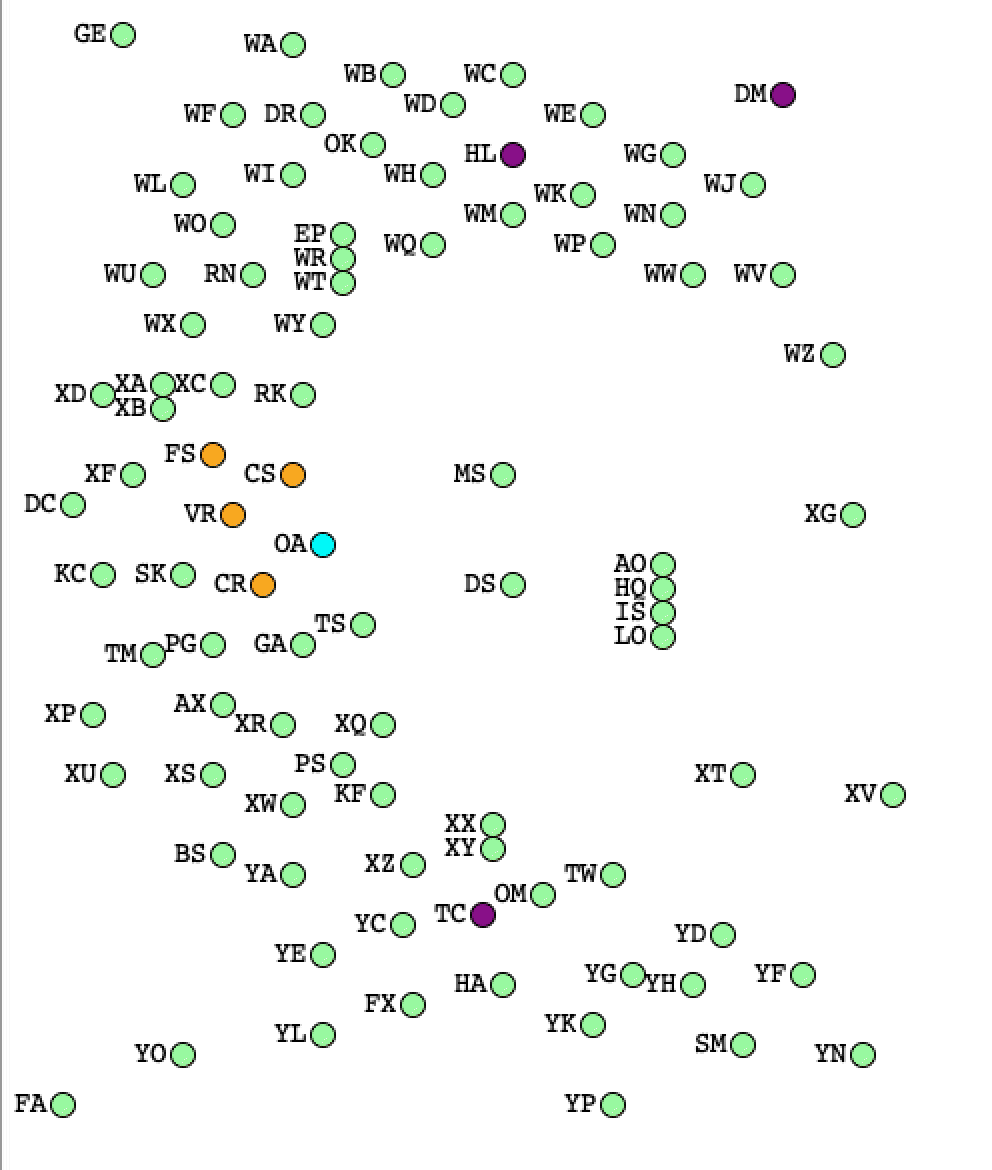
The following is based upon an essay by Shireen Hamsadeh, Department of Inter-Planetary Affairs, Pakesh University, dated 12th December 2479. For a listing of planets with descriptions and their attributes, see A Catalog of Planets. For an introduction to the Celesti after which the sector is named, see The Celesti. For an interactive map of the planets, download KAC.tcl and follow instructions at the top of the file to run the program.
Our sun is one among millions of stars that make up our galaxy. Some say the number of stars in our galaxy approaches millions of millions. Be that as it may, the Celesti Sector is our immediate neighborhood in this vast galaxy, and is itself vast, containing tens of thousands of stars. Light, traveling at its fantastic speed, would take one hundred years to go from one end of the Celesti Sector to the other. This essay describes the Celesti Sector as we believe the Gods, who make their home on Olympia, must see it. To them, Olympia is the capital of the sector in the same way that Pakesh is the capital of Ursia.
We have the name Celesti Sector from the gods. The second word in the name explains itself. The first word is the name of the enormous beings that create conjunctions on the worlds. These beings exist only in our neighborhood of the galaxy. There are many theories about their origins, but no proof to support any of them. We will not discuss the Celesti here, but instead will concentrate on describing the prominent planets of the sector, and the manner in which the gods govern them. Roughly one hundred habitable planets have been discovered in the Celesti Sector, by means of the conjunctions that allow us to travel between them. These worlds are divided, by the laws of the Gods, into three types. Olympia stands on its own as the home of the gods. The Free Worlds are four in number, and upon them, human beings are free to do as they please. The Open Worlds make up the rest. Each Open World is owned by a God, or a number of Gods, or an Olypian Corporation, and is subject to the laws of the Gods and the whims of its owners.
In the centuries following their arrival in the Celesti Sector, the gods discovered dozens of bioformed planets linked by hundreds of conjunctions. They discover more planets and conjunctions every century. At the last count, the Olympian council knows of one hundred and fifty bioformed planets and three thousand conjunctions.
Terran species survive well on the bioformed planets. Travel between the planets is made simple by conjunctions. Sapiens live on most planets, as do Terran flora and fauna. When Olympia was first settled, in the fifth century before the founding of Endromis, several hundred gods arrived from Terra, soon to be followed by more, and hosts of demons and demigods and dozens of rogue daemons. A century later, two thousand elves arrived, and a century after that, two thousand dwarves arrived, courtesy of the Illuminati. Three centuries later still, the gods brought two hundred thousand sapiens from Terra. In the twenty-fifth century after the founding of Endromis, three thousand years after the arrival of the first gods, the Olympian Council estimates the population of the Celesti Sector as follows.
| Species | Population |
|---|---|
| god | 1,000 |
| demigods | 10,000 |
| demons | 100,000 |
| daemons | 100 |
| sapiens | 500,000,000 |
| elves | 2,000,000 |
| dwarves | 4,000,000 |
Dwarves live mostly on the Free Worlds and Olympia. Half the elves live on Olympia, where thy make up the entire administration of the Olympian Council. Of the remaining million elves, almost all live on Clarus. Four hundred million sapiens live on the Free Worlds. The remaining hundred million live on the hundred or more Open Worlds, under the watchful eyes of the gods.
The Laws of the Gods are laws laid down by the Olympian Council. The gods elect twelve of their number to the Olympian Council every one hundred Olympian years. The council passed the Free World Declaration in 13 BE:
Examples of the gating duty are: adult sapien $5k, child sapien $2k, kobold $2k, metals 25% of value on Olympia, and perishable food 25%. If we transport gold off Clarus to Olympia by gate, we must pay a 25% tax, which can be paid by transferring one quarter of the gold to the Olympian Council. If gating were the only way to move gold from Clarus to Olympia, we would expect the value of gold to be 25% less on Olympia. But goods may also be transported from Free Worlds to Open Worlds by conjunction, and such transport is not taxed, for such taxation is deemed by Olympia to be impractical. In practice, the value of gold on the Free Worlds is roughly 10% greater than on Olympia. Currencies, however, such as the Ursian dollar or the Olympian dollar, or even a note that is backed by gold on Clarus, is not subject to tax, no matter how it is transferred, so that banks can operate between the planets and exchange money freely.
There are additional Clauses Seven through Ten, particular to Clarus, Comitor, Feras, and Vagor respectively. Clause Four has been relaxed for Clarus, but not for the other Free Worlds. Note that imports are restricted, but exports are not. The gods import goods from the populous Free Worlds. Most Open Worlds are subject to no trade restrictions, but creatures upon Open Worlds must abide by the Laws of the Gods.
On the open worlds, injuring a god or an emissary of the gods is punishable by death. The forces of Olympia will come after you and kill you. In the Free Worlds, the gods do not seek to protect themselves with their police and armies. The gods believe they must limit the population of the Open Worlds to one hundred million, or else their own safety will be threatened by the uncontrolled weight of the sapien population. They fear the Illuminati will invade the sector if the sapien population grows so strong as to pose a threat to the Illuminati planets.
Each Open World has a population limit and is owned by a god, or several gods, or an Olympian corporation. Every hundred Olympian years, the Olympian Council carries out a census of each planet. If the sapien population exceeds its limit, the owner must pay a proportional fine, and take steps to reduce the population. Each planet must have associated with it a force of well-trained and unquestionably loyal sapien soldiers numbering one percent of the planet's population. These soldiers must be under the control of the same corporation that owns the planet, or under direct control of the Olympian Council. They can be called upon by the Olympian Council for service at any time. They serve both to keep order on their planet, and to give security to the gods.
The combined armies of the planetary corporations and the Olympian Council make up a one-million strong fighting force. The gods trust this army to dominate rebellion in the Open Worlds, to keep the large population of the Free Worlds confined, and to deter the Illuminati from invasion. But the more active gods believe that their army would be powerless against the superior technology of the Illuminati.
The main expenses of the gods are their standing armis, their administrations, their opulent living, and their biological bodies. On average, these bodies cost ten million Olympian Dollars ($) each, and must be replaced every century. The standing army of one million men costs eighty billion dollars a year, when you include all its associated administration, supply, and pensions for retired soldiers. The Olympian bureaucracy alone costs twenty billion dollars a year. The spending of a thousand gods upon magnificent buildings, opulent parties, fabulous gardens and creatures, amounts to about ten billion dollars a year.
The Olympian tax per sapien in the Open Worlds is $1000 per year. With one hundred million sapiens in the Open Worlds, that makes one hundred billion dollars in taxes per year, which pays the eighty-billion dollar army budget, and the twenty-billion dollar administrative budget.
Most gods running their Open World planets are unable to extract $1000 per year per sapien from their population. A family of four must provide $4000 per year. Even if a god has the skill to obtain $1000 per sapien per year from his populations, there is the risk that the population will grow beyond its legal limit, bring fines upon him, and force him to kill off the excess. Or the population might shrink, leaving him with the same amount due each tax, but too few people to provide it. Between the years 500 AE and 1500 AE, many gods went bankrupt trying to keep control of their planets.
The Free Worlds supply extra income to the Gods, and at low risk. There are no taxes due on the Free World populations, so all a god has to do is persuade people on the Free Worlds to give things away, and what is given is all profit, and not taxable. In the years 1000 AE to 1500 AE, many gods saved themselves from bankruptcy as a result of their Open World operations using the profits from their Free World operations. The most profitable Free World was Clarus, where the rules governing temple plots and summoning, combined with the freedom of its various human races, conspire to provide more profit per person. The average income per sapien in the decade leading up to the turn of the fourteenth century was $2000 per year.
When Gelden brought the Dark Ages to Clarus, the population collapsed and the income from the planet vanished. Over the next two centuries, twenty of the one hundred Open Worlds were sold by gods who could no longer afford them. All of these twenty were purchased by large planetary-management corporations, owned by ten or twenty gods at a time, and run by elves.
By the fifteenth century AE, half the gods of the sector were showing signs of senility. These gods retained their rights as citizens to vote for the council and own planets. The lucky ones entrusted their affairs to their elf servants. The unlucky ones went bankrupt trying to manage things themselves.
By the twenty-fifth century, nine-tenths of the gods show signs of senility. Five hundred of them spend most of their time hibernating in healing-chambers that appear to slow the effects of their mental aging. The Opens Worlds are in the hands of the elves who run the Planetary Corporations, and the hundred or so active gods who run their planets themselves. The elves run their planets according to the tenets of the Olympian Peace and Prosperity camp. Some of the gods do the same, but others are making good money with Cultural Dynamism.
The Peace and Prosperity style of planetary management leads to a steady population, well-cared for and protected from invasion. In the twenty-fourth century this style of management provided between $1000 and $2000 income per sapien per year. After paying tax of $1000 per year, the planets were yielding a healthy profit for their owners.
Many of the Cultural Dynamists allow their populations to swell without check between the censuses. They extract only $500 per person, so in the first few decades they make a loss on the planet. But as the population grows, they begin to make a good profit. A decade before the census, with a populations three or four times the legal limit, the planet owners arrange for plague, war, and disaster to reduce the population to the limit again. It is an exciting game, and brutal, but the Cultural Dynamists are making more money than the Peace and Prosperity camp, and their money is giving them more power in the council.
The Free Worlds lie within a sphere fifteen light years across. Olympia lies just outside this sphere of the Free Worlds. Hundreds of conjunctions link the Free Worlds to one another and to Olympia. The average time required to travel by conjunction between two randomly selected points upon the populated continents of the Free Worlds is nine Claran months, with overland travel at 1000 km per month. The average travel time to Olympia is slightly shorter, but travel to Olympia is restricted.
You can travel between the Open Worlds either by space bridges tuned by the gods and their daemons, or by conjunction. The Open Worlds are less populated than the Free Worlds, and many of their conjunctions are in isolated locations with no local inhabitants to support the traveler. Moving from one conjunction to another, in an effort to travel between planets, can be difficult. Nevertbeless, the self-sufficient traveler, and in particular a traveler with a flying mount, can make good progress between the Open Worlds using conjunctions. A determined traveler might go from one end of the Celesti Sector to the other in ten years.
Few travelers between the Open Worlds will choose to use conjunctions. The gods have an extensive network of space bridges that connects Olympia with temples all over the Open Worlds. These bridges are called temple gates. It is simple to travel from one temple gate to another, no matter how far they are separated. You can do so, however, only with the approval of the gods. Unless one is serving the Gods, one has to pay the gating tax to travel through a gate, and this is roughly 50 gp for adults and 20 gp for children. The tax is levied by Olympia upon all travelers using the gates. Olympia can charge the tax because all the gates lead to Olympia, so that travel between planets is travel through a bridge to Olympia first, and then through a bridge to the planet, often with a few steps through a chamber on Olympia as one goes from one bridg to the other.
Although not governed by the Laws of the Gods, the Watchers of the Free Worlds are funded by Olympia, in chief by the distribution of longevity drugs to its members. The watchers of each Free World are a global organization of accomplished adventurers who are paid to enforce the tenets of the Free World Declaration. The Watchers guard conjunctions and act as customs men for trade between the Free Worlds. For example, they deny passage to any living creature that is not native of Terra, or an elf, or a dwarf. They do not permit the transportation of hippogriffs, wyverns, or destriers, for example, so that interplanetary travelers cannot take such mounts through conjunctions to continue their journeys on the other side. The Watchers hope to stop hellspawn from spreading across the Free Worlds. Hellspawn exist in significant numbers only on Clarus.
Citizens of the Free Worlds can pass freely between the Free Worlds and Open Worlds, but they must have a passport that proves their citizenship of the Free Worlds. Citizens of the free worlds can buy a passport from the Watchers at a conjunction, or from an agent of the Watchers in certain cities, for a fee of 50 gp (five hundred grams of gold, or fifty guineas, which is approximately five thousand Ursian dollars). Non-citizens can buy citizenship in the Free Worlds for 500 gp. A passport consists of a single piece of paper, folded four times when carried in a pocket, and made of a vellum paper with line-engraved printing of exceptional detail, metal threads woven into it in places, watermarks, and the seal of the group of Watchers who issued the passport. On the passport are the name, birth date, birth place, and a description of the passport-holder, as well as finger-prints, and the bearer's signature, but no photograph. The entire piece is water-proof by saturation in wax after it has been filled out and signed. The pieces of paper are manufactured on Olympia and are sold to the Watchers for 10 gp each. When the Watchers sell a Free World passport, 200 gp remains in the hands of the local Watcher organization, 100 gp goes to the Olympian headquarters of the Watchers, and 200 gp goes into a fund to compensate gods and pantheons for losses incurred by the movement of non-citizens into regions of the Free Worlds that these gods control or take interest in. On Clarus, this loss is easy to calculate: if one thousand non-citizens travel through a conjunction from an Open World and make their way to a temple plot, the god who owns that plot must purchase a population block to avoid over-count fines. Population blocks can sell for as much as $20M Olympian, which is 200 kgp on Clarus, so the owner of the plot will expect 200 gp in compensation per person thus arriving on her plot. On the remaining Free Worlds, the calculation is more complicated, and the gods make a point of appealing frequently to the Citizenship Fund in the hope of receiving compensation.
The watchers check passports at all conjunctions between free and Open Worlds, but not at those between Free Worlds or between Open Worlds. Citizens of the Free Worlds can bring their personal belongings with them when they re-enter the Free Worlds, but they must permit their belongings to be searched by the Watchers to make sure they are not bringing banned creatures with them, such as non-citizen hellspawn hiding in their carts or trunks.
Not all conjunctions on the Free Worlds are known to the Watchers, but when those that are known open up, Watchers show up with clip-boards and assistants, checking everyone and everything that passes through. Sometimes they might levy taxes in accordance with local laws, but no such taxes are required by any Olympian law. In Clarus, some conjunctions occur in the Outlands. These, too, are monitored by the Watchers, but doing so forced a practical agreement with black orcs, who now share the profit from such exercises.
The most dangerous and romantic responsibility of the Watchers is that of preventing time travel and time travelers from affecting the course of history within the Free Worlds. Any asymmetrically accelerated space bridge acts as a time machine. Space bridges carried by daemons on their travels between the stars can span millennia. Daemons, assisted by their servants and slaves, are the most prominent time travelers. They are the Watchers' most dangerous and terrifying adversaries.
Although an obscure field of study, paleontology gives us insight into the pre-history, the very ancient history, of our worlds, millions of years in our past, before the Gods arrived, and before even the Celesti. And so we devote a few paragraphs to paleontology here.
It is possible for a living creature to die and become part of the rock of a planet. Such creatures are said to be fossilized, and their remains are fossils. The fossilization process takes millions of years. Because the Gods arrived in the Celesti Sector only three thousand years ago, it is impossible for any life brought by the gods to be fossilized. And yet fossils have so far been found on fifteen of the bioformed worlds in the Celesti Sector. The silent forests that cover newly-discovered worlds contain no animal life, and yet the fossils discovered on Clarus appear to be of creatures larger than an elephant. The Gods have concluded that these fifteen worlds with fossils did, at one time, support their own life, which was native to the planet, having evolved from the birth of the planet by natural processes.
If such is the case, then we expect to see distinct creatures in the fossils of each of the fifteen worlds. Among those who study fossils, or paleontologists, it is axiomatic that no creature from one planet will ever occur among the fossils of another planet. There have been several episodes in which an exception to this rule appears to have been found, but in each case, the exception turned out to be a hoax played by one paleontologist upon the others. In short: it appears that independent and diverse life forms existed upon these fifteen planets.
Paleontologists can, to some extent, determine the age of a fossil by examination of the stone in which it is found, and the layers of stone with which the fossil was covered. The ways in which they determine the age of fossils are many and ingenious, but we will not present their methods here. Instead, we present their conclusion, which is that life on all fifteen inhabited worlds ceased suddenly and at the same time, twenty-five million years ago.
What caused the sudden end to life upon the inhabited planets of our sector twenty-five million years ago is a matter of speculation among paleontologists, and passing concern for the Gods. What if this cataclysmic sector-wide event occurred again? Some believe that the celesti destroyed all pre-historical life. But the cataclysm occurred twenty-five million years ago, and the Gods believe the celesti arrived in the Celesti Sector no more than half a million years ago. If the cataclysm were something engineered by a violent or agressive culture, the Gods believe it is unlikely that all fifteen inhabited worlds would be wiped clean of all life so suddenly. Therefore, the most popular theory of the cataclysm is that some galactic event occurred, such as the exploding of an old star, and the resulting burst of light and heat put an end to life on all planets in our sector, leaving only fossils as evidence of their existence.
Efforts have been made to recreate creatures from fossils, much as has been done for fossils recovered from Terra. Some of these efforts may have met with short-lived success, but it is possible that the strange creatures generated and photographed by paleontologists are further hoaxes.
Aside from the presence of fossils, the planets that held pre-historic life share other features. Chalk, limestone, and marble are far more common on these planets than upon others. Reserves of flammable oil and gas exist beneath the surface. The fossil planets have stable orbits and stable climates. Among the Free Words, Comitor and Clarus are both fossil planets. The others are not. Nor is Olympia a fossil planet.