The following is taken from Kambiz's Almanac of Conjunctions, 2475 AE Edition. For a listing of planets with descriptions and their attributes, see A Catalog of Planets. For an introduction to the Celesti after which the sector is named, see The Celesti. For interactive maps of planets and conjunctions, as well as an automated route-finter, download KAC.tcl and follow instructions at the top of the file to run the program.
Kambiz's Almanac of Conjunctions has been an indispensable reference for interplanetary travelers since the publication of its first edition in 2335 AE. It is a handbook for the interplanetary traveler who chooses to use conjunctions to move from one planet to another. A conjunction is a space bridge created by a pair of celesti. The conjunction connects two planets, or occasionally two locations on the same planet, in a safe and predictable manner. You can carry any material through a conjunction, either chemical or magical. You can carry a space bridge with you, and use it to talk to your family and agents at home. If you travel through the gates made by the Gods, you must leave certain magical items behind, and all your space bridges. Furthermore, the Gods are capricious, and can divert the unwary traveler to any destination they choose, or ban a traveler from going where they wish to go. A conjunction opens of its own accord, and only force of arms can stop the traveler from passing through it. But there are enough conjunctions for the traveler to choose from, and men at arms are sufficiently expensive to retain, that control of travel through conjunctions has proved to be prohibitively costly for the Gods, which means that sapien travelers can, with the help of the Almanac and sufficient funds, go where they will. The gates provided by daemons might also be attractive to travelers, but they introduce time shifts, so that you run the risk of arriving back home at a time earlier than you departed. Time shifts are dangerous and drive most sapiens insane. But conjunctions have negligible time shift. So far as we know it is impossible to arrive back where you started at a time earlier than you left, even if you traveled from one conjunction to the next at the speed of light. Conjunctions are not be the fastest way to travel the planets, but they are reliable, safe, and independent of any agency divine or mortal.
To make travel among the planets possible, the Almanac lists all known conjunctions on all known worlds. This edition lists 91 worlds and 1163 conjunctions. The Almanac lists all occurrences of these conjunctions for the ten years following its publication date. The Pocket Almanac lists all known conjunctions also, but in most cases gives only one occurrence, leaving it to the reader to calculate subsequent occurrences by adding the conjunction period repeatedly to the first occurrence. The Pocket Almanac is for the traveler, and we assume the traveler has time to perform such calculations. The full-length Almanac is for the router, who works out of an office and finds for customers in the shortest possible time the best possible for a proposed inter-planetary journey.
The purpose of this Almanac is to provide the traveler with the dates at which conjunctions occur, the time of year on each side of the conjunction so that the traveler will be able to anticipate the weather, the location of the conjunction, and sufficient geographical information to assess the difficulty of traveling between conjunctions. The Almanac includes a map of each planet, a description, dates at which conjunctions occur, and their latitude and longitude.
Each of the Almanac's planetary maps takes up two opposite pages. Some planets are visited by hundreds of known conjunctions. Each known conjunction is marked on the map and assigned a two-letter code indicating the planet to which the conjunction connects, and a number to distinguish this conjunction from others connecting to the same planet. On the Clarus map, we see TS1 marked on Eldrich to indicate the Clarus-Tanilus Number One conjunction. The maps give the traveler a rough idea of where the conjunctions will occur. On the pages following the map are notes that list any known obstacles to travel across the planet. These notes are updated with each edition of the Almanac. On Clarus, the notes point out that it is almost impossible to travel from the far-side continents to the near-side continents because of the kraken patrolling the seas.
For each planet, we define a system of longitude and latitude. Upon the map, and more precisely in the description of each planet, we define the location of zero longitude. From this location, positive longitude runs east. Latitude zero is the equator, with positive latitude running north. We give the tilt of the axis of the planet, the length of its day, the length of its year, and other information that will enable a skilled navigator, equipped with a sextant, compass, and an accurate chronometer, to find a conjunction. For each planet, we give the Ursian date of one of its recent spring equinoxes. This date, together with the length of the planet's year in Claran days, allows the traveler to determine the season that corresponds to any other date.
The most reliable chronometer available to a traveler is a space bridge to the office of a router on Clarus. The router keeps accurate time. The router has a copy of the Almanac. The router can take the traveler's measurement of the altitude of the sun at mid-day and calculate the traveler's longitude. But many travelers are unwilling to trust their journey entirely to a space bridge back home, or they may be unable to take with them any space bridge because part of their journey includes being gated by the Gods between two planets. In such cases, an accurate chronometer and the Pocket Almanac are essential equipment. The chronometer is essential for determining longitude, but there is no special need for the traveler to possess an accurate chronometer in order to determine the times at which conjunctions will occur. Most of the timing of travel between conjunctions can be managed by counting local days, having determined in advance how many local days are equal to the number of Claran days specified by the Almanac.
Each conjunction has its own entry in the Almanac. Many conjunctions have their own names. The Jamsheed Conjunction connects Clarus to Feras, and occurs south of Pakesh. In the abbreviated nomenclature of the Almanac, the Jamsheed conjunction is CSFS1, where CS is for Clarus, FS is for Feras, and 1 is to distinguish this conjunction from others between Clarus and Feras. The Jamsheed conjunction is listed under FSCS1. We arrange the two-letter codes of each planet in alphabetical order. When a conjunction connects two locations on one planet, which is rare, the two-letter code for the planet is repeated, as in CSCS1, which joins Ursia and Weiland on Clarus.
For each conjunction, we list a number of dates of its occurrences, the period of its occurrence, and the longevity of its occurrence. The period and longevity are in Claran days. The dates are in the Almanac Calendar, which we also call the Clarus Calendar. The Almanac Calendar is designed for the convenience of routing calculations. It measures time in standard days, with day zero being the first day of the year in which the Almanac was published. Day zero for this edition is 1st January 2475. In addition to the standard days, an Almanac Date and Time gives the day number and the time of day in hours, minutes, and seconds. In order to allow the traveler to determine if it will be night or day on another planet, we specify the Almanac Date and Time of midnight of a particular day. We choose the day containing a recent northern-hemisphere winter solstice, so that the same Almanac Date and Time will allow the traveler to determine what season it will be on the same planet.
Hundreds of millions of years ago, and millions of light years away, there prospered a civilization of magic-using biological creatures we call the Distantae. We have no direct contact with the Distantae. We deduce their existence from our study of the machines they created. The Distantae evolved on a weakly magical world. They suffered no competition from creatures made of magical materials. Nevertheless, they evolved the ability to use magic and make space bridges. Their mastery of the technology of space bridges and magical materials far surpassed that of our own wizards, of the machines possessed by the Gods, and of the Illuminati who made the Gods.
The Distantae unified their galaxy with magical machines we call celesti. A former-celesti is a mountain-sized machine that modifies magical planets so that they are habitable for the Distantae. A joiner-celesti is tens of meters across and connects two habitable worlds with a space bridge called a conjunction. When we speak of celesti, we are usually referring to the joiner-celesti that create conjunctions. Former-celesti never appear on habitable worlds. By a fortunate coincidence, or perhaps because of some common requirement for the evolution of intelligent biological life, a world made habitable for the Distantae is a world made habitable for sapiens.
Nemesis, the daemon who discovered the celesti, reports that former-celesti travel in packs of fifty or more. They explore a new solar systems, select a planet, descend to its surface, and transform its atmosphere and terrain over the course of a thousand years. When the transformation is complete, the planet's land masses are covered with forest and grass, but no animal life. The forests support algae that generate carbon dioxide from plant debris, and the forests generate oxygen. The oxygen content of the atmosphere is close to one fifth. Carbon dioxide is usually below three parts in a hundred. Nitrogen makes up over seven tenths. The bioformed world has between one tenth and nine tenths of its surface covered by oceans. The average atmospheric pressure at sea-level is of order 100 kPa, regardless of the planet's gravity. The worlds upon which this transformation is brought about are all magical. No bioformed world has been encountered with a wind strength less than 0.1 Y.
Former-celesti contain chemical, spirit, and conjured matter. They make extensive use of space bridges to syphon harmful gases from a planet, to generate colossal forces, and to transport heat. We assume that these machines are making their worlds habitable for Distantae colonists, which is how we deduce that the Distantae are biological. Because there is no animal life on the bioformed worlds, some scholars propose that the Distantae are vegetarians. But the Distantae could just as easily bring with them animals to graze on the existing vegetation, which is what we do when we colonize a newly-discovered world in the Celesti Sector. Terran herbivores survive well upon the original flora. But these alien species grow slowly, are vulnerable to Terran blights and insects, and do not recover well from grazing. When we colonize a newly-discovered planet, we introduce Terran flora and fauna at the same time. Within a few centuries, the original flora has almost disappeared.
A group of celesti left the home galaxy of the Distantae hundreds of millions of years ago. They crossed the inter-galactic void and reached our own galaxy a few hundred thousand years ago. Since then, they have been making their way inwards. The habitable worlds of the Celesti Sector mark the path of one descendant group of celesti. As the former-celesti move on, they leave behind joiner-celesti, which connect the habitable worlds with conjunctions, and in turn reproduce themselves to create further conjunctions. Somewhere, there may be a conjunction that leads all the way back to the galaxy of the Distantae. We have found no evidence of inhabitation by the Distantae on any world in the Celesti Sector. It could be that the Distantae were extinct long before their celesti arrived in our galaxy, and all that remains of their race are the marvelous machines they created. These machines make their way through the universe, reproducing themselves, and bioforming planets.
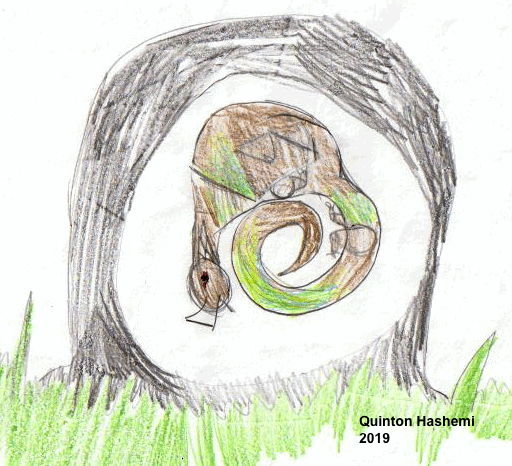
The celesti meet their mates and commence their long-lasting union out in deep space. They generate space bridges and share the two halves of the bridges between them. The female takes some of these bridges, and the male takes their the south halves of these bridges, and the male the north halves. Once mated, a couple separates and each goes in search of a magical, bioformed planet. Their search can take thousands of years. Once they have selected their planets, they remain in orbit most of the time, but descend at regular intervals to land upon the planet surface and create a conjunction. The female celesti is always producing an offspring. A female with a new embryo is forty meters across and ten meters high when fully-expanded upon a planet surface. A male measures thirty meters across and ten meters high. A female about to give birth is sixty meters wide and twenty meters high. Gestation takes a thousand years. The child is born in orbit around the mother's planet. It remains in orbit for several centuries, then leaves in search of a mate. The former-celesti reproduce also, but they do so while they are bioforming new planets, and their gestation is tens of thousands of years.
Both the joiner-celesti and former-celesti are intelligent and thoughtful. Several daemons have learned to communicate with celesti out in deep space, using a language of movement and light. It is from these communications that we have confirmation of the existence of the Distantae. A mated pair of celesti generate their conjunction for thousands of years, until one or other of them becomes incapable of doing so. A celesti might be struck by a meteorite in orbit. Or it might be assailed by sapiens while on a planet surface and damaged beyond repair.
A conjunction is a class-four space bridge joining the bodies of two celesti, and therefore permitting travel between their two planets. Any type of matter may be carried through a conjunction, including all type of magical matter and even space bridges. A conjunction has a spirit matter sheath. Scholars believe that the celesti were designed to obscure the manner in which they make this spirit sheath. Several layers of conjured matter enclose the sheath, and tampering with these layers causes the conjunction to close rapidly. Repeated abuse of the conjunction will result in the celesti lifting off the planet prematurely.
Mated pairs effect their unions at regular intervals. Each descends upon a bioformed world, always within a kilometer of the same location, and more often within a few meters of the same location. They descend several Claran days before their conjunction is due to open. They arrive in the middle of the night. If there is no night, they will, if possible, arrive in a thunderstorm or blizzard. They will emerge from low-hanging clouds and settle upon the earth. Sometimes, such descents occur ten or twenty days before the conjunction is due to open, which suggests that the celesti watches for a suitable storm to make use of, and is willing to arrive early to take advantage of such a storm. If no such storm occurs, the celesti descends in daylight, and it is on these rare occasions, near planetary poles in summer, that we are able to observe the celesti descending from space. They come straight down, passing through the entire atmosphere in one or two hours. Their bottom side is hard to see when looking straight up from the conjunction location, because it takes on the same color as the sky beyond. But if we are to one side, and the sun is low on the horizon, we will see the shadow cast by the celesti, or the red light of the sun upon its sides.
Once on the surface, a celesti attaches itself to the terrain and swells with conjured matter to fifty meters across and twenty meters high. The celesti and its mate open a space bridge three or four meters in diameter. The bridge is accessible from both sides through tunnels entering the celesti bodies. This procedure is repeated at regular intervals, but the interval is different for each pair. We call the interval the period of the conjunction. The period is measured from the start of one occurrence to the start of the next. The shortest known period is thirty-one Claran days, and the longest are several thousand, but the average period is around four hundred.
A conjunction opens at regular intervals, but the regularity is not perfect. Two consecutive intervals will differ by up to one part in one hundred. If the start of the first and second occurrences of a conjunction are 100 days apart, the third will start between 99-101 days after the second and the tenth will start between 992-1008 days after the second. For most conjunctions, we know the dates of many previous occurrences, and we use the average interval as measurement of the period. With this longer-term measurement, our calculation of the date of the tenth occurrence will be be more accurate. The movements of moons about a planet affect the occurrence times of its conjunctions, and other seasonal variations have a slight effect as well. The Almanac staff consider all such effects to obtain the best possible estimate of occurrences for the ten years following the publication date of each edition. Beyond that, the traveler must add the Almanac's best estimate of the period to obtain future occurrences. We recommend travelers carry the latest edition of the Almanac to make sure they are equipped with the most reliable dates.
The time for which the conjunction remains open is its longevity. The longevity is a fixed fraction of the period for each conjunction. The longevity is one thirtieth of the period for most conjunctions, but there are a few for which the fraction is is one tenth and some for which it is one hundredth. Suppose the start of the first and second occurrences of a conjunction are separated by an interval T. If we go to the site of the conjunction T days after the mid-point of the second occurrence, we can be certain that the conjunction will be open. This is the Rule of Succession.
Any difference in pressure between the atmospheres of the two planets in the neighborhood of a conjunction will cause a wind to blow through the conjunction. The former-celesti ensure that the average atmospheric pressure at sea level on bioformed worlds is close to 100 kPa. But pressure drops with altitude and fluctuates with weather. In gravity 10 m/s2, atmospheric pressure drops to around 30 kPa at altitude 10,000 m. Weather can easily generate a drop in pressure of 10 kPa from one day to the next. For a difference of 10 kPa, air would move through the conjunction at over 100 m/s, which would make passage through the conjunction impractical on foot. The Distantae were well aware of this potential problem, and so the celesti are designed not to allow air to pass directly through the conjunction. Each entrance to a celesti is secured by an orifice that opens and closes in cooperation with an orifice in its mate. We enter the celesti when the orifice is open. At this time, the orifice on the other side of the conjunction, in the partner celesti, will be closed. The orifice behind us will close. When it is closed, the orifice in the partner celesti will start to open. Air will most likely rush in or out of the chamber within the two celesti. The noise made by the air varies from one celesti to another. It can be like a hiss, or a gasp, or a prolonged blast on the lowest note of an organ. Some are almost silent. Standing in the chamber, our ears feel the change in pressure as we move from the atmosphere and weather of one planet to that of another. When the second orifice is full open, and we walk out. The same process occurs through the other passage at the same time, except in the opposite direction. When an orifice opens in one celesti, another opens in its mate. When an orifice closes, another closes in its mate.
Sometimes, the pressure difference between the two sides of the conjunction will be negligible. On such occasions, the conjunction orifices remain open, and we can pass freely, without delay, between the two locations. The orifices will stay open when the pressure difference is less than 100 Pa. The wind blowing through the conjunction will be no more than 10 m/s.
The lack of any orifice on the ends of the conjunction passages permits dragons to fly straight through without stopping. When approaching any conjunction, keep watch on the sky for dragons. If you see one, withdraw to a distance of at least one hundred meters and wait until the dragon passes through. If the conjunction is blocked by an orifice, the dragon will swoop down several times to drive away anyone nearby, breathing fire if necessary, before landing and entering one of the chambers. Do not attempt to enter the conjunction with the dragon. The interior of the chamber is fire-proof, and the dragon will not hesitate to heat the chamber with its flames, killing everyone inside. When the conjunction is not blocked by orifices, the dragon may choose to dive down and fly straight through at 100 m/s, throwing everything and everyone out of their way. In such cases, you may have little or no warning of the dragon's approach. When passing through an unrestricted conjunction, approach quickly, pass through without delay, and move away from the conjunction on the other side as fast as you can.
The time between openings of a Celesti's orifice is its cycle time. This cycling can stop altogether if the pressure difference between the two sides of the conjunction is negligible, but small pressure differences are a rare event. Most often, each orifices will be cycling with a steady period of one Claran hour throughout the occurance of the conjunction. Each orifices will open for half an hour, then close for half an hour. When one of a Celesti's orifices closes, the other will open within a few minutes. There are short periods when both orifices are closed, but never a time when both orifices are open. Every half an hour, we have the opportunity to enter one of the orifices, have it close behind us. We will be in a closed passage. Within a few minutes, the orifice on the far end of the passage, in the partner celesti, will open.
When a celesti departs, it does so at night, several Claran days after the conjunction closes. If no night is available, it will wait for up to ten Claran days for a storm or a blizzard. If none such event occurs, it will ascend in daylight. Its body swells upwards. It begins to lift away from the earth. As it rises, it grows and accelerates. High above the earth, visible by telescope on a clear day, the celesti body breaks into countless fragments, all rising into space. One of the fragments is the heart of the celesti itself. All the rest of the material is a temporary shell that the celesti creates for itself to carry it up and away.
Celesti prefer planets with stronger maeon winds, and they prefer to connect planets that are closer to one another than farther apart. Across the ninety-one planets listed in this edition of the Almanac, the minimum maeon wind strength is 0.1 Y, which is shared by half a dozen planets, and the maximum is 2.0 Y, which is attained only by Olympia. The average maeon wind is 0.57 Y. This Almanac lists 1163 conjunctions. Almost all conjunctions connect two different planets, so the average number of conjunctions per planet is 25. The following table gives the number of listed conjunctions for a selection of planets.
| Planet | Wind (Y) | Conjunctions |
|---|---|---|
| Clarus (CS) | 1.0 | 60 |
| Olympia (OA) | 2.0 | 76 |
| Feras (FS) | 1.5 | 60 |
| Comitor (CR) | 0.8 | 37 |
| Vagor (VR) | 0.5 | 37 |
| Fantasia (FA) | 0.1 | 2 |
| Draxius (DS) | 1.6 | 46 |
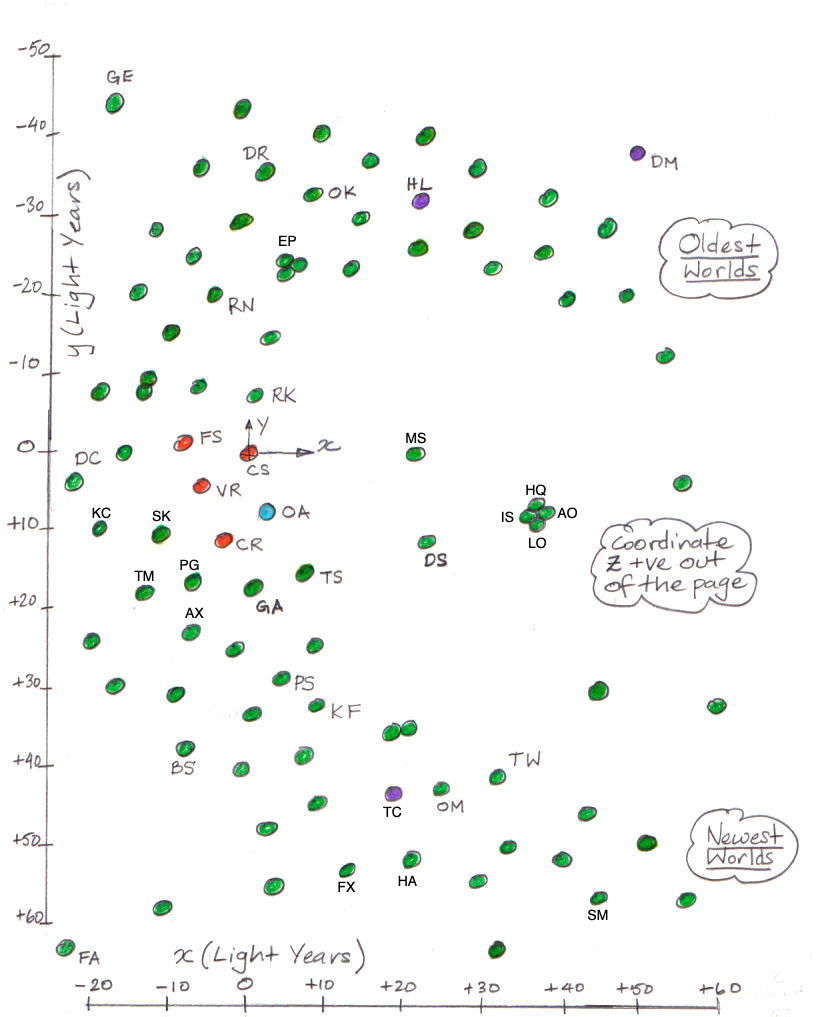
The Celesti Sector, which is the area of space connected by the known conjunctions, is contained by a sphere of radius one hundred light years centered upon Olympia. The bioformed planets are, however, concentrated in a horse-shoe forty light years thick and three hundred light years long. Olympia lies mid-way along the horse-shoe, on the inner edge. The Free Worlds are close to Olympia, in a region we call the center of the horseshoe. Most conjunctions connect planets that are ten or twenty light years apart. But some connect the most distant planets. According to Nemesis, the former-celesti are at one tip of the horseshoe, working on new planets. We call this the front end of the horseshoe. The oldest planets are those at the other tip of the horseshoe, which we call the back end. Some planets are no longer connected to the others by conjunctions, but only by gates made by the Gods. Domus is one such planet. It lies on the back end of the horseshoe, and is among the oldest planets in the sector.
By careful study of celesti, by which we can determine their ancestry among the celesti known to the Almanac, and by study of the record of conjunctions that have been known and since vanished, we estimate that joiner celesti take roughly one thousand years to bioform a new planet. Once bioformed, the planet is a potential site for joiner-celesti to institute a new conjunction. Joiner-celesti give birth to one child every thousand years of so. The joiner-celesti do not live forever. Collisions with asteroids and other hazards appear to destroy one of the one thousand known conjunctions every few years. The oldest planets in the sector were bioformed tens of thousands of years ago, while the youngest were bioformed only a few thousand years ago.
Conjunctions occur only upon land that is never flooded or swamped. The amount of land on the surface of a habitable world of the Celesti Sector varies from millions to hundreds of millions of square kilometers, but the the number of conjunctions that frequent a world is not dependent upon its land area. The number depends upon the strength of its maeon wind and the proximity of other magical planets. Because joiner-celesti tend to arrive and depart with darkness or foul weather, one must discover conjunctions on the ground. They are large objects, and they remain in place for days or weeks. When they depart, they leave behind signs of their visit. Trees will be uprooted. Rocks will be moved. Each conjunction has two halves, either of which can be discovered. Only if both halves occur in a sparsely populated area is is possible for a conjunction to remain undiscovered for centuries. Most conjunctions can be detected at a distance of a kilometer with the help of a compass, and if we are flying above the ground, conjunctions are easy to see. If conjunctions were scattered at random across the surfaces of planets, many of them might go unnoticed. But four out of five known celesti are coincident with at least one other on the same planet: they appear within a few hundred kilometers of another celesti that visits the same planet. The first place one looks for more conjunctions is in the vicinity of existing conjunctions. Even if one side of a conjunction is not coincident, the other side will most likely be coincident. Only one in sixteen conjunctions is not coincident on both sides, and it is only these that are likely to remain undiscovered.
One in five conjunctions is synchronous with another conjunction. On one side, the conjunction occurs with the same period and at the same time as another conjunction on the same planet. Most often, conjunctions are synchronous when they are also coincident, so that no more than a few hundred kilometers separates one from the other, and we have a good chance of being able to get form one to the other by foot or boat. The CSTS1 conjunction, for example, is synchronous with OATS1. On Tanilus, the two conjunctions are only a few kilometers apart, so that we can pass from Clarus to Olympia via Tanilus with a modest hike. The coincidence and synchronicity of conjunctions greatly increases their utility. On Clarus, the Vale of Wortham and the Field of Conjunctions near Susa are examples of places where coincident and synchronous conjunctions bring travelers together and make trade possible between planets at an intermidiate location.
For each planet, the Almanac gives its location in units of light years with respect to Olympia in the coordinates shown in the Almanac's planetary map. We obtained these coordinates in some cases by triangulation of star bearings upon planets visited by our agents, and in some cases from measurements made by daemons, but in most cases by measurements made by the agents of the gods, which are available in libraries on Olympia. Using these locations, and examining the number of conjunctions that occur on each planet, we find that half of the conjunctions on one world will lead to another world less than twenty light years away, three quarters to a world less than forty light years away, and so on.
The Almanac is intended to be a reliable guide for the interstellar traveler. It lists only those worlds and conjunctions that have been observed directly by the Almanac's agents. Every measurement of time, duration, location, maeon wind strength, repulsion constant, gravity, day length, year length, axis rotation, lunar periods, and all other particular measurements presented in the Almanac have been measured directly by these agents at least once. The Almanac pays close attention to reports from its readers as to the inaccuracy of its content, and will dispatch agents to repeat its measurements or confirm the disappearance of a conjunction when such reports are convincing. Thus, while there is rumor of almost one hundred and twenty planets connected by conjunctions in the Celesti sector, this edition of the Almanac lists only ninety-one, including three that were once connected to the others by conjunctions, but are no longer.
Finding the optimum route for a traveler to take between two worlds requires that we examine hundreds of possible conjunctions and the possible ways of getting between them to get to the traveler's destination, and most often, back home again. This extended calculation requires a thorough knowledge of The Almanac and a firm grasp of mathematics. It may take a traveler carrying The Almanac several days of study to determine the best route home, but a good router will find the same route in minutes or hours. A good router will often find you a way to travel across your own world by traveling a shorter distance across another world. You go to a nearby conjunction to a second world, pass through it, go a short distance to another conjunction, and pass through the second conjunction to return to your own world, near your destination. Three or four steps might be used to shorten your journey. Usually, the shortest journey between two nearby worlds uses a single conjunction, but between distant worlds, the fastest rout may use ten conjunctions.
An outward or return journey that uses only one conjunction is called a one-link. When it uses two conjunctions, it is a two-link, and so on. Because four out of five conjunctions are coincident with one or more others, it is usually possible reduce the overland distance of the route by adding more waiting time for coincident conjunctions to occur. Because one in five conjunctions occur synchronously with another conjunction, there are times when two points on two distant planets are joined conveniently by two or more conjunctions and only a few hundred kilometers of overland travel. A good router is aware of the most useful such synchronous links, and can use them as a basis for longer journeys.
Here is an example of a router's calculation. We ask the router to tell us the best route from Clarus 22° Latitude 17° Longitude to Feras 17° Latitude 150° Longitude, starting on 30-SEP-2486 and ending no later than 01-APR-2487, with maximum surface speed of 1000 km/Cday and maximum total surface travel of 10,000 km. The high surface speed implies we are traveling by wyvern, which may restrict the planets we visit, but ignoring that possible concern, the router responds with the following.
Route from CS 22.0 17.0 to FS 17.0 150.0
    0 km    0 Cdy  START CS   22.0   17.0
 2888 km   11 Cdy  CSOA7 OA  -67.2 -107.4
 2911 km   19 Cdy  OAWF1 WF   10.7   -0.2
 2911 km   60 Cdy  WFXB1 XB   40.4  100.4
 3044 km  105 Cdy  FSXB2 FS   21.4  139.7
 4497 km  106 Cdy    END FS   17.0  150.0

Route from CS 22.0 17.0 to FS 17.0 150.0
    0 km    0 Cdy  START CS   22.0   17.0
 1157 km    1 Cdy  CSRK1 RK  -48.0  -31.0
 1222 km   53 Cdy  RKWR3 WR   28.2 -143.5
 1233 km   81 Cdy  RKWR1 RK  -67.2 -178.9
 1264 km   82 Cdy  RKXB1 XB   40.9  100.1
 1337 km  105 Cdy  FSXB2 FS   21.4  139.7
 2790 km  106 Cdy    END FS   17.0  150.0
Here we see two routes, both taking the same amount of time. The first one requires 4497 km of overland travel and uses four conjunctions to arrive in 106 Cdy (one hundred and six Claran days, or three Claran months). The second takes the same time, but requires only 2790 km surface travel and uses five conjunctions. The second route is complex, and would be discovered only by a diligent router: the traveler goes 1157 kmm to the CSRK1 conjunction, passes through to Rebok, travels 65 km to the RKWR3 conjunction and passes through to WR, where it is an 11-km journey and a 28-Cdy wait for RKWR1, which takes the traveler back to Rebok, to arrive near the RKXB1 conjunction, which takes the traveler to XB, arriving at a point near the FSXB2 conjunction, and so through to Feras 1453 km from the end point.
According to the Relativistic Transformation, when two halves of a space bridge travel long distances through space, the space bridge will acquire a time shift. The space bridges carried by daemons certainly acquire such time shifts, so we might suppose that conjunctions would likewise acquire time shifts as the two mated celesti search for their planets. But the time shifts of conjunctions are no more than a hundredth of a second. We suppose that the joiner-celesti are designed to coordinate their movements so as to keep their time shift small. Once they choose their planets, they remain in orbit around the planet. Thus the time shift of their conjunction changes by only a few milliseconds from one year to the next, and this too could be reduced if it accumulated to a fraction of a second after a millenium.
Because the time shifts of all conjunctions is so small, it is impossible to go on a journey through conjunctions and return where you started at a time earlier than you departed, even if you travel faster than the speed of sound, as can dragons. If the Gods of Olympia had their way, all bridges between planets would be bridges that had been transported from one planet to another through a conjunction, for only then can we be sure that the bridge does not possess a time shift. But daemons and even dragons have transported many space bridges through interstellar space, and these have time shifts of days to years.
All space bridges are magnetic monopoles, either north or south. Conjunctions, being enormous space bridges, can produce a powerful magnetic field. They do produce a field, but not nearly as strong as that which would be produced by single bridge of the same size. From this we conclude that conjunctions are a variety of doublet. They have two bridges pressed against one another, one a south pole and the other a north pole. If this were not the case, it would be impractical to carry anything made of iron through the conjunction because the force attracting it to the center would be thousands of times greater than its weight. Instead, the magnetic field in the immediate vicinity of a conjunction is barely noticeable except with a compass needle. When we stand at one end of the conjunction passage, facing the space bridge inside, the north tip of the compass needle points towards the space bridge. As we move around to one side, the needle rotates until it points back the way we came, and parallel to the passage inside the conjunction. When we stand facing into the other end of the passage, the compass needle points away. Thus conjunctions have two sides, north and south.
Some conjunctions have a stronger magnetic field than others, and some planets have stronger magnetic fields than others. Sometimes, the magnetic field generated by a conjunction can dominate the magnetic field of a planet at a distance of ten kilometers, making the conjunction easy to find on foot with a compass. Most often, however, the field generated by a conjunction will merely disturb the direction of a compass at ranges of up to one kilometer, and only if we approach the conjunction in a direction perpendicular to its central passage. The north and south entrances tend to face the same directions on each planet surface every time the conjunction occurs, but occasionally they will rotate, making the compass needle less reliable as an indication of its proximity.
All the habitable worlds we know of in the Celesti Sector were once covered with the silent, alien forests planted by former-celesti. Almost all of the original flora are edible and nourishing to Terran species. But there are some that contain chemicals that induce remarkable or fatal effects in Terran animals. Some species cannot be understood unless we accept that the Distantae were possessed of a sense of humor. In contemporary times, original floral species are among the most prized ingredients for medicines and potions. Beautiful and plentiful though they are when a new world is first discovered, the original flora have no resistance to Terran insects and blights. On Clarus, the original flora survive only in sterile greenhouses and in certain locations where, through some local confluence of effects, they are able to thrive.
| Original Species | Description | Habitat |
|---|---|---|
| Fanflower Plant | Huge fan-like red, fleshy leaves that look like flowers | Brackish swamps with lots of sun |
| Ornam Grass | A dry, robust grass with black, powdery seeds | Salty, dry soil with frequent fires, not well understood |
| Ingot Gel Plant | A translucent tuber with petal leaves | Symbiotic with certain fungi and ant colonies, not well understood. |
| Mandalus Fern | A plan with a fernlike stem and leaf arrangement but its leaves are rounded and gelatinos | Survives in hot, sulfurous soil. |
| Kaleidoscope Tree | Graceful smooth-barked tree with variety of distinctly-shaped fruits that have diverse effects upon biological creatures. | Slow-growing, but will survive in a large flower-pot if treated frequently with insecticide and fungicides. |
Many of the original species are so rare and valuable that it is worth traveling a great distance to collect them. Some planets have more original flora than others, and to these planets adventurers will travel, Almanac in hand.
Limestone is made of the skeletons of microscopic sea creatures that died millions of years ago, or longer. The oceans of bioformed worlds do contain such creatures, and these skeletons do accumulate on the ocean floor. But there is no limestone on Olympia, and there are many ways in which we can estimate the time for which the original flora existed on a world before the Gods arrived. The age of rivers, diverted by the former-celesti, can be dated from the surface texture of the pebbles in their beds. The age of a swamp can be deduced from the depth of the peat beneath its surface. The Gods eventually determined that no world in the Celesti Sector could have been bioformed more than a million years ago, and most likely only a few hundred thousand years. And yet limestone was present on roughly one in five of the planets they discovered. Not only limestone was present, but marble, which is metamorphic limestone, and fossils of strange extinct creatures. These are the fossil planets. The study of fossil planets is the work of paleontologists. These scientists travel the conjunctions, Almanac in hand, to search for and to compare the fossils of different fossil planets. Their knowledge advances every decade. So far, they have concluded that the extinct life on each planet is distinct from that of all other fossil planets, but that all forms of life on these planets became extinct roughly twenty-five million years ago, when some galactic event wiped them out. The Almanac indicates the fossil planets in the planetary descriptions, and attempts to aid the paleontologist with indications of where the best fossil sites are located with respect to the conjunctions.